- KOMENTARZ
- WIADOMOŚCI
- WAŻNE
Denmark’s apple of the eye. Why Greenland is strategic for Denmark

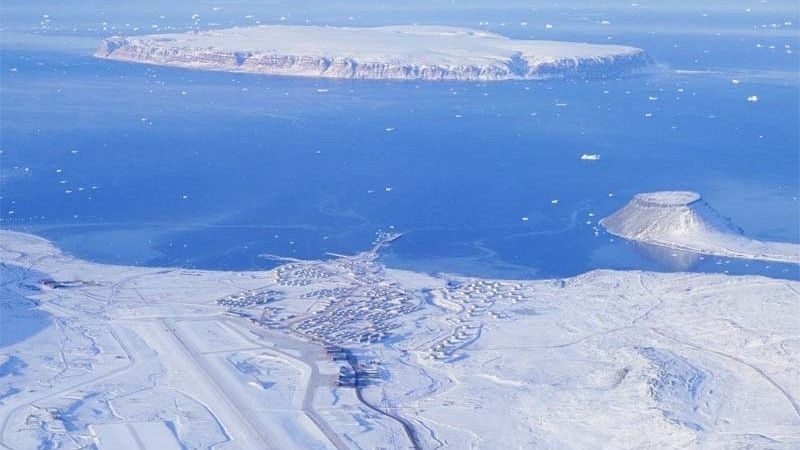
Photo. Wikipedia
Greenland is Denmark’s strategic Arctic outpost, crucial for NATO, controlling sea routes, and competing powers access to resources.
Greenland, the world’s largest island, has been under Denmark’s formal control for over three centuries, although since 1979 it has had broad autonomy, and since 2009 an extended self-rule status. While formally part of the Kingdom of Denmark, in practice it is one of the most important elements of Denmark’s national security strategy and geopolitical position in the Arctic. In 2026, amid intensifying great power competition over the Arctic, Greenland’s significance for Copenhagen is greater than at any time since the Cold War.
For Denmark, Greenland functions as a strategic NATO outpost in the far north. The island lies at the junction of the Atlantic and Arctic Oceans, controlling important maritime and air routes between Europe and North America. Greenland sits along the shortest route for Russian submarines and ballistic missiles leaving bases on the Kola Peninsula toward the eastern coast of the United States.
Since 2022, Danish security strategy emphasizes that the Arctic is no longer a low-tension zone. After Russia’s invasion of Ukraine, the opening of new shipping routes, and increased military activity by Russia and China in the region, Copenhagen considers Greenland one of the three pillars of its own security, alongside the Faroe Islands and continental Denmark.
In practice, this means maintaining the Thule Air Base, which formally belongs to the U.S. but is located on Greenlandic territory, expanding its own territorial defense forces, such as the Slaedepatruljen Sirius, and gradually increasing naval and air presence east of the island. Additionally, Denmark engages in close intelligence cooperation with the U.S., Canada, Norway, and the U.K. as part of the extended „Five Eyes” network.
History of American interest
The United States has long considered Greenland a key element of its own security. The first serious American interest in the island arose during World War II, when in 1941 U.S. forces occupied Greenland to protect Atlantic convoy routes. After the war, in 1946, President Harry Truman officially offered to purchase the island from Denmark for $100 million, but the proposal was rejected. In 1951, an agreement on military bases on the island was signed, which remains in effect today and was most recently extended in 2025 for another ten years. In 2019, Greenland returned to the spotlight in connection with President Donald Trump’s proposal to „buy” the island. The idea was rejected by both Denmark and Greenland’s autonomous government, but it demonstrated that Washington still considers the island a strategic priority. In 2025, the U.S. administration revisited the issue, emphasizing the expansion of military presence on Greenland and influence over the island’s resource policy, including rare earth metals and uranium.
China and Russia: A new face of the arctic game
Russia has been steadily increasing its military presence in the Arctic for several years. Cold War-era military bases are being rebuilt, submarines equipped with ballistic missiles are stationed there, and the military conducts intensive exercises and maneuvers. For Moscow, Greenland has strategic significance as a potential control point over the GIUK Gap (Greenland–Iceland–UK), a crucial area for monitoring submarine traffic between the Arctic and the Atlantic.
China views the Arctic primarily in economic and infrastructural terms, calling the region a „new Silk Road” (Polar Silk Road). Since 2018, Beijing has declared itself a „near-Arctic state” and has engaged in various resource and infrastructure projects in Greenland. In 2018–2019, the Chinese company Shenghe Resources attempted to acquire the Kvanefjeld uranium mine, but the operation was blocked by the Danish government. In the following years, from 2023 to 2025, China showed interest in the world’s largest untapped rare earth deposit at Kringlerne. Additionally, Chinese research vessels regularly visit Greenlandic ports, and China has engaged in airport and port projects, most of which were halted or blocked.
In recent years, the Danish government has restricted or blocked all major Chinese investments in Greenland, citing national security concerns and NATO commitments. These decisions aim to protect the strategic interests of the region and control foreign influence on the island.
Greenland Today: Autonomy vs. Dependence
Modern Greenland enjoys broad autonomy within the Kingdom of Denmark. It independently manages education, healthcare, infrastructure, fisheries, resource extraction, and police operations. However, certain competencies remain solely with Denmark, including foreign policy, defense, and monetary policy.
Greenland’s Prime Minister, Múte B. Egede, notes that the topic of independence is present in political discussions, but the island is not financially prepared to fully separate from Denmark. Transfers from Copenhagen account for roughly 60% of Greenland’s budget, limiting its ability to independently fund state expenditures.
In this situation, Greenland becomes an area of interest for several countries. Denmark maintains formal control over the island and influence within NATO structures. The United States seeks maximum military presence on the island and to use it to counter China’s actions. Beijing, meanwhile, sees Greenland as a source of critical minerals and a potential logistical base in the Arctic.
Why Greenland is so important for Denmark
For modern Denmark, Greenland is not just an overseas territory but also a vital element of the country’s 21st-century strategy. Losing real control over the island would reduce Denmark’s status as a full Arctic state, weaken its role in NATO, and diminish cooperation with the United States in the region. In 2026, amid increasing militarization of the Arctic by Russia, rising Chinese interest, and changes in U.S. policy, Copenhagen treats Greenland as a key strategic element and simultaneously as its main political challenge to resolve.