












- ANALIZA
- WIADOMOŚCI
- WAŻNE
ESA launches into European defence

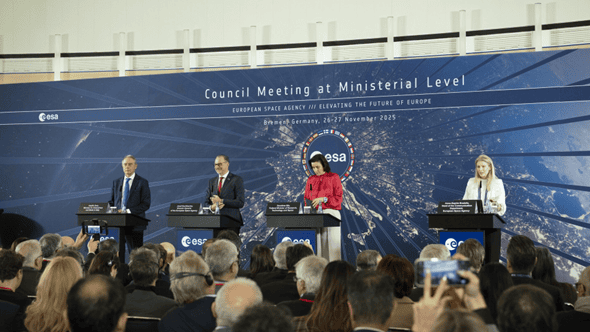
In a historic shift, the European Space Agency will begin using its space assets for non-aggressive defence purposes. With its newly approved record budget and the launch of the European Resilience from Space programme, the Agency is poised to become one of the key pillars of Europe’s security from space.
ESA was never meant to contribute to European defence. Its founding document, the ESA Convention, commits the Agency to serve „exclusively peaceful purposes.” Therefore, the decision to explicitly pursue defence-related applications marks a genuine paradigm shift as acknowledged by the Agency itself.
This shift did not emerge out of nowhere. Geopolitical instability, the war in Ukraine, and the rising strategic importance of space have created momentum for change that has been skilfully leveraged by Director General Josef Aschbacher. Since his appointment in 2021, he has consistently advocated for expanding ESA’s role in defence, effectively breaking the long-standing taboo.
Pouring billions into space defence
This course was confirmed by the Member States during the recent 2025 Ministerial Council in Bremen. The Agency received a „clear mandate” to boost Europe’s space resilience and security, while securing a historic budget of €22.1 billion for the next three years, a 30% increase over the current budget.
Dual-use capabilities will account for a significant share of the Agency’s spending. Earth Observation, Connectivity and Secure Communications, Navigation, and Space Safety together will receive roughly one-third of the total budget (€7.5 billion). The largest allocation, however, will go to space transportation, which is vital for ensuring Europe’s space autonomy and resilience, amounting to 20% (€4.4 billion).
What best epitomizes ESA’s entry into the defence domain, however, is the European Resilience from Space initiative, officially launched at MC25 and proposed earlier this October by Aschbacher. Worth €1 billion, the programme aims to develop new space defence capabilities to be jointly used by the participating Member States.
As proposed by the Director General, the ERS will be built around three equally important components — Earth Observation, Navigation, and Secure Connectivity — together ensuring joint real-time situational awareness from space. €750 million of the budget will be allocated to the Earth Observation component. It will be developed by pooling existing national, commercial, and European assets into one shared constellation — a true system of systems — delivering faster, higher-quality, and more comprehensive data. The second component, Navigation, will operate in a similar way and receive the remaining €250 million.
The final component, Secure Connectivity, will focus on supporting the EU’s flagship project, IRIS², offering a sovereign European alternative to the Starlink constellation. In this context, ESA will provide technical expertise as well as logistical and technological support. This ESA–EU collaboration, also reflected in the Navigation component, is a positive sign that the institutions will avoid duplicating resources and capabilities, opting instead to develop them jointly.
The Agency will also invest in its ground-based R&D infrastructure for dual-use capabilities. To this end, it plans to establish a new Space Security Centre in Poland. The decision to choose Warsaw is hardly surprising, given Poland’s key role in advocating for ESA’s stronger involvement in defence, as well as its increased financial contribution to the Agency’s budget, rising threefold from €194 million to €731 million.
”Merciless” facts
ESA’s step into space defence clearly reflects the spirit of the times, as the domain becomes ever more contested and strategically vital — a reality increasingly acknowledged by Europe’s capitals. Nevertheless, in his opening speech at CM25, Aschbacher pointed to several „merciless” facts that should prompt deeper reflection among European leaders.
The record €22 billion budget, though significantly increased, represents only 0.03% of the Member States« combined annual GDP, or barely €15 per citizen per year. The US accounts for less than 20% of global GDP but invests around 60% of the world’s space budget. By contrast, ESA’s economies represent 24% of global GDP, yet contribute only about 10% of global space spending. Globally, defence spending accounts for about 50% of all space budgets, while in Europe it remains below 15%.
Europe could and should invest more in space and its security from above. It is undoubtedly an impressive success for ESA that it managed to sense the changing tide, repurpose itself accordingly, and elevate its financial and strategic standing despite contractionary fiscal sentiment in many capitals and a drastic shift in priorities. Still, European leaders do not seem to fully realise that they will face a far higher bill if they wish merely to keep pace — let alone compete — in the new space race.


