












- ANALIZA
- WIADOMOŚCI
Following their defeat: The Wagner Group withdraws from Mali

However, it remains present in a new guise—as the African Corps. The Russian Federation has decided to end its „special operation” in Mali and redeploy its troops back home, likely sending them to Ukraine. The entire mission in Mali was a failure, as the Wagner Group repeatedly lost to terrorist factions and Tuareg forces. Now, most operations are delegated to African mercenaries, although Russia retains both political and military presence.
In early June 2025, just days after announcing the withdrawal of the Wagner Group from Mali and its replacement by a new structure dubbed the Africa Corps (which is already active in Libya and Burkina Faso), Russian forces were attacked in northern Mali. Dozens of Russian soldiers died in the ambush. This brutal baptism of fire serves as a harsh introduction for the new formation, intended to carry on Russian influence in the region following Prigozhin’s death. The attack clearly demonstrates that the loudly proclaimed victory of the Wagner Group and exit from Mali was hollow, and that Russia’s military presence in Africa continues to face active resistance from terrorist organisations and local armed groups.
On 1 July 2025, JNIM, the Al‑Qaeda affiliate in the Sahel, launched an unprecedented coordinated offensive in western Mali, striking at dawn across seven towns, including Kayes, Niono, and Nioro du Sahel. Though Malian forces managed to repel the attacks, the scale and scope of the operation are alarming—they indicate potential expansion toward Bamako and the borders with Senegal and Mauritania. These are JNIM’s first such operations in this part of the country and may signal an attempt to seize new territories and expand the region’s destabilisation.
A bit of background
Bamako turned to private Russian firms—primarily Wagner—to bolster national security in response to repeated terrorist attacks and to reduce the involvement of the French Republic. It is worth noting the role Wagner’s involvement played in the Central African Republic: their presence in Bangui significantly strengthened Moscow’s position and influence in sub‑Saharan Africa. Wagner envoys lobbied the transitional Malian authorities as early as 2020, shortly after Bamako and Moscow signed a defence agreement in 2019. Mali was in fact the first country to openly embrace Russian mercenaries and fully abandon cooperation with France. This occurred following the May 2021 military coup, when Assimi Goïta assumed full power (having served as vice president since the 2020 coup).
The new ruler decided to cut ties with the French Republic. To consolidate his power, he needed external backing to pursue an authoritarian agenda and indirectly secure support from the Russian Federation. France withdrew from Mali in 2022, but from 2020 onwards Paris’s influence gradually weakened.
In early 2022, Bamako formally terminated its defence agreements with Paris. To expedite France’s withdrawal, the Russians claimed to have recordings showing the French burying bodies to falsely accuse Paris of mass graves—a narrative endorsed by the Malian junta. Thus, Mali willingly relinquished a valuable counter‑terrorism partner in France.
With the withdrawal of the last French troops from Senegal, the redeployment of French forces to Gulf of Guinea countries such as Benin and Ghana aims to reinforce France’s new light military footprint strategy. Paris is strongly advocating for a new global approach in combating terrorist organisations, drawing on momentum from military coups in the Sahel (Mali, Burkina Faso, Niger). This holistic strategy confirms France’s intent to more actively pursue regional military cooperation—mentoring, training, and equipping—in its diplomatic and military engagement with West African states like Benin, Togo, and Ghana, emphasises Emmanuel Dupuy, President of the Institute for Prospective and Security Studies in Europe (IPSE).
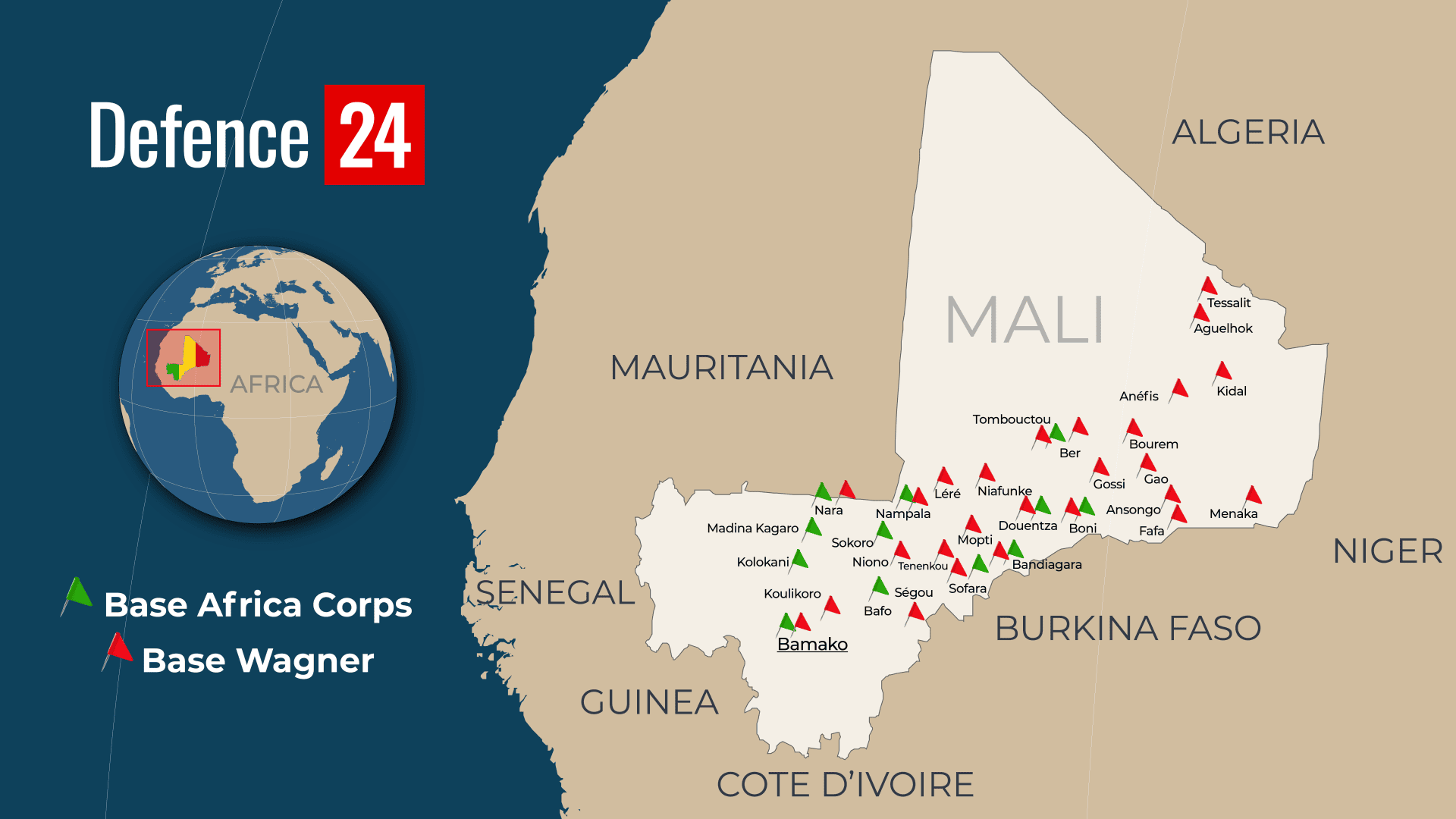
Wagner operatives first arrived in Mali in December 2021, less than six months after Goïta’s coup. Initially, they began constructing a camp adjacent to Bamako’s Modibo Keïta international airport (previously used by MINUSMA), not far from Airbase 101—a military facility used by Mali’s air force. Land was prepared for their base in the months prior to their arrival.
From January 2022, Wagner expanded its operations across central Mali, with personnel deployed to Timbuktu, occupying former bases of the French Operation Barkhane, which had been handed over to the Malian army in December 2021. The arrival of Russian mercenaries accelerated the departure of French and European forces.
Wagner launched its first combat operations between 2021 and 2022. In exchange for US $10.8 million per month and mining concessions, they provided security and training to the junta, as well as military engagement against jihadists. As French troops withdrew, about 800 to 1,000 Wagner mercenaries entered the country. One of Wagner’s major adversaries became Katiba Macina (KM), part of the JNIM terrorist coalition, which was the primary target of joint operations by Wagner and Malian forces in central Mali. The first engagements—resulting in Wagner casualties—took place in January 2022.

Current Capabilities
As of 2025, around 2,000 Russian mercenaries—comprising the Africa Corps and remnants of the Wagner Group—are operating in Mali. Accurate numbers are elusive, as Russians often bypass Bamako, using airports in Gao and Timbuktu; Wagner operatives are also being deployed east to Menaka. Their main role is supporting the Malian army in attempts to control northern territories long dominated by Tuareg separatists. They are involved in armed clashes aimed at seizing strategic towns (e.g. Kidal) and military bases once used by UN forces, more than fighting terrorist organisations. These engagements contribute to blockades and impede Malian authorities« ability to control the territory.
Financing Bases
Wagner—and now the Africa Corps—leverages its presence in Mali to control transport, agriculture, and mining sectors. Russian operators collect fees and duties to fund their operations. As in other countries, the regime and national army either tolerate or deliberately overlook crimes committed by Wagner personnel against civilians—such as the massacre in Moura in March 2022, where Russian forces and Malian troops allegedly killed at least 500 civilians under the pretext of counter‑terrorism operations. They effectively function as a self‑financing army supporting anti‑terror efforts.
Russia Is Not Gaining Strength
It must be emphasised that over three years after the arrival of Russian mercenaries, security in Mali has deteriorated. Despite ongoing conflict between Al‑Qaeda and ISIS factions in the Sahel, both terrorist groups are consolidating their influence, recruiting smaller groups, and expanding into new territories. There have been instances of Malian army colonels joining jihadists. The conflict now spreads across the Sahel, posing threats to nations in the Gulf of Guinea. Meanwhile, JNIM—active in Ghana, Benin, Togo, and Côte d’Ivoire—retains a robust presence in the region.
The deployment of the Wagner Group and the departure of French forces has severely depleted the Malian government’s counter‑terrorism capacity. Russian mercenaries lack the experience of the French in Mali and possess far fewer resources for locating, targeting, and eliminating terrorist threats. Moreover, Wagner never operated in Mali independently—it remained entirely logistically dependent on the Malian army, a dependency that ended disastrously in Mozambique. French regional experience and superior military equipment eclipsed the capabilities of Russia’s mercenaries. Additionally, France worked alongside a coalition under Operations Barkhane and Takuba. Wagner’s and the Africa Corps« capacities remain inadequate by comparison—France’s specialised air operations neutralised terrorist infrastructure and aerial assets, which the Russians are not equipped to replicate. Indeed, terrorist attacks surged following France’s withdrawal.
It would not be an exaggeration to say that Mali remains the cradle of the Africa Corps« presence in sub‑Saharan Africa. Moscow continues to use mercenaries to expand its influence, steadily deepening cooperation with Bamako, and effectively blocking the return of Western powers.
Most critically, the Africa Corps lacks the capability to fully support Malian armed forces in confronting terrorist groups and Tuareg/Arab factions. At best, Malian authorities could maintain control over parts of the territory, but substantial success would require significant arms deliveries from Russia—or possibly Iran or North Korea—plus the deployment of several hundred troops. Yet the Russian Federation, heavily engaged in Ukraine (with Wagner forces already deployed and plans for another 18,000 fighters in Eastern Europe) and other commitments in Africa and the Middle East, cannot afford such support. Moscow appears set to remain part of a protracted regional conflict, while financially exploiting Mali to fund its broader military presence across Africa.
The Sahel remains strategically vital as a transit zone between the Maghreb and sub‑Saharan Africa. Western armed forces will surely attempt to reclaim influence in the Sahel, but the cost will be immense.
Moscow exposed, yet persists
Russia handled Mali in its characteristic fashion—securing financial gains, preserving political ties, testing its equipment, recruiting mercenaries. When difficulties arise—as seen in Mozambique, Sudan, and the CAR—its presence rapidly diminishes. Now, the Africa Corps carries the operational burden in Mali, staffed largely by Africans but under Russia’s firm control. Failures will attach to their proxy rather than to the Kremlin.
While the West might welcome the Wagner withdrawal, in reality nothing has changed. Terrorist groups are gaining ground, further destabilising the Sahel and triggering increased migration to Europe, while undermining investment and cooperation in the region.
Russia continues to back the Africa Corps, but recognises more urgent needs in Ukraine and Belarus. Thus soldiers redeployed from Mali—whose experience in Africa and with Wagner will inform future missions—will be sent there. In this way, Russia maintains a weakened but persistent presence in hotspots across the globe.
Russia is diminishing its military potential, yet persists in recruiting African mercenaries. Mali remains hostile to Western powers—but perhaps future Russian or pro‑Russian setbacks will alter that stance.


