












- KOMENTARZ
- WIADOMOŚCI
- WAŻNE
French nuclear umbrella for Europe

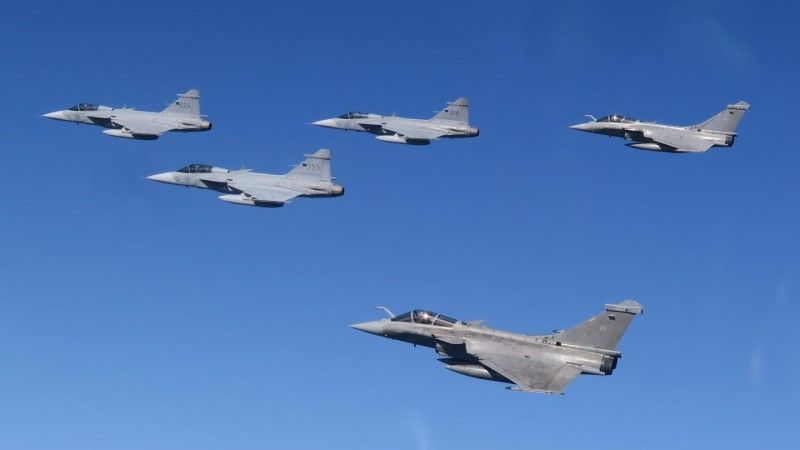
Photo. Försvarsmakten
France offers deterrence to European allies. After months of debate and speculation regarding the potential role of the French nuclear deterrent in Europe’s security, Emmanuel Macron has presented a new concept of so-called „advanced nuclear deterrence” for France and, more broadly, the continent.
Limited participation
In his speech in Brest, President Macron effectively announced an evolution of the French nuclear doctrine towards what he described as „advanced nuclear deterrence”. And it is indeed advanced, because it will include a European dimension. At the same time, tempering any enthusiasm, this will occur ”without any sharing of the final decision to use nuclear weapons”, which will fully remain in the hands of the President of the Republic.
Macron recognised that, in the face of simultaneous national and European threats, France must view its deterrence strategy on the scale of the entire continent. Of course, the president – ending his ten-year presidency in a year and a half – wants to become (finally) a leader of European security.
Importantly, this will be a gradual process, beginning with offering allies the opportunity to participate in „shared deterrence exercises”. It may also include the deployment of elements of the French strategic air forces on allied territory in order to „complicate the calculations of our adversaries” – however mysterious that may sound. Macron did not specify whether this would also involve the deployment of nuclear weapons, probably deliberately increasing ambiguity and uncertainty.
The most important point of the speech is that eight European countries agreed to participate in the „advanced deterrence”, namely: Germany, the United Kingdom, Poland, the Netherlands, Belgium, Greece, Sweden and Denmark. Notably, this winter British representatives took part in exercises of the French air forces for the first time in history.
Paris’s new approach is meant to indicate that France’s security will no longer be viewed solely within the borders of French territory, both at the conventional and nuclear levels. Macron believes the new solution will strengthen France’s defence by giving it greater reach, while simultaneously linking allied territories to French deterrence. He also emphasised the complementarity of the project with NATO; meaning it is to serve as a supplement, not a replacement, for the Alliance’s nuclear deterrence offered by the United States.
Prime Minister Tusk confirmed that Poland is holding talks with France and a group of its closest European allies on an advanced nuclear deterrence programme: we are arming ourselves with our friends so that our enemies will not dare to attack us.
And Russia?
France has a very long history of nuclear deterrence. The issue has now returned to the agenda and allied countries may – only now – be covered by the nuclear umbrella. Paris can indeed demonstrate its potential using Rafale fighter jets and enter a level of competition feared by the Russian Federation.
In response to the evolution of Russia’s nuclear doctrine, especially the lowering of the nuclear-use threshold announced by President Vladimir Putin in November 2024, the French Minister of Foreign Affairs, Jean-Noël Barrot, described the decision as mere rhetoric and assured that the Fifth Republic would not be intimidated by such actions.
The message was reinforced at the beginning of March this year by President Emmanuel Macron, who openly spoke of a threat to France and the French, as well as the possibility of extending French nuclear deterrence to the rest of Europe. He expressed hope of achieving cooperation by the end of the first half of 2025, following technical talks with other leaders, including Poland. This – of course – did not happen, but the door has now been reopened.
France increases and modernises its nuclear arsenal
France also intends to focus on modernising and appropriately increasing its nuclear arsenal because – as Macron stated – the coming half-century will be an „age of nuclear weapons”. He announced an increase in the number of nuclear warheads (currently around 290, reduced from over 300 in recent years).
An element of the expansion of capabilities will also be a new strategic ballistic-missile submarine —L’Invincible — which is to enter service in 2036 and ensure a second-strike capability, currently provided by fourTriomphant -class units based at Île Longue near Brest.
Paris will also cease publicly reporting their number, as it has done until now. Nor will it disclose the definition of its „vital interests”, whose violation could lead to a nuclear response – in order to further complicate an adversary’s calculations.
Ultimately, there is no major revolution on the French side, but it is clear that Poland is part of allied discussions concerning nuclear deterrence. For years, pragmatic Paris has invited cooperation. Even if these are only preliminary talks, joint exercises and plans involving nuclear issues may be undertaken in a few years, in cooperation with the United Kingdom or the United States. And later perhaps also within its own capabilities…
Authors: Kacper Kremies, dr Aleksander Olech


