












- ANALIZA
- WIADOMOŚCI
Geopolitical ramifications of Russia’s 2022 aggression against Ukraine: CEE Perspective

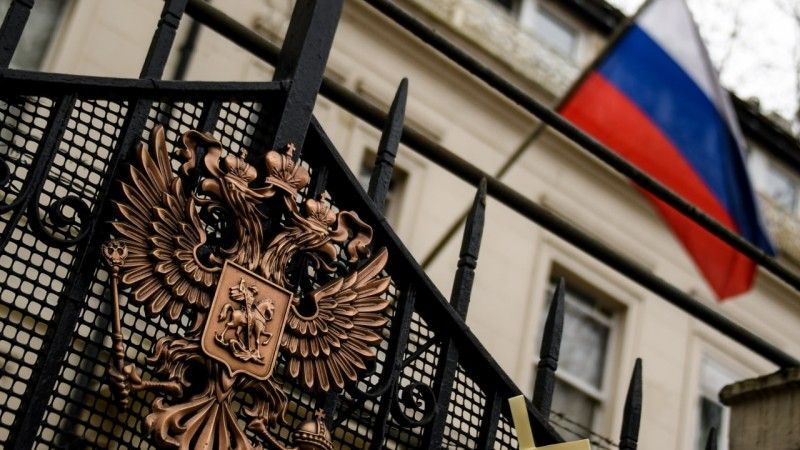
Photo. Russian Embassy, UK (@RussianEmbassy)/X
The geopolitical context in which Russia launched its full-scale aggression against Ukraine in 2022 has significantly altered the political and strategic dynamics of Central and Eastern Europe.
While the war itself was not a direct result of changes in the security policies of regional states, its outbreak and subsequent developments highlighted the inability of existing international cooperation frameworks to effectively respond to escalating threats.

Collaboration among CEE
The need for closer collaboration among Central and Eastern European countries has become increasingly evident, prompting states in the region to seek new and more effective mechanisms for security cooperation. The 2022 invasion of Ukraine by the Russian Federation fits into the broader context of West-Russia rivalry. Some experts foresee a renewed division into geopolitical and economic blocs, with Russia and China on one side and the European Union and the United States leading the other.
Western Europe, despite its considerable capabilities, will likely struggle to maintain influence over Central and Eastern Europe. This is largely due to crises that have been, and continue to be, poorly managed. Consequently, the deepening asymmetry between Western and Central Europe may, hopefully, be halted and, in the longer term, even reversed.
These trends are unfavourable for Western Europe. Without a formula that balances the EU while also extending Europe’s boundaries eastward, the integration process risks collapse, as Central and Eastern Europe may become too strong for the existing asymmetrical relationships within the European Union to be sustained.
Three potential outcomes are commonly projected for the Russia-Ukraine conventional war: a Ukrainian victory, a protracted conflict, or a Russian victory. In the scenario of a Ukrainian victory, Russia would fail to achieve territorial gains, and a series of effective Ukrainian counter-offensives would push Russian forces back to their pre-24 February 2022 positions. This outcome would be facilitated by continued Western military support, particularly from the United States, which would increase progressively over time.
This scenario envisages the collapse of the Russian campaign and Ukraine moving onto the offensive, potentially leading to Russia losing control of the entire Donbas region while retaining only Crimea, which Ukraine is preparing to recover through a planned campaign.
Shield for the West
From a geopolitical standpoint, a prolonged conflict in Central and Eastern Europe under sustained Russian pressure positions regional states as a „shield” for the West. Such an arrangement would require these countries not only to maintain but also to demonstrate credible deterrent capabilities against a range of aggressive actions.
Primarily, this would involve deterrence against territorial aggression that stops short of open, conventional warfare, as well as against limited territorial incursions executed under the shadow of nuclear threats, especially tactical nuclear weapons. Such threats, while exploiting the doctrine of nuclear de-escalation, would demand heightened vigilance from European states and preparation for extreme scenarios.
A different scenario would unfold if Russia were to achieve victory and the West, seeking to avoid further escalation, were willing to make concessions, potentially sacrificing some of its interests in Central and Eastern Europe. Such decisions would stem from a search for a new détente with Russia, necessary to pursue other vital Western interests in regions such as the Middle East or Asia. In this case, a form of soft agreement reminiscent of Yalta-era arrangements could emerge, effectively redrawing spheres of influence in Europe.
The result could involve partial demilitarisation of NATO’s eastern flank, weakening defence capabilities in that part of the continent. The United States and Western European states might also enter into tacit arrangements, designating some NATO members as „second-tier” and certain EU countries as peripheral, with a slower pace of integration. Such agreements could entail partial recognition of Russian interests in Central and Eastern Europe, considered significant and, to some extent, respected by the West.

Three zones in Europe?
Over the next decade, Europe may effectively divide into three zones. The first would be the European portion of a weakening Russia, which sooner or later will have to abandon imperial ambitions due to severe domestic challenges in maintaining statehood and its current territories. The second zone is Central and Eastern Europe, pursuing a distinct geopolitical and cultural identity alongside increasingly intensive intra-regional economic exchange. The third zone is Western Europe, which may continue to face crises and fragmentation.
The 2022 Russo-Ukrainian conflict has reshaped the region’s geopolitical landscape. States bordering Russia directly: Poland, the Baltic republics, Ukraine, and Belarus; perceive the Kremlin threat as immediate and real. Western European states, while aware of the growing threat from Russian aggression, approach the situation through a different lens, emphasising diplomatic and economic solutions and broader European interests. This divergence has led to tensions and challenges in coordinating a common policy.
What with Belarus?
Belarus, a key Russian ally, occupies an important place in proposed shifts to regional geopolitical mechanisms. Events in 2020, when Belarusian authorities received Russian support to suppress mass protests, are particularly significant. In return for this assistance, President Alaxandr Lukashenko committed to deepening military and economic integration with Russia. This close cooperation limits the prospects for substantial political change in Belarus.
In February 2022, Russian President Vladimir Putin told German Chancellor Olaf Scholz that states such as Belarus and Ukraine „should not exist” on the world map. Despite this, Lukashenko continues close collaboration with Moscow, raising questions about Belarusian sovereignty. Many analysts contend that only radical changes, including the removal of the current regime, could secure full independence for Belarus, which currently functions effectively as a Russian satellite, or even a colony.
To prevent the war from escalating into Poland or the Baltic states, Western democracies must reassess their approach to Belarus. The prevailing political assumption that Minsk cannot be extricated from Moscow’s influence should be replaced by a strategy aimed at integrating Belarus with Western structures, such as the European Union, and incorporating it into the European security system.
At present, the West maintains a cautious „waiting” stance towards Belarus, which does not favour long-term regional stability. A new strategic approach is needed, one that supports civil society in Belarus while implementing more effective sanctions mechanisms. Only this approach can lay the foundation for a democratic and sovereign Belarus, thereby enhancing security across Europe.
See also 

Less confrontational Russia?
Domestic developments in Russia could also influence Central and Eastern European geopolitics. While the nature of potential reforms is difficult to predict, external pressures and internal challenges could weaken Vladimir Putin’s authoritarian regime. Prolonged economic stagnation, growing public dissatisfaction, and corruption could necessitate leadership changes. Political liberalisation in Russia, though currently unlikely, could open opportunities for cooperation with Central and Eastern European states.
A transition to a more pragmatic, less confrontational Russian leadership could lead to foreign policy prioritising regional stability and constructive relations with neighbouring states. A more open and cooperative Russia could benefit Central and Eastern Europe by improving security and expanding opportunities for economic and political collaboration.
Russia’s aggression in Ukraine has reshaped the geopolitical outlook for the region, exposing both the weaknesses of existing security structures and significant divergences in defence and security approaches among Central and Eastern European states. Existing cooperation mechanisms, including regional initiatives and political-military formats, have proved insufficient to address the challenges posed by an escalating conflict. Some organisations and agreements have been unable to provide a unified, effective response to Russian aggression.
Consequently, the war in Ukraine has accelerated the reorganisation of regional cooperation and prompted intensified efforts to enhance defence capabilities at both national and regional levels.


