












- KOMENTARZ
- WIADOMOŚCI
- WAŻNE
Global conflict hotspots in 2026

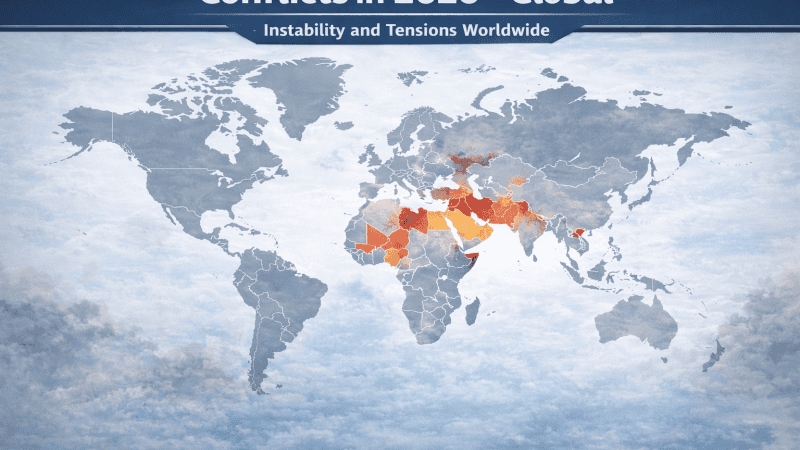
Beyond the wars in Ukraine and Gaza/Israel, a number of other regions are emerging as potential flashpoints that may shape the global security environment in 2026 and directly affect European and transatlantic stability.
Strategic debate increasingly focuses on where the next major crises and conflicts may emerge. Looking ahead to 2026, it is clear that instability will not be limited to the most visible theatres of war. Instead, a combination of great-power competition, proxy conflicts and structural fragility is likely to intensify tensions across several regions of strategic importance.
1. Russia in Africa (the Sahel and the Gulf of Guinea)
The Russian Federation continues to expand its influence in Africa, particularly in the Sahel, by exploiting political instability, internal conflicts and the gradual withdrawal of Western actors. At the same time, Moscow is increasing its presence in states along the Gulf of Guinea, which in the longer term may provide access to key maritime routes and new opportunities for power projection beyond Europe.
2. Terrorism and migration pressure from the Sahel towards Europe
The sustained activity of jihadist organisations in the Sahel and West Africa is deepening both the security crisis and the humanitarian catastrophe in the region. In 2026, this dynamic is likely to generate intensified migration flows towards North Africa and Europe, increasing pressure on the southern flank of NATO and the EU. At present, none of the external actors involved has a credible or effective strategy for stabilising the region.
3. Abkhazia and the Black Sea (Ochamchire)
Russia’s military presence in Georgia, including the expansion of military infrastructure and the port facilities in Ochamchire in occupied Abkhazia, is strengthening Moscow’s capabilities in the Black Sea. These activities increase pressure on Ukraine and NATO states in the region and form part of Russia’s long-term competition for control over the maritime domain.
4. Sudan as a theatre of proxy competition
Sudan remains one of the most critical flashpoints, where internal conflict, humanitarian collapse and competition over resources—particularly gold—intersect with the interests of external powers. The result is a growing number of casualties and millions of displaced people, further destabilising the wider region.
5. Greenland and the Arctic as an emerging area of rivalry
Greenland is increasingly visible as a potential arena of strategic competition in the Arctic. Public declarations supporting its sovereignty and territorial integrity signal that the region may become a source of tension, including within the transatlantic space. Greenland’s importance stems from its geographic location, resource potential and its role in controlling Arctic routes.
6. Other areas of instability in 2026
Looking ahead, continued instability is also likely in Syria, still marked by internal fragmentation and external interference; in the Democratic Republic of Congo, where conflict and competition over resources undermine regional security; and in Venezuela, which remains exposed to strong geopolitical pressure and the risk of escalation.
The year 2026 is unlikely to bring de-escalation. Instead, it will probably see the further dispersion of instability across multiple regions simultaneously. For Europe and NATO, this underscores the need for a genuinely global approach to security—one that recognises how crises in Africa, the Arctic and the Black Sea can interact and reinforce one another, shaping an increasingly complex and demanding strategic environment.


