












- KOMENTARZ
- WAŻNE
- WIADOMOŚCI
London Summit on Ukraine awaits Trump’s move

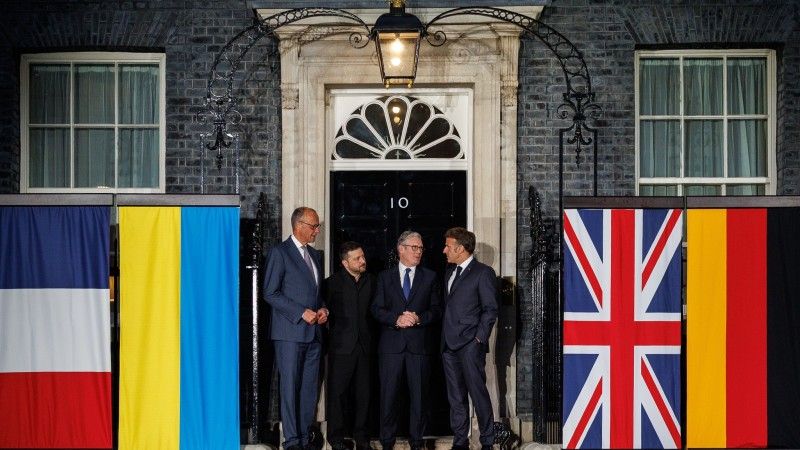
Photo. Macron / X
The London meeting between Keir Starmer, Emmanuel Macron, Friedrich Merz and Volodymyr Zelenskyy confirms that the European track on Ukraine is still active, but it also shows its main limitation. Europe wants to shape the post-war order, discuss security guarantees and prepare a multinational force for Ukraine. Yet the key political cards remain in Washington, because it is President Trump who is leading the main peace track between Kyiv and Moscow.
The statement after the London meeting is important because it sets five political conditions for any settlement with Russia: a full ceasefire, negotiations based on the current line of contact, respect for Ukraine’s sovereign right to choose its alliances, legally binding security guarantees, the continued immobilisation of Russian assets until compensation is paid, and protection of European security interests in any deal. This is a strong political framework, but it does not answer the most difficult military question: what exactly will Europe be ready to do on Ukrainian territory after a ceasefire.
The military dimension remains unclear. Originally, the Coalition of the Willing was expected to be led mainly by the United Kingdom and France, while Germany was not expected to send troops to Ukraine. The statement now refers to the deployment of a Multinational Force – Ukraine, but still does not define its character. Will it be a training mission, a stabilisation force, a reassurance presence, a border-support mechanism, or something closer to a security guarantee? This is the central issue, and it remains open.
The political reality is that Trump still holds the decisive cards. The European leaders can coordinate, prepare, pressure Russia economically and support Ukraine militarily, but the direct negotiation track between Russia and Ukraine is being shaped above all by the United States. This does not mean that Europe is irrelevant. It means that Europe is trying to ensure that no deal is made over its head, especially on issues related to NATO, the EU, sanctions, Russian assets and future security guarantees for Kyiv.
The composition of the meeting is also significant. France, Germany, the United Kingdom and Ukraine are clearly trying to build a core political format for the next phase of the war and the post-war settlement. Poland was not present. Italy was not present. The Nordic states were not present. This matters, because if the future of Ukraine’s security, reconstruction and military support is discussed mainly by this quartet, then British, French and German companies will naturally try to position themselves early in the reconstruction process and in long-term industrial cooperation with Kyiv.
For Poland, this is a serious signal. Warsaw remains one of Ukraine’s most important military and logistical supporters, but it is not automatically present in every key political format shaping the post-war order. This is even more sensitive after the recent controversy around the UPA issue, which was received very badly in Poland and again showed that historical memory can still influence political trust between Warsaw and Kyiv. Poland cannot afford to be only a transit state, warehouse and frontline supporter while others define the political and economic settlement.
The London statement also connects directly with the coming international calendar. The G7 summit in Evian, the next meeting of the Coalition of the Willing and the NATO summit in Ankara will all be used to increase pressure on Russia, coordinate military support for Ukraine and discuss future guarantees. Another meeting of this European-Ukrainian format is likely after the NATO summit in Türkiye on 7–9 July. This shows that the coalition is being maintained and institutionalised, even if many of its most important decisions still depend on Washington.
The strongest element of the statement is the recognition that Ukraine’s security is inseparable from wider Euro-Atlantic security. This is correct. If Russia is rewarded for aggression, the entire European security system becomes weaker. But if Europe wants to be treated as a decisive actor, it must answer the question that still remains unanswered: who will send troops, under what mandate, with what rules of engagement and with what political backing if a ceasefire actually enters into force. Until this is clear, Europe will remain active, but Trump will remain central.


