- KOMENTARZ
- WAŻNE
- WIADOMOŚCI
Macron furious with the defence industry. “This is not a war economy”

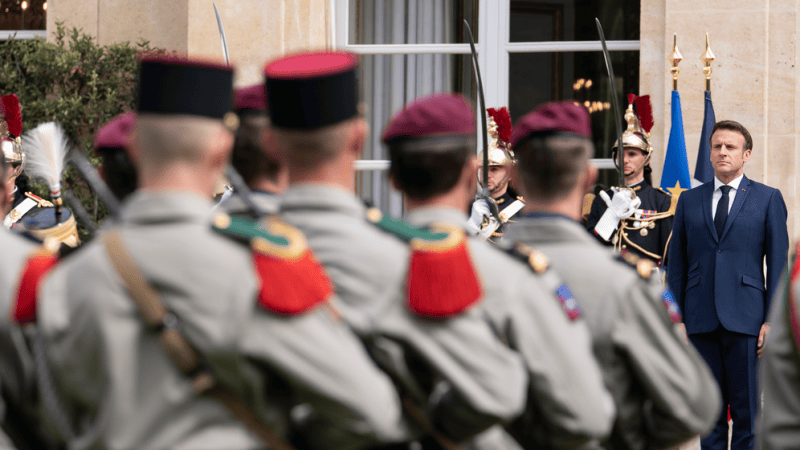
Emmanuel Macron has publicly questioned the pace and scale of activity of the French defence industry, stressing that despite declarations in recent years France is neither functioning in nor implementing a „war economy”. The President made it clear to the domestic industry, and to the world, that patience in the Élysée Palace is running out. If European partners prove faster and more effective, Paris will reach for solutions outside its own market.
During his speech at the Istres air base, Macron used exceptionally harsh words towards domestic arms manufacturers. He was highly undiplomatic – which is rare for him – saying: „We have done a lot, we have doubled, sometimes tripled production capacities, but let us be honest with ourselves – are we in a war economy? The answer is no.”
It was Macron himself who built this new narrative from 2022 onwards, when he announced France’s entry into a „war economy” (fr.économie de guerre). Then, in January 2025, he said that 2% of GDP for defence was not enough, pointing to the example of Ukraine, which spends far more – and still not enough – on its war with Russia. He stressed that France and other countries must significantly increase their budgets. Yesterday he added: „If we were in a state of war, I would hope that we would not be producing in this way.”
The drone issue stood out most strongly. Macron admitted that France is significantly behind in this area, pointing to Ukraine as the benchmark. „The Ukrainians have been able to innovate in an extraordinary way, while other partners and industries were faster than us and also less arrogant.”
According to data cited byLe Monde, Ukraine produced millions of drones in 2025, while the French scale is counted in thousands. This shows not only a difference in potential, but above all a difference in approach to a war economy – production under the pressure of war versus production in the rhythm of procedures.
The President also challenged the belief that the French armed forces are the customer of the French defence industry by definition and that this must remain so. He strongly emphasised that there are no protected markets. There is brutal competition, which forces the French industry to be ready to act and to be proactive. He said: „I need an industry that stops treating the French armed forces as captive customers.” This is a clear signal that the era of comfort is ending and a phase of being held to account for pace, scale and the ability to deliver equipment is beginning. Macron wants – after three years of slow implementation of his strategy – results in the form of finished products.
In my assessment, the strongest element was the suggestion that Paris may turn to solutions outside France. Macron warned that if European solutions prove faster or more effective, this is where orders will be directed. In the context of many years of strategic autonomy policy, this is a crucial change in tone. In practice, it means putting the domestic industry against the wall: either acceleration, or the loss of its privileged position on the market.
It is worth noting that this criticism stands in clear contrast to the assumptions of the parliamentary report from late 2024 and early 2025, which was meant to be a roadmap for France’s transition to a war economy. The document assumes investments of around €413 billion under the LPM 2024–2030, an increase in orders, relocation of critical production (including propellant to Bergerac), strengthening of supply chains and greater industrial flexibility. The goal was to move from quality to capability, where not only technological advancement matters, but also the ability to produce on a large scale.
The problem is that – as Macron’s statements indicate – this model still largely remains a plan. Yes, Rafale production is increasing, foreign orders are growing, budgets are being raised, but the system still operates in the rhythm of peacetime administration.
Le Monde recalls the complexity of procurement structures and the role of the DGA (the equivalent of Poland’s Armaments Agency), which has long been criticised for procedures and slow decision-making. Macron himself has previously spoken about the need for a „deep change of culture” towards simplicity, flexibility and boldness. Recent personnel changes in the leadership of the DGA show that Paris sees the problem and will increasingly push for solutions.
The President of France is sending a signal once again. This time, however, it is the strongest of all. Paris buying abroad and turning away from its own suppliers is something entirely new in Europe.
France has entered a war economy at the level of political narrative, partial acceleration of production of key platforms destined for export (Caesar, Rafale) and budgetary plans. However, it has not entered it at the level of the entire state. The war in Ukraine exposes the differences between a designed industry and a producing industry. The French defence industry must shift to mass production, speed up deliveries and become flexible, fearing competition. Otherwise, it will begin to lose not only to the United States, but also to Germany, Sweden, Ukraine and countries such as South Korea, Turkey and India.
This is a major test for France and a reprimand from Macron. If the „war economy” launched in 2022 has turned out to be a failure, then France – and the President himself – have two years left for a complete change of approach. In 2027 there will be presidential elections, which will be crucial for the country’s security and its role as a strong (including militarily) ally.