












- WIADOMOŚCI
- KOMENTARZ
Modi’s visit to Slovakia: India’s advance into Central Europe
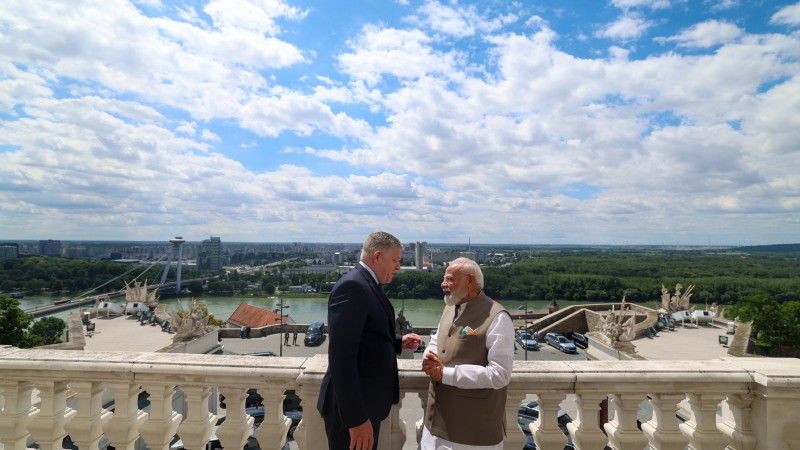
Photo. PMINDIA / Photo gallery
Indian Prime Minister Narendra Modi paid an official visit to Slovakia from 14 to 16 June. He was received with the highest state honours. It was his second trip to Central Europe, following his landmark visit to Poland.
For decades, Central Europe had remained on the periphery of New Delhi’s strategic attention. That changed under Prime Minister Modi, particularly during his second term when S. Jaishankar – a seasoned diplomat with prior postings in the region – became Minister of External Affairs. Jaishankar’s 2019 visit to Warsaw opened the door, followed by engagements across the region. The 2022 Russian invasion of Ukraine further sharpened India’s focus: under “Operation Ganga,” New Delhi evacuated more than 20,000 Indian citizens from Ukraine via Poland, Slovakia, Hungary, Moldova, and Romania, forging new logistical and diplomatic bonds with these countries.
In August 2024, Modi visited Poland – the first visit by an Indian prime minister since 1979 – and then travelled to Ukraine. The visit to Poland was historic, culminating in the elevation of bilateral ties to a Strategic Partnership. It also carried business significance and a deeply emotional dimension, as Modi laid flowers at monuments honouring the Maharajas of Jamnagar and Kolhapur, who had provided refuge to Poles during the Second World War.
The Slovakia visit had a somewhat different character. It marked the first-ever trip by an Indian prime minister to the country since its independence in 1993. Bratislava rolled out the red carpet with exceptional pomp. Modi was greeted at the airport with the traditional offering of bread and salt, accompanied by folk dances. The Indian diaspora gave him an enthusiastic welcome at his hotel. He was awarded Slovakia’s highest state decoration, the Order of the White Double Cross. In his acceptance remarks, Modi said: “I thank the citizens and government of the Slovak Republic for this award, which belongs to all 1.4 billion inhabitants of India.” That evening, Bratislava Castle was illuminated in the colours of the Indian flag – a rare and striking gesture.

Prime Minister Robert Fico visibly warmed to his guest, even wearing a matching Indian jacket. The two leaders took an informal boat trip along the Danube for frank, protocol-free talks. President Peter Pellegrini hosted Modi for a relaxed “coffee” meeting. The Prime Minister also participated in a public yoga demonstration in Bratislava ahead of International Yoga Day – an initiative Modi himself championed at the United Nations early in his premiership.
Slovakia attached exceptional importance to the visit not merely because India is a rising global power (Western leaders routinely court Modi, with Italy’s Giorgia Meloni notably cultivating an especially warm and extended rapport). Bratislava had its own compelling reasons, as did New Delhi. During the visit, the two countries upgraded their relationship to a Comprehensive Partnership – only the second such agreement India has signed in the region after the Strategic Partnership with Poland.
For Slovakia, India is a valued economic partner. The flagship investment is the Tata-owned Jaguar Land Rover plant in Nitra, one of the country’s largest automotive facilities, producing several Land Rover models. Smaller Indian firms are also active in auto components and IT. Slovak authorities are pleased with the performance of these investments and eager to attract more.
For India, Slovakia represents a reliable partner and a strategic foothold. The joint statement emphasised cooperation with regional formats including the Slavkov Trio (S3), the Visegrad Group (V4), and the Three Seas Initiative (3SI), with particular attention to interconnected infrastructure projects that enhance connectivity, sustainable growth, and regional integration. As India’s global influence grows, so too does its willingness to engage in European formats where it was previously less active. Both sides also stressed the urgency of concluding the long-awaited EU-India Free Trade Agreement. Slovakia voiced support for UN Security Council reform and a permanent seat for India.

Several important agreements were signed during the visit, including a Letter of Intent on Defence Cooperation, MoUs on Digital Technologies, Critical Infrastructure Protection and Post-Quantum Cryptography, Higher Education and Research, and, particularly significant for India, cooperation on labour migration and the establishment of a Consular Dialogue Mechanism. The latter directly supports provisions of the future EU-India FTA regarding the mobility of skilled workers.
Modi invited Fico to pay a return visit. All indications suggest that India intends to deepen its engagement in Central Europe – a region it has only recently begun to “discover.” New high-level interactions with other countries in the area, as well as further high-level meetings with Poland, appear likely in the coming period.


