












- ANALIZA
- WAŻNE
- WIADOMOŚCI
Poland is to Blame for Everything [OPINION]

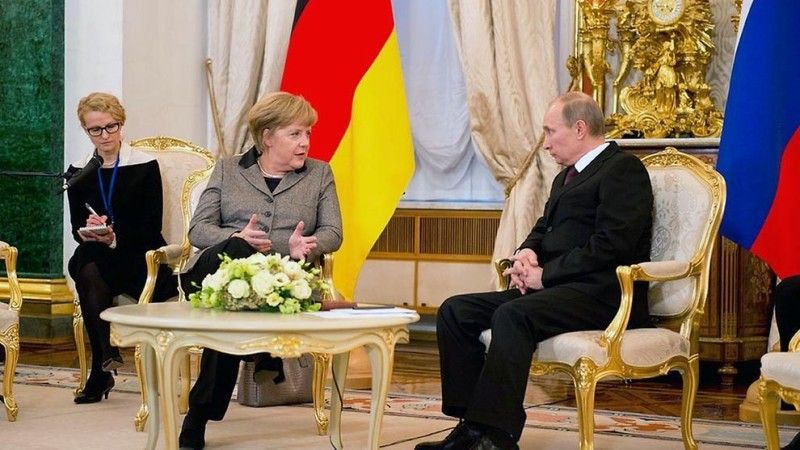
In recent weeks, it has become increasingly clear that both Russia and Germany, albeit in different forms, are beginning to develop convergent narratives: Poland is to blame.
In an interview published on YouTube, former Chancellor Angela Merkel stated that the opposition of Poland and the Baltic states to the resumption of dialogue with Putin in 2021 contributed to the deterioration of relations between Russia and the West, which, in her opinion, paved the way for Russian aggression against Ukraine. A few days later, during a speech at the Valdai Club on October 2, 2025, Vladimir Putin blamed pre-war Poland for the catastrophe of 1939, accusing it of rejecting German territorial proposals and preventing the Red Army from passing through its territory, which, in his narrative , led to the September defeat. These statements are not directly related, but they coincide in time and content, reinforcing the message: building an image of Poland as the perpetrator, not the victim, of history and politics.
Portraying Poland as a troublemaker is not a new tactic. It has a long tradition in Russian political thought. Already after the November and January uprisings of the 19th century, Russian publicists created an image of Poland as a „hotbed of revolution” and a „tool of the West.” Fyodor Tyutchev wrote about the „plague of the West” spreading through the Polish rebellion, and Mikhail Katkov portrayed Poles as conspirators driving a wedge between the East and the West. In the interwar period, Poland was, in the Russian narrative, the „white guard of Europe” and „the wedge of the West driven into Eurasia.” During the USSR era, it was referred to as an „unruly satellite” and „an unreliable link in the Eastern bloc.” After 2014, and especially after 2022, the Kremlin has almost literally revived these patterns. Poland has once again been portrayed as a „frontline state,” a „provocateur,” and an „inspirer” of Western anti-Russian policy. Putin’s propaganda uses history as a tool to delegitimize Poland’s contemporary politics.
On the German side, we are also seeing a shift in the emphasis of responsibility. It was the policy of the Merkel governments, not the position of Warsaw, that actually enabled Putin to build military power. The Nord Stream I and II projects increased Europe’s dependence on Russian gas and provided the Kremlin with enormous financial resources for armaments. Poland’s warnings were ignored and the voice of Central and Eastern Europe was marginalized. A strong pro-German-Russian lobby within the German political, economic, and media elites played a major role, presenting the Polish position as „Russophobia” for years. In this context, it is worth recalling the words of CDU MP Erika Steinbach in 2010, who said that „the Poles were the first to mobilize” – which was perceived as an attempt to relativize German guilt for the outbreak of the war. The political and media landscape thus shaped today favors the reinforcement of a narrative in which responsibility is shifted towards Poland.
Pro-Russian circles in Germany are also promoting this narrative today. Sahra Wagenknecht’s camp and Saxony’s Prime Minister Michael Kretschmer are using the investigation into the sabotage of Nord Stream to promote the thesis of an alleged „conspiracy by Poland and Ukraine” against Germany and Russia. August Hanning, former head of the BND, spoke in a similar vein, accusing Presidents Zelensky and Duda of allegedly agreeing on the sabotage operation. These claims were quickly picked up by pro-Russian media and opinion-forming circles, reinforcing the message that Poland and Ukraine are countries acting against the „true” interests of Germany and Russia. This is part of a broader disinformation campaign in which the Nord Stream investigation is being used as a tool of political pressure.
The actions of the German prosecutor’s office and services in the Nord Stream sabotage case can also be interpreted in a broader context. According to commentators, the intensity of the investigation has a symbolic dimension – it is an attempt to rebuild the image of the German security apparatus after a series of compromising scandals, including the cases of Jan Marsalek and Carsten Linke, which have strained the trust of the public and foreign partners. Olaf Scholz’s decision in February 2024 to extradite Vadim Krasikov, an FSB agent convicted of murder in Berlin’s Tiergarten, showed that Berlin does not always follow consistent criteria. All this calls for caution in assessing the current actions of German institutions in this case.
At the same time, Russian leaders repeatedly emphasize that Russia’s development and „normalization” in Europe are only possible in cooperation with Germany. Putin has declared his readiness to resume energy cooperation, Ambassador Nechaev has spoken of a desire to „rebuild relations,” and the Russian media portray Germany as a strategic partner. The Moscow-Berlin axis remains a key element of political maneuvering in Russian thinking, often at the expense of Central and Eastern Europe.
As a result, we are faced with a dangerous phenomenon: the convergence of Russian propaganda and German narratives, which together create an image of Poland as a troublemaker, a provocateur, and responsible for the mistakes of others. Russia does this brutally and through propaganda. Germany does so through half-truths, wrong decisions, and acquiescence to pro-Russian internal narratives. If this trend continues, it will come as no surprise when we soon hear that it is Poland, not Angela Merkel, that is to blame for the migration crisis – even though it was Berlin’s decisions in 2015 that triggered the greatest humanitarian and political challenge facing Europe today.


