












- KOMENTARZ
- WIADOMOŚCI
- WAŻNE
Reaction: yes. Shooting down a Russian aircraft: no

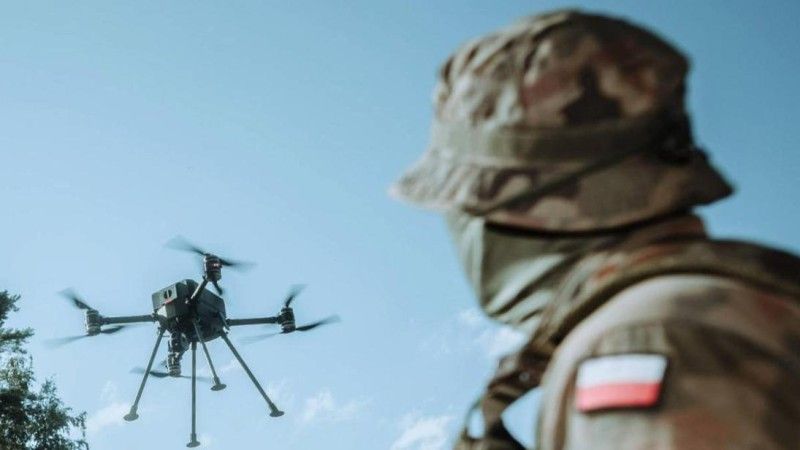
The Russian Federation has been testing NATO and its allies for years. In 2025 there is a clear intensification of activity on various axes. Immediately after the invasion of Ukraine, one of the main targets of hybrid attacks (sabotage, cyber-attacks, migrant pressure, espionage, etc.) was Poland. Now we are facing a much more aggressive Russia — for example the use of drones or prolonged entries into airspace — operating along the entire eastern flank. This does not, however, mean that one must respond with force, as Ukraine expects. On the one hand, Russia is testing NATO’s reactions; on the other, the Allies are showing that they are ready. Neither side wants to trigger a conflict.
The clashes of recent days have significantly distorted many people’s perception of the threat, but this does not mean anything is changing in Poland’s and the Allies« approach to responding to Russia’s aggressive moves. Procedures within NATO and contact between states allow for the implementation of standing schemes that were developed earlier. However, if events occur that significantly change the current confrontation with the Kremlin, all instruments are used to minimise losses and ease tensions.
There is no book or guide saying „if Russia does this, NATO will act that way”. The threat is assessed on an ongoing basis and in consultation with the Allies. There are many factors, but a few are the most important. In the case of drones, key issues include verification of the potential target of attack, assessment of the type of threat (especially where the objects are armed with explosive charges), analysis of damage caused by previously used UAVs, and forecasting possible further waves of raids. With fighters, assessments focus above all on their armament, flight path, contact with the crew and the potential threat in terms of the aircrafts« proximity to critical infrastructure. In addition, in peacetime — in line with NATO procedures — visual identification is required, which is crucial because on radar a drone, a missile or even a civilian paraglider can look very similar.
Recent incidents and the Turkish case. To shoot or not to shoot?
On the night of 9–10 September, nearly 20 drones entered Polish airspace and fell in various places in Poland. NATO capabilities were employed, as fighters were scrambled and enabled the neutralisation of part (I repeat, part) of the aircraft that could have posed a threat. No other actions — in the military dimension — were taken that would have constituted a response to Russia or Belarus.
Subsequently, under Operation Eastern Sentry, support was sent to Poland from various NATO countries, including the Netherlands, Germany, France and the United Kingdom. The response was limited to defence, strengthening defensive capabilities and deterrence. No one was harmed (this time) in Poland, so one should not expect an armed strike on Russia, because it must be underlined that NATO — led by the USA — does not want to trigger a Third World War.
Then on 19 September three Russian fighters violated Estonian airspace. This is not the first time, nor even the first this year. In fact, since 2014 Russian aircraft have violated Estonian airspace more than 40 times. In addition, the Russians have entered Estonia’s territorial waters, which shows that we are dealing with a long-term and deliberate strategy.
Again, the reaction was limited to maximum control of the situation. Russia is testing NATO’s reaction militarily and politically. An airspace violation does not automatically mean a shoot-down. It should be emphasised here that NATO applies a graduated response: radio warnings, then visual signals/escort, followed by firmer manoeuvres; and it was at this point that the Russian fighters were escorted away.
In many respects this cannot be compared with the incident when Turkey in 2015 shot down a Russian Su-24 fighter. There were several important elements there that did not occur either during the drone attack on Poland or the subsequent entry of Russian aircraft into Estonian airspace.
First and foremost, the Russian Su-24 was operating on the Syrian border, in a theatre of war. No NATO country is currently engaged in warfare in the context of its confrontation with Russia. Moreover, Turkey repeatedly warned that even a brief airspace violation would end with a defensive response. Moscow received a signal as to the consequences. To date NATO has not issued such messages. Only Estonia’s Defence Minister suggests that such actions should be considered. At the same time he noted that NATO is functioning efficiently and is ready, if necessary, to use force.
In Turkey’s case, the rule on the use of force resulted from the sharpening of Ankara–Moscow relations after earlier incidents, which were also on the verge of mutual shoot-downs. Importantly, the Russian Su-24 was heavily armed and conducting combat operations near the borders of the Republic of Turkey. By contrast, Russia has not carried out such actions with fighters. In the case of the drones, they had to be shot down — and they were.
It is worth recalling that Turkish fighters had a standing order to open fire if warnings were ignored. The Russian side had also been informed of this several times. Ultimately, the Su-24 was warned repeatedly (Turkey published recordings of its actions), and the shoot-down fell within the state’s defensive doctrine, which Ankara communicated to both NATO and the Kremlin.
After the Su-24 was shot down, Russia responded with trade and tourism sanctions, maintaining them until July 2016, when President Recep Erdoğan issued an official apology. It was nevertheless made clear that Turkey decided on such action because it occurred near a warzone, at high politico-military tension, and on precisely and previously delineated „red lines” as to what would happen if the Russians violated airspace.
In Poland’s context, decisions were taken to shoot down drones. In Estonia’s context, a classic NATO air policing mission in peacetime continues — interception under previously established procedures. NATO’s reaction was appropriate. Italian F-35s from Ämari intercepted the Russian aircraft and escorted them to the Kaliningrad Oblast. Finnish and Swedish aircraft were also scrambled.
If anyone in NATO wants to fire at Russian military objects, doctrinal and strategic conditions must first be worked out as to where a „hybrid attack” ends and war with Russia begins. For the moment, it has been decided to trigger NATO Article 4 and hold consultations with the Allies.
It is true that Russia is testing Alliance states, but entering an open war is in no one’s interest. Even if calls to shoot down appear in Poland, Romania or Estonia, they do not appear in Western Europe or the USA. And that reality must be faced.

Ukraine’s expectations
Once again, on the Ukrainian side it was made clear that the reaction must be firm — and indeed military. Such slogans have been voiced for months, not only by President Zelensky, but also by Ukrainian politicians, diplomats and experts. After the events in Poland and Estonia they could be heard across Europe.
Although one can support Ukraine with all one’s strength — which Poland has done since the outbreak of the war, effectively leading the initial surge and continuing to be a hub for assistance — no one in NATO intends to start exchanging fire with Russia. This did not happen when Ukrainians expected it after the war broke out, when hybrid attacks occurred in Europe, when the missile fell in Przewodów, when 1,000 drones were launched from Russia and Belarus, or when a strike hit the parliament building and a nuclear power plant.
NATO does not intend — at the current scale of Russian actions — to respond militarily. Yes, the Alliance is engaged in strengthening defence and investing in a doctrine of deterrence, but it will not join the ongoing war because Kyiv indicates that Article 5 should be triggered.
Ukraine’s communication activities — in relation to both drones and fighters — are to a large extent an element of politics. Kyiv’s aim is consistently to emphasise that Russia is a threat to the security of all Europe, which is intended to mobilise NATO and the EU to increase military assistance and impose further sanctions on Moscow. The problem, however, lies in the choice of narrative. For example, statements by President Zelensky about shooting down hundreds of drones in a single night while simultaneously suggesting that Poland and NATO intercepted only a few can create the impression that the Alliance is unprepared for war. Such rhetoric, instead of increasing the determination to help, may lead to the opposite effect, namely that member states will begin to worry about their own defensive capabilities and limit the transfer of equipment in favour of keeping it at home.
Ukraine is the wall that stands against Russia, and with full responsibility we must acknowledge its heroic defence and pay tribute to the fallen soldiers. However, NATO member states have adopted a fairly open position. Military support, so that Ukraine can not only defend itself but also attack. This does not include Alliance intervention in Ukraine or entry into open conflict.
Here Kyiv must begin to understand the situation and respect those who have stood shoulder to shoulder with Ukraine from the beginning. More imagery and criticism of allied states (including Poland) will bring nothing good. Assertions that „NATO has already lost to Russia” or „You cannot defend yourselves” only undermine the Alliance’s narrative. The last thing Ukraine needs is the loss of trust, which has already been severely strained in several situations in recent years.
Attacks and the Polish question
It is now very clear how thin the line is between peace and „non-peace”. The incident with Russian drones deliberately violating Polish airspace required an immediate response by the defence system — from radar detection, through scrambling quick reaction alert pairs, to decisions on selective use of weapons. Only a few years ago, few would have thought that drones would be part of a military attack marking the beginning of a war. But no one imagined North Korean soldiers in Ukraine fighting on Russia’s side, or African special forces on exercises in Belarus, either. As stressed at the outset, Poland has for years been one of the main targets of the Russian Federation, which is only intensifying these actions.
In the context of drones, it should be underlined that this was the first instance since the Second World War when the Polish Armed Forces were forced to carry out kinetic defence over their own territory, and the first time in NATO’s history when Alliance aircraft used weapons in its airspace. These are further elements of the „Alliance’s response”, which are a kind of novelty for everyone in NATO.
As General Maciej Klisz, Operational Commander of the Armed Forces, emphasised: „The actions were surgical — the priority was effectiveness and avoiding collateral damage. Ultimately, several of the most dangerous objects were shot down and the rest fell in various places in Poland. The trajectories indicated, among other things, the direction of Rzeszów airport, which is crucial for supporting Ukraine.” This demonstrates control over an event that was a serious threat, but where the reaction was key.
Both incidents were attempts to probe not only reaction, capability and potential, but also how such Russian pin-pricks would affect NATO’s stability. Here it must be stressed that the responses were very good, i.e. allied solidarity in reaction, as well as the decision to launch Operation Eastern Sentry to strengthen the defence of the eastern flank. In this case the signal is: the Alliance responds.
Although the scale of the response in light of recent years« events can be assessed in different ways — after all, Russia attacks and we only defend — one should build such defence that the Kremlin will fear to touch. Hence the continued rearmament of NATO states on the eastern borders.
Meanwhile, there are many offensive capabilities that do not trigger open conflict. First and foremost, weapons are being supplied to Ukraine, which strikes targets on the territory of the Russian Federation; NATO has enormous capabilities in cyberspace that many states already employ; and it is also necessary to demonstrate what the objectives are and what further Alliance reactions will be if the Russians escalate.
So far NATO has limited itself to interceptions and escort, but the lack of unequivocal declarations can be read in Moscow as permission for further provocations. It is therefore worth considering, as part of an information campaign, firm communications that further violations of airspace may end with Russian aircraft being shot down. Precise and public indication of such a threshold would strengthen the deterrent effect, and the Kremlin would have to reckon with a real risk of losses, which could reduce the scale of similar actions.
In line with the principle I discussed at international conferences in Helsinki and Tallinn, devoted to security in the context of the situation in Ukraine — namely „4D”: defence, deterrence, diplomacy and destroy. This concept assumes that the Alliance’s actions must be parallel: to include both determined defence and deterrence, as well as conducting diplomacy and readiness to destroy the opponent’s capabilities when the situation requires it.


