












- WIADOMOŚCI
Russia wanted the nuclear treaty because it is facing difficulties, expert says

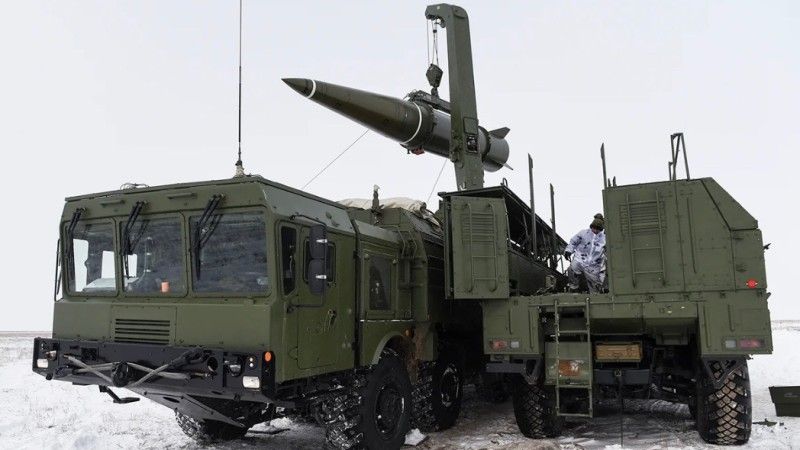
Photo. mil.ru
On Thursday, February 5, the New START arms control treaty officially expires. How will this affect U.S.–Russian relations and the approach of both powers to nuclear policy?
On 8th April, 2010, a bilateral international treaty between the United States and the Russian Federation was signed in Prague. The purpose of New START (the New Strategic Arms Reduction Treaty) — which entered into force exactly 15 years ago, on February 5, 2011 — was to limit the number of deployed U.S. and Russian warheads to 1,550 on strategic delivery systems.

START expires. What comes next?
The expiration of the New START treaty on Thursday means that, after more than 50 years (dating back to 1972, when the U.S. and the USSR signed the SALT I agreements — Strategic Arms Limitation Treaty), there will no longer be a formal agreement aimed at limiting the American and Russian nuclear arsenals — the arsenals of countries that possess the overwhelming majority of the world’s nuclear weapons.
It turns out that the expiration of New START — although it affects both Americans and Russians — is less palatable for the latter. „Russia urged the U.S. to maintain the limitations of the New START agreement because it would currently be harder for Russia than for the Americans to expand its strategic forces, and it wants to avoid the associated costs,” says Artur Kacprzyk, an expert at the Polish Institute of International Affairs (PISM). In a conversation with Dr. Aleksander Olech, he recalled that the Americans have more warheads in reserve that could be uploaded onto existing intercontinental ballistic missiles and bombers (the U.S. has around 1,500–2,000 warheads for these forces, while Russia has at most 1,000). In theory — as the expert notes — Russia has the technological capability to produce additional warheads and land-based missiles, but due to the ongoing war in Ukraine, this is not a current priority for Moscow.

Discontent, but not desperation
„However, while Russia is dissatisfied with the treaty’s expiration, it does not appear to be desperate because of it. Even if the Americans deploy more strategic warheads than Russia, they will not gain a significant advantage, at least over the next few years,” Artur Kacprzyk continued.
In his view, this relative calm on the Russian side stems from several factors. Moscow possesses systems not covered by the New START treaty. These include, among others, intermediate- and shorter-range forces, such as Oreshnik missiles. It should be added that this category also includes far more numerous warheads for Kalibr- and Iskander-class missiles, as well as even surface-to-air missiles alongside classic bombs. Incidentally, Russia has also recently deployed non-strategic nuclear weapons in Belarus, which violates the provisions of the preamble to the 1997 NATO–Russia Founding Act. In this area, the U.S. has only modernized B61-12 bombs, which have recently been integrated for carriage by the F-35. Moreover, it is worth remembering that in addition to its rivalry with Russia, the United States is preoccupied with a „duel” with China, which is expanding its nuclear arsenal year by year (the number of Chinese warheads has more than doubled since the treaty was signed — from fewer than 300 to around 600 — and continues to grow).
Doctrinal issues also come into play. „Russia does not need to have as many nuclear warheads as the U.S. to deter it. Remember that a very important element of U.S. doctrine is maintaining the ability to strike an adversary’s nuclear forces in an attempt to destroy as many of them as possible before they are used. Russia certainly also has such plans, but the foundation of its strategic doctrine is maintaining the ability to retaliate during or after an enemy strike. And destroying the largest American cities requires far fewer forces than striking several hundred nuclear missile launchers,” adds the expert from the Polish Institute of International Affairs.
See also 
What comes next?
The current relative calm among the Russian authorities does not mean it will last for years. Russian objections will be particularly focused on the future. According to Artur Kacprzyk, Russia’s situation will become much worse already in the 2030s. Why? This is mainly due to the technological revolution that will soon take place in the United States.
New U.S. intercontinental ballistic missiles and strategic bombers will begin entering service in greater numbers. The Americans may decide to increase their production, not only to replace existing strategic nuclear delivery systems with new ones, but also to increase their overall numbers (the question remains how financially feasible this will be, given the desire to simultaneously strengthen conventional forces for a potential war with China). In addition, Russians fear that the U.S. will make major advances in the development of ballistic missile defense for its territory under the "Golden Dome" project. They also fear that the U.S. will deploy a large number of conventional intermediate-range missiles in Asia and Europe, capable of carrying out rapid strikes against parts of Russia's nuclear forces and their associated command, control, communications, and early warning systems
Kacprzyk summarizes.


