












- ANALIZA
- WIADOMOŚCI
The evolution of Polish-American security relations

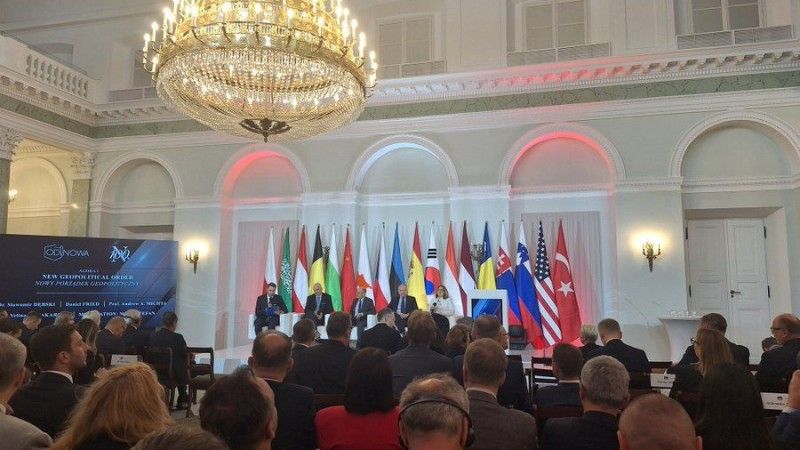
“The current White House administration is characterized by an exceptional intensity of infighting among clashing interest groups. These frictions hit allies—a stark example of which was the information chaos surrounding the suspension of the American rotational brigade in Poland,” said former U.S. Ambassador to Poland Daniel Fried during the 1st Strategic Culture Forum.
What strategic vision does the Donald Trump administration possess and implement? What do the discrepancies between official documents and the White House’s practical actions indicate? What role does Poland have to play in international politics today?
On Tuesday, June 16, the 1st Strategic Culture Forum “The Next 100 Years” took place at the Presidential Palace. The first panel discussion was dedicated to the shaping of a new geopolitical order. The debate featured: Dr. Velina Tchakarova (FACE), Dr. Sławomir Dębski (College of Europe), Prof. Andrew Michta (University of Florida, Scowcroft Center), Daniel Fried (Atlantic Council), and Marek Stefan (moderator,Układ Sił).

What is the strategic vision of the contemporary USA?
One of the main questions posed at the beginning of the discussion was whether a clear strategic vision stands behind the actions of the Donald Trump administration. According to Dr. Velina Tchakarova, the primary goal of the White House today is to best position the U.S. for a “long-term, multidimensional systemic rivalry with China.” As Tchakarova noted, the current administration’s priority was to eliminate elements that hindered the conduct of policy in the Indo-Pacific. This explains recent actions related to the Panama Canal, Venezuela, and Iran. Another equally important goal subordinated to the rivalry with Beijing is intended to be the closing of political chapters related to Ukraine and the Middle East.
Meanwhile, Daniel Fried, former U.S. Ambassador to Poland, stated that elements of almost every American strategic school can be seen in the Trump administration’s actions. The Monroe Doctrine is visible, as is the “Asia First” approach. There is also room for transactionalism, neo-isolationism, and indifference toward European security.
“Alongside negative trends, however, there are good elements that draw on a Reaganite perspective. It is a right-wing version of the synthesis of the thought of Woodrow Wilson and John F. Kennedy—namely, a Free World strategy,” noted the expert, who also spoke about internal frictions within the administration affecting United States foreign policy.
“The current administration is characterized by an exceptional intensity of infighting between clashing interest groups. These frictions hit allies—a stark example of which was the information chaos surrounding the suspension of the American rotational brigade in Poland,” he added.

Transatlantic Relations
The panel also discussed transatlantic relations. According to Prof. Andrew Michta, one of the main problems in U.S.-Europe relations is the deep political division of the Old Continent and systemic, long-term disarmament.
“The situation in which Europe has lived for the last 30 years is unsustainable. One cannot expect one actor (the USA) to constantly carry the lion’s share of the entire alliance’s burden. Europe must urgently build its own conventional capabilities, rebuild its manufacturing industry, and its defense base. Only then can it approach the USA with concrete, partnership-based proposals,” he said, adding that a highly regionalized security outlook can also be observed in Europe.
As he noted, countries such as Estonia, Finland, Sweden, Norway, and Poland view the Russian threat quite differently than Germany and France. Consequently, according to Prof. Michta, NATO urgently needs to redefine its internal mechanisms today and constructively utilize these diverse threat perceptions to maintain the stability of transatlantic relations.

The Role of Poland
Both Prof. Michta and Dr. Dębski spoke about Poland’s geopolitical situation and its role in the contemporary security architecture. Both experts agreed that Poland has a vital relationship with the U.S., and its authorities must find an effective way to reach President Trump and his advisors. The goal should be a “precise understanding of the convergence of interests and offering the U.S. specific defense solutions that will realistically lower the costs borne by Washington.” Furthermore, as Dr. Dębski stated, there must be an awareness among Polish elites that the skillful management of transatlantic relations and the country’s position in NATO constitute the foundation of Poland’s security and a multiplier its power.
The changes that have occurred in Poland over the last three decades were also discussed. It was stated that in the context of international politics, recent years have been a journey toward achieving much greater agency. “30 years ago, Poland was a poor country, extremely dependent on the American vision of the world. When the USA decided to remain engaged in Europe after the Cold War, we tried to participate in that actively. We believed in the vision of a Europe undivided and living in peace—we aspired to alliances, signed friendship treaties with all our neighbors, and were a constructive player despite modest resources. (…) Today, we are in a completely different place. We are stronger, we are rapidly increasing our military capabilities, and we constitute an absolutely crucial logistics hub for the invaded Ukraine,” said the former head of the Polski Instytut Spraw Międzynarodowych (Polish Institute of International Affairs).
“We can no longer be merely an object of international politics—we must become its subject. We should systematically influence Washington through a permanent political and institutional presence, co-shaping how the United States defines its role in NATO. Today, we already have the appropriate resources and political instruments for this, and where they are still lacking, we must consistently build them,” he concluded.


