- WIADOMOŚCI
- KOMENTARZ
We are now rebuilding what we used to have: Polish foreign minister on NATO’s costly mistake

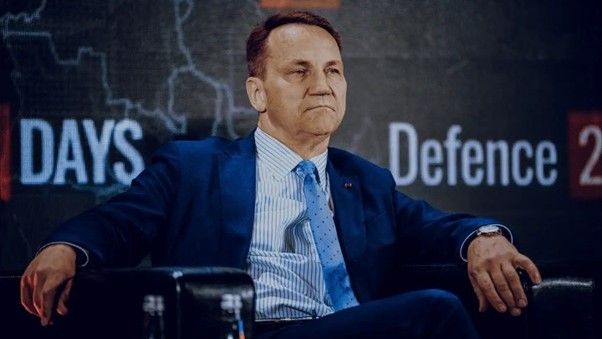
Photo. defence24
Poland’s foreign minister was unequivocal about NATO’s past mistake in redesigning its militaries for expeditionary operations, while arguing that Europe today does not need to do “anything heroic” to deter Russia, but simply “what we promised.”
In a conversation with Edward Lucas at Defence24 Days, the largest security conference in Central and Eastern Europe, held in Warsaw on 6–7 May, Poland’s foreign minister made several striking remarks on NATO, Europe, and the direction of Polish foreign policy.
Sikorski pointed to NATO’s past mistakes, especially the era of expeditionary operations, during which the Alliance dismantled or disposed of much of the equipment that Ukraine now urgently needs and actively uses, like tanks and heavy artillery. As large-scale conventional war has returned to Europe in a way NATO had not anticipated, he noted that “we are now rebuilding what we used to have.”
In military terms, Sikorski made two interesting observations. First, he argued that Europe does not need to surpass Washington in defence spending or military sophistication, but rather “just has to be better than Putin, not the United States.” His words therefore run against the widely observed tendency to use the US as the benchmark for Europe’s rearmament efforts. Second, he stressed that the commitments already made by European allies are sufficient, provided they are actually delivered. As he put it, “We don’t have to do anything heroic, we just have to do what we promised.”

Asked what would happen in the event of a serious provocation, the Polish foreign minister assessed the likelihood of a large-scale conventional attack as low, arguing that Russia remains too heavily engaged in Ukraine. Sikorski expressed greater concern, however, over unconventional threats, warning that Putin might still attempt “something desperate” in the NATO eastern flank.
This is one of the reasons why Europe must learn from what Sikorski called the “revolution in military affairs” taking place in Ukraine. One of Ukraine’s key insights has been that Russia’s size — historically seen as its strength — is also its vulnerability: Moscow cannot protect everything across such a vast territory. For this reason, Sikorski argued that deep-strike capabilities should become a priority. In his view, Europe should also emulate Ukraine’s more dispersed logistical and industrial model, built around competition, adaptability, and operational agility.
Renewed hopes for the Visegrád Group and the Three Seas Initiative
Asked about the future of regional formats that have been stalled by unfavourable political configurations in some countries — including the Visegrád Group and the Three Seas Initiative — Sikorski suggested that a new chapter may be possible, particularly for the former, following Orbán’s fall and Fico’s more positive stance towards Ukraine.
He was somewhat less optimistic about the Three Seas Initiative, which he described as a “useful forum for dialogue,” especially in the context of military mobility. At the same time, he noted that most funding for related projects still comes from the EU, while Poland remains relatively alone in financing the 3SI itself, with the expected U.S. funding still not materialising.

The question of US troops after withdrawal from Germany
Sikorski’s remarks come at a particularly difficult moment for Poland and Europe in their relations with the United States. Over the past month, Washington has threatened to suspend Spain’s rights as a NATO member, withdraw part of its troops from Germany, and question the United Kingdom’s claim to the Falkland Islands in punishment for their stance towards the Iran war. Meanwhile, Polish Prime Minister Donald Tusk has recently questioned whether the United States “is ready to be as loyal as it is described in our NATO treaties.”
In this context, Sikorski said during his conversation with Lucas that Poland’s policy is to say “yes” to a larger American troop presence. He also stressed, however, that this should not come at the expense of any other ally, echoing earlier remarks made by Donald Tusk on the matter.
His words follow the recently published Polish Foreign Policy Strategy, which identifies Russia as the major threat to Poland, whose potential attack would be intended to “challenge the international institutions and alliances upon which Poland’s security is founded.” The document also acknowledges the risk of a “significant reduction in the engagement of U.S. Armed Forces in Europe,” while stressing Poland’s aim to “sustain the U.S. military presence on its territory,” “bolster NATO’s European pillar,” and “expand the EU’s strategic and security dimensions” in complementary ways.