












- ANALIZA
- WIADOMOŚCI
A Polish aircraft against drones, as in Ukraine?

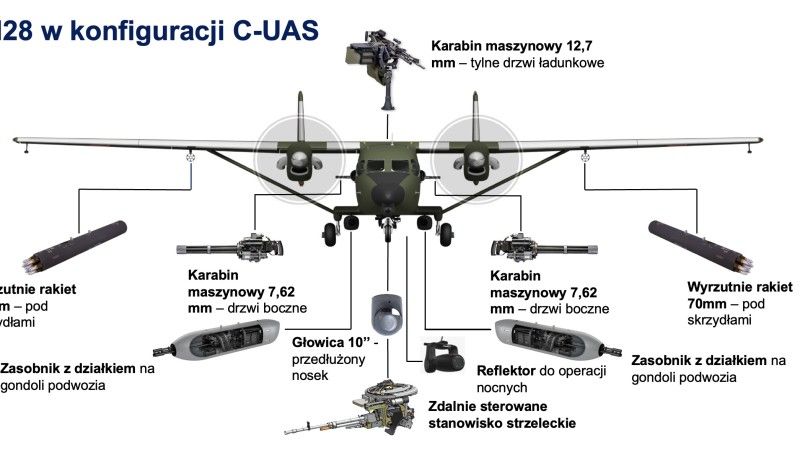
Photo. PZL Mielec
The Polish Armed Forces are analysing the acquisition of aircraft specialised in countering drones. One of the industry proposals is to use the well-known M28 platform. As its manufacturer, PZL Mielec, shows, it can be quickly adapted to neutralize UAVs.
The Polish Armed Forces are examining the possibility of acquiring aircraft specialised in countering unmanned aerial vehicles, including loitering munitions and long-range drones such as Iranian Shaheds. As Defence24.pl reported earlier, the General Command of the Polish Armed Forces is carrying out analyses on introducing such capabilities, which could relieve classic combat aviation in the fight against mass-produced unmanned systems.
In response to the aforesaid requirement, industry proposals are also emerging. One of them is a proposal to use of the M28 aircraft, used among others by the Polish Armed Forces, as an airborne counter-drone platform. The concept for using the aircraft was recently presented during a conference organised by the Land Forces Military University.
Drones are changing the economics of air defence
In recent years, and especially during the full-scale war in Ukraine and conflicts in the Middle East, unmanned aerial vehicles have played an increasingly important role on the battlefield. They are used both as small reconnaissance drones and as loitering munitions and larger strike systems capable of attacking critical infrastructure or the adversary’s logistics chain.
The scale at which the UAVs are used means that the traditional approach to air defence is becoming less and less economically effective. Cheap unmanned systems can be produced and used in huge numbers, while the systems designed to counter them are often many times more expensive.
In theory, unmanned systems can be countered by classic fighters such as the F-16 or F-35. In practice, this is an extremely expensive and operationally inefficient solution. Aircraft of this class are designed primarily to fight other manned enemy aircraft and cruise missiles, to break through air defences, or to carry out precision strikes.

Photo. SSgt John B. Ennis
Using supersonic fighters to engage slow and relatively small aerial targets means tying up the most expensive air platforms for tasks that could be performed by far cheaper means. In practice, it also means „fixing” the most modern aircraft on combat with unmanned systems, which may number in the hundreds, and preventing their mass use against the opponent’s conventional capabilities and infrastructure. Yet this is exactly the condition for building an advantage based on air power, which is a core element of NATO doctrine.
The cost and availability of munitions are also problems. In many cases, air-to-air missiles costing hundreds of thousands of dollars, and in the case of more advanced missiles even more than $1 million, are used to shoot down drones. Such missiles are usually delivered in batches of several hundred, just over a thousand, or at most a few thousand per year, and the time from order to delivery is three years or longer. Meanwhile, the drone being shot down may cost many times less. It is produced much faster, with annual Russian production of long-range unmanned systems measured in tens of thousands and still growing. This means an extremely unfavourable cost-effectiveness ratio and the rapid consumption of stocks of missiles that should be intended primarily for fighting enemy aircraft and missiles.
One reason why the idea of building a layered counter-drone system is appearing more and more often is that, alongside classic missile systems, cheaper means of countering unmanned systems are needed. Alongside interceptor drones, gun artillery and low-cost missiles, this concept also includes armed manned aircraft that are slower and cheaper than fighters and capable of long-duration air patrols.
Bryza as a C-UAS platform
One such proposal is the use of the M28 aircraft, also known as Bryza, produced in Poland by PZL Mielec. These aircraft, in various configurations, are used in a wide range of roles – from transport and border patrol to reconnaissance and maritime missions, including as part of NATO activities in the Baltic and Mediterranean.
More than 100 M28 aircraft have been delivered to users on different continents, including armed forces and state institutions. The aircraft is designed and developed in Poland, which gives the manufacturer the ability to introduce modifications and integrate new mission systems relatively easily.

Photo. Cpt. Ewa Złotnicka
During a recent conference on the evolution of the battlefield organised by the Land Forces Military University, PZL Mielec presented the M28 in a configuration for countering drones. This platform can be adapted relatively quickly to new tasks and become part of a broader system for countering unmanned threats.
For Poland, an additional advantage is that the platform is already well known to the armed forces, so the starting point for building counter-drone capability could be the modification of existing aircraft.
„The M28 aircraft is already used in the Armed Forces, which gives it a huge advantage. It is a platform widely used in the military, with trained pilots, capable of very short take-off and landing. It is also very economical both in flight and in maintenance, which makes it possible to quickly implement such a solution without significant costs. We can also adapt existing aircraft already serving in the Polish Armed Forces to the new task,” Janusz Zakręcki, president of PZL Mielec, told Defence24.pl.
Weapons and airframe configuration
To configure the M28 for countering unmanned systems, it is necessary to install additional weapons and equipment. In the simplest version, these are M134 7.62 mm multi-barrel machine guns mounted in the side doors, allowing fire during patrol flight. A 12.7 mm heavy machine gun can also be installed in the rear fuselage.
The concept of using an onboard gunner firing from the aircraft door is not new. In recent months, a similar idea has been used in Ukraine, where a twin-engine An-28 aircraft was adapted to counter Russian drones. It was also produced in Mielec and became the basis for the development of the M28, a significantly modernised and westernised variant with new engines and avionics.
Available footage from the front shows that the well-known An-28 performs effectively in hunting Russian drones, especially in the case of slower unmanned systems such as Shaheds.
Its armament consists of M134 Minigun 7.62 mm multi-barrel machine guns mounted in the aircraft’s side doors. The weapons are fitted with laser sights, and the gunners wear night-vision goggles. In video material, the An-28 in such a configuration can be seen carrying out a combat mission. The crew of one such aircraft has already shot down more than 100 unmanned systems.
A significant advantage of the An-28 – and therefore also the M28 – is its aerodynamic layout, with a high-mounted wing, which provides an excellent firing field from the side doors. The absence of structural elements limiting the firing sector allows the gunner to engage targets located below and to the side of the aircraft, which is crucial when countering slow-flying unmanned systems.
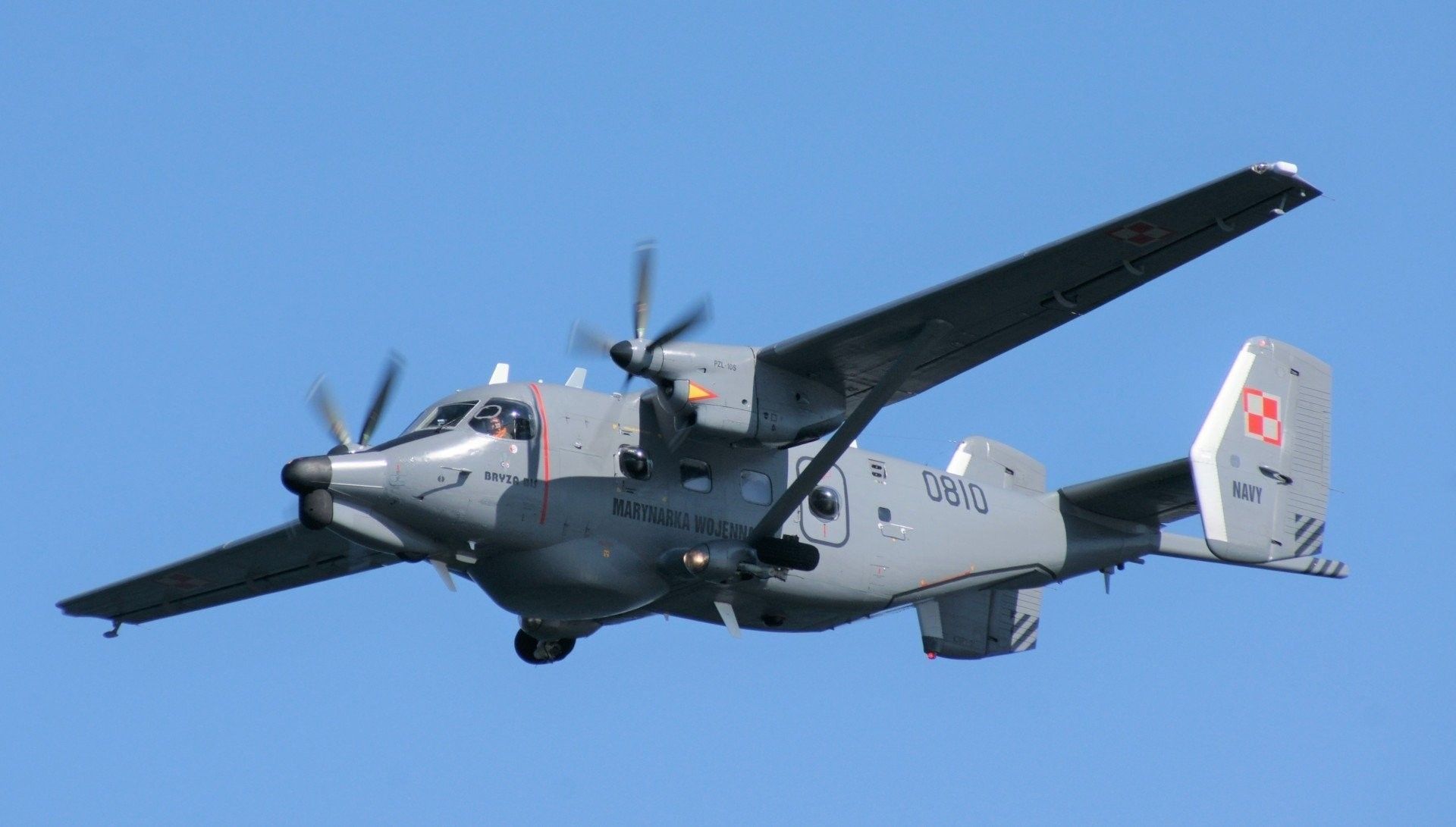
Photo. Jarosław Ciślak/Defence24.pl
In a more advanced configuration, also available through conversion of existing aircraft, the M28 can be fitted with an electro-optical head in the front fuselage (installed in a manner similar to the latest naval patrol aircraft variants), as well as a movable, remotely operated weapon station with a 12.7 mm (.50-cal.) machine gun. This would allow targets to be engaged regardless of direction, through a 360-degree arc, as well as maritime targets, including drones, and land targets. In addition, laser-guided 70 mm APKWS or Telson rocket launchers could be mounted under the wings, and 20 mm cannons could be installed on undercarriage pods for forward-firing.
Sensor suite and integration with the air defence system
The most advanced version of the concept envisages an optional expansion of the reconnaissance and communications package. The M28 could be equipped with an onboard radar capable of detecting small aerial targets, enabling wide-area monitoring and early detection of incoming drones.
The aircraft could also use secure communications systems, including V/UHF radios, satellite communications and a Link 16 data link, enabling information exchange with other elements of the air defence system. This is complemented by the military IFF M5 identification system and an INS/GPS navigation system resistant to jamming. Thanks to this, the M28 aircraft could operate within an integrated air defence system.
Fast deployment
According to PZL Mielec, one of the main advantages of the concept is the ability to field such a capability very quickly.
„This solution can be introduced very quickly because it does not require full certification, as is the case with new designs. Existing aircraft can be equipped within a few weeks, for example with heavy machine guns, and begin to be used for new tasks,” emphasises Janusz Zakręcki.
It is also highly significant that the M28 is already present in the Polish Armed Forces. Poland currently operates more than 25 An-28/M28 aircraft, both in the Air Force and within Naval Aviation structures. The Naval Aviation Brigade has a large fleet, where the aircraft, including specialist variants, are used primarily for maritime patrol, reconnaissance tasks and support for search and rescue operations. The remaining aircraft are in Air Force transport units, where they are used mainly for training and transport and tasking missions.
This means that, at the initial stage, a basic capability could be achieved by modernising aircraft already in service, without having to wait for the production of entirely new platforms.
At the same time, PZL Mielec declares readiness first to launch integration and then to begin production of new aircraft, should the military require them.
„We are ready to quickly launch the integration of existing aircraft and the production of new ones. This means jobs in Poland, the development of industrial skills and real benefits for the domestic defence industry. Our plant is ready to respond to the needs of the Armed Forces of the Republic of Poland,” Janusz Zakręcki notes.
Lessons from the war in Ukraine show that effective defence against unmanned systems requires the right density of detection and engagement assets, as well as their dispersal across the operational area. In this context, deploying around 20 M28 aircraft in permanent operational alert status at bases in eastern and north-eastern Poland, as well as along the Vistula line, would make it possible to create a two-layer defence system capable of responding to threats coming from the east and north-east.
Supplementing this layout with a maritime component – by stationing appropriately configured M28 aircraft at Navy bases – would make it possible to extend coverage towards the Baltic direction, including countering attempts to penetrate airspace and acts of sabotage at sea.
A key advantage of this concept is the M28 platform’s low logistical support requirement, which – as with many solutions used in Ukraine – makes it possible to field the system quickly using existing infrastructure, without the need for time-consuming expansion of the support base.
An airborne layer of counter-UAS solution
The concept of an armed M28 fits into the increasingly discussed need to build a layered counter-drone defence system. In such a model, heavy air defence systems would be responsible for countering enemy missiles and aircraft, short-range systems and distributed ground-based C-UAS would protect troops and infrastructure, while patrol platforms could conduct surveillance and counter drones over a wider area.
If the concept were developed further, Poland could obtain a relatively inexpensive airborne C-UAS platform based on a domestic design already in service today and capable of being adapted to new tasks relatively quickly. In conditions where unmanned systems are becoming increasingly important, such solutions may become one element of the air defence system.


