- KOMENTARZ
- WIADOMOŚCI
- WAŻNE
Defence Tech Valley 2025 – a war laboratory without Polish companies

On 16–17 September, Defence Tech Valley 2025 took place in Lviv – an event already described as the largest investment forum dedicated to defence technologies in Ukraine’s history. The summit, organised by Ukraine’s Ministry of Digital Transformation and the state cluster Brave1, gathered over five thousand participants from fifty countries. Alongside investors, government representatives and the defence industry, there were also experts, military officers and leaders of global and Ukrainian technology companies. Representatives of Defence24 also took part – CEO Piotr Małecki and retired General Jarosław Gromadziński.
A global forum of defence innovation
The organisers reserved the right to keep the venue strictly confidential. Participants were informed of the conference location only several hours before the event. This was understandable given wartime conditions and the real threat of Russian missile and drone attacks. The agenda was intensive – around one hundred speakers took to the stages. Speakers included Hülya Bayraktar, President of the Turkish company Baykar Defence; Andrius Kubilius – EU Commissioner for Defence and Space; as well as Ukraine’s First Deputy Prime Minister Mykhailo Fedorov, who emphasised that Ukrainian technologies have already become a benchmark for the world in fighting modern threats. Particular emotions were stirred by the first public appearance of Colonel Pavlo „Lazar” Yelizarov, commander of a special unit of Ukraine’s National Guard, who, together with Captain Roman „Fish”, for the first time showed operational footage and described the destruction of Russian equipment worth twelve billion dollars.\ Discussions focused on investment in Ukraine’s defence sector, the potential to commercialise wartime innovations, and new dimensions of warfare – from mass use of artificial intelligence and the automation of command processes to integrating big data with weapons systems. Many talks addressed lessons from the battlefield and how they are reshaping the practical role of technology in defence.
Ukrainian dominance, Polish absence
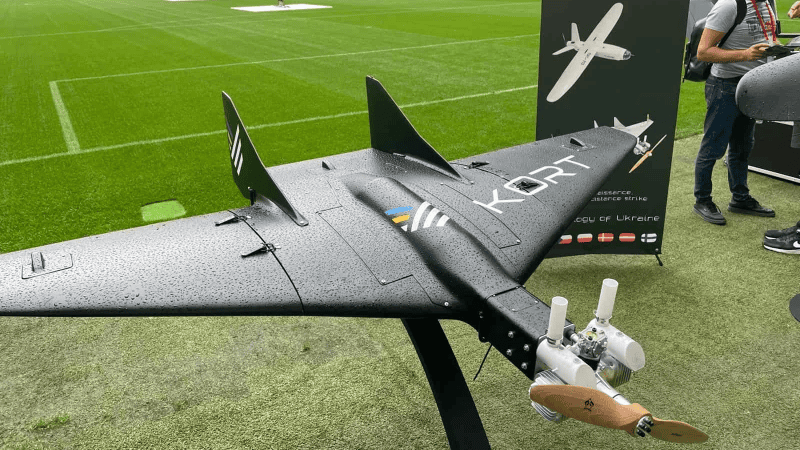
An integral part of Defence Tech Valley was also an exhibition of new-technology equipment – the largest of its kind in independent Ukraine’s history. More than 230 domestic and foreign companies presented both solutions already used at the front and entirely new technologies, including missile systems, lasers, interceptor drones, aerostats, combat turrets, as well as modern electronic warfare and communications systems. The unmanned ground platform arena drew significant interest, with urban, forest and off-road conditions recreated, and guests able to test over 20 robot models live in realistic combat scenarios.\ Against the broad representation of companies from the USA, the United Kingdom, the Nordic countries and the Baltic states, Poland’s presence was very modest. Polish exhibitors did not appear, there were no stands presenting domestic technological potential, and entrepreneurs from our country present on site hardly took advantage of the opportunity for direct talks with Ukrainian partners. The limited presence contrasted with the activity of Ukrainian firms, which over the last two years have become a symbol of wartime innovation and the real application of new technologies at the front.
Unmanned ground platforms – the future of the battlefield
Retired General Jarosław Gromadziński, present at the event, draws attention to the importance of unmanned ground platforms in future warfare. The designs shown in Lviv covered a wide spectrum – from light reconnaissance vehicles capable of autonomous patrolling to heavier transport platforms able to carry ammunition and equipment or evacuate the wounded under fire. There were also strictly combat models capable of carrying weapons and supporting infantry operations. The key to their effectiveness, however, must be the level of autonomy. In an electronic warfare environment, vehicles must be capable of operating offline, using artificial intelligence algorithms to avoid obstacles and recognise threats. Equally important is modularity – the ability to quickly adapt the platform to different tasks: from reconnaissance, through logistics, to strictly combat roles. Ukrainian start-ups presented systems already used at the front, and as a result their offering stands out with practical experience that many Western companies lack.
A new dimension of investment
Defence Tech Valley also had a clear financial dimension. The event was attended by over 300 investors from Europe and North America – twice as many as at the previous Brave1 forum. During the forum, four funds from Europe and the USA announced plans to invest over one hundred million dollars in Ukrainian defence technologies. The Dutch NUNC Capital declared twenty million euros for the development of new materials and the building of local industrial capacities; the German–Luxembourg Verne Capital plans to allocate twenty-five million euros to defence innovation; and the Swedish fund Varangians unveiled a broad investment plan, details of which are to be announced soon. Separately, the company Swarmer reported raising fifteen million dollars from American investment funds – the largest public funding round in the history of Ukraine’s defence sector.
What does this mean for Poland?
Defence Tech Valley was a clear signal to many investors that Ukraine is becoming a centre of global defence innovation. Ukraine’s authorities are seeking to cultivate such an aura around the equipment of a country at war and to leverage the fact that they have the largest – and indeed the only – experience in today’s free world with the use of drone and anti-drone systems. Ukraine is striving to prove that it is now setting directions in drones, autonomous systems, electronic warfare and the integration of AI with command processes. For Poland this means both an opportunity and a threat.\
- An opportunity – because geographical proximity and shared experience could make Poland a natural partner in developing and implementing such technologies.\
- A threat – because if we do not participate in this process, we will be sidelined while others build relationships, gain experience and secure contracts.\ Of course, Polish systems in, for example, drones are at a much higher level compared to Ukrainian ones – today based to a large extent on components from China – but Ukraine has one huge advantage: the number of companies able to demonstrate wartime experience. They also make constant modifications that become innovations, surprising the enemy. They are continually striving both to reduce costs and to increase effectiveness. Ukrainian firms have somewhere to test, promote themselves brilliantly worldwide and have constant support from their government.\ The absence of Polish firms in Lviv can be read as a lack of courage or awareness of the importance of such events. At a time when the whole world is investing in defence technologies and Ukraine is becoming a laboratory and forge of practical solutions, the lack of an active Polish presence raises legitimate concern.
A need to change our mindset
Yet the presence of experts alone is not enough. Poland must actively support its own companies, help them with promotion and build conditions for investing in military innovation. Without this we will remain observers rather than participants in the global technology race.\ Defence Tech Valley 2025 showed that the future of defence is not only aircraft or tanks, but increasingly drones, autonomous platforms and AI-based systems. If Poland wants to be part of this future, it must go beyond the role of spectator and start boldly investing in the development and promotion of its own technologies.