












- sponsorowane
- WIADOMOŚCI
- ANALIZA
Groundbreaking Polish technology. PONAR Wadowice at MSPO 2025

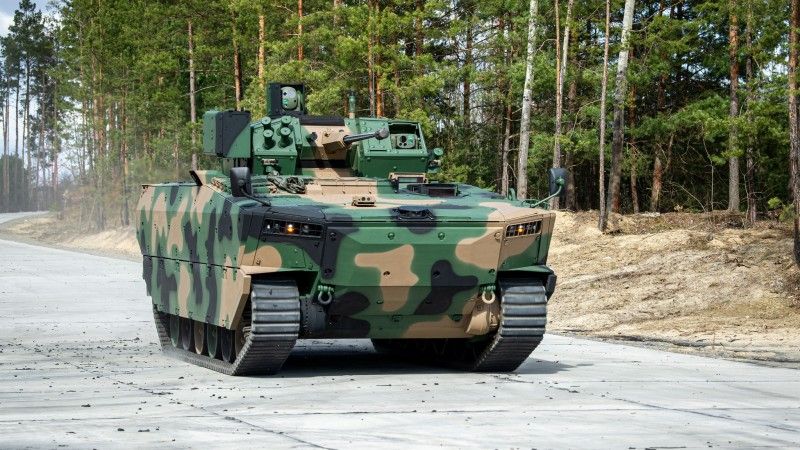
Photo. Polska Grupa Zbrojeniowa/Facebook
At the International Defense Industry Exhibition (MSPO) in Kielce, PONAR Wadowice S.A., a key producer of hydraulic systems for Poland’s defense industry, will once again be present. The company continues to invest in the development of unique competencies in the region, which are expected to deliver tangible results in the coming years.
Sponsored article. The partner of this material is PONAR Wadowice S.A.
At the PONAR Wadowice booth at MSPO in Kielce, a certain paradox will occur. The most important exhibits will not be the ready-to-produce components, but rather those that… will remain at the company’s headquarters, hidden from the wider public. To explain – PONAR’s facilities in Wadowice and Łaziska Górne each host divisions of the company’s Research and Development Center. Today, prototypes of solutions are being developed there that will strengthen PONAR’s position among Europe’s leaders in this specialized field in the coming years.
The Wadowice-based company has accustomed defense sector observers to systematic expansion of competencies and long-term investments. One example is the hydropneumatic suspension for combat vehicles. Already today, PONAR’s Research and Development Center is working on next-generation solutions designed for a much broader range of vehicles than before. For this reason, the exhibits at the PONAR booth at MSPO should be seen not only as a showcase of high-quality components for the defense industry, but above all as a preview of innovations that will be unveiled in the coming years. And there is much to look forward to.
“Dual-use, heavy duty”
But let us not get ahead of ourselves. Before describing the solutions currently under development at the Wadowice and Łaziska Górne plants, let us briefly list what visitors to the company’s booth in Kielce can expect:
- actuators serving as executive elements of the positioning system in a deployable radar station;
- support rotation actuators used in the loading, unloading, lifting, and lowering of a transport container from a truck without the use of a crane;
- a sectional distributor used in a mobile, three-coordinate long-range radar station, controlling actuators for raising and deploying the wings of two antennas: the main one and the Identification Friend or Foe (IFF) system;
- a hydraulic power unit supplying the hydraulic system of a 155 mm self-propelled howitzer;
- a hydraulic balancing mechanism and brake for a 155 mm self-propelled howitzer, counteracting barrel rotation and gun inertia during vertical movement;
- WHP25 and WHP35 hydropneumatic suspension arms designed for tracked armored vehicles with a maximum permissible weight of 25 and 35 tons respectively, with six pairs of road wheels.

According to Dr. Eng. Piotr Rosikowski, Director of Technology and Development at PONAR Wadowice S.A., alongside defense components, products for other industries will also be showcased in Kielce. “This year we want to present solutions we have so far used in extremely demanding environments such as the mining and construction industries. This equipment must meet criteria that are just as demanding as in the defense sector. We are convinced these solutions can also prove effective in military applications,” he states.
Rosikowski aptly describes these civilian-sector solutions with the English term “dual-use, heavy duty.” PONAR Wadowice’s catalog includes proportional sectional distributors used in mobile technology, as well as satellite motors resistant to contamination of the working fluid. In his opinion, products of these classes can be successfully transferred to the defense industry.
The Only Way Forward is Development
A completely new feature at the PONAR Wadowice booth will be a semi-active hydraulic track tensioner for combat vehicles. The device is powered by a unit that supplies hydraulic oil to the actuator. Adjustments to the tensioner are made from a control panel. This innovation will allow crews to adjust track tension while stationary, without leaving the vehicle, adapting to terrain and weather conditions. For soldiers who currently perform this task with traditional tools, this represents a significant improvement in quality of life.
But the company is not stopping there. “The next step we are considering is a fully active device, so that tensioning would be carried out automatically depending on changing conditions and parameters,” says Dr. Eng. Rosikowski. Such a system would adjust settings automatically based on ambient temperature, vehicle speed, and terrain type—whether loose snow, deep mud, forest tracks with ruts, or paved roads. PONAR’s engineers are drawing extensively on experience gained from hydropneumatic suspension module projects.
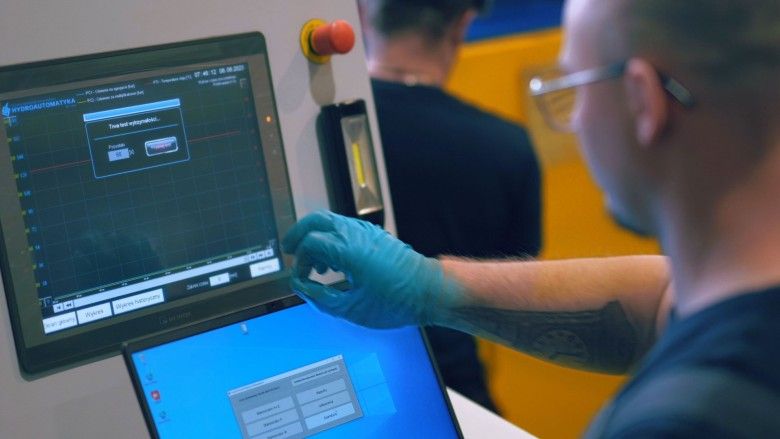
Extreme pressure testing of key components of a Krab SPH suspension module.
Photo. PONAR Wadowice S.A.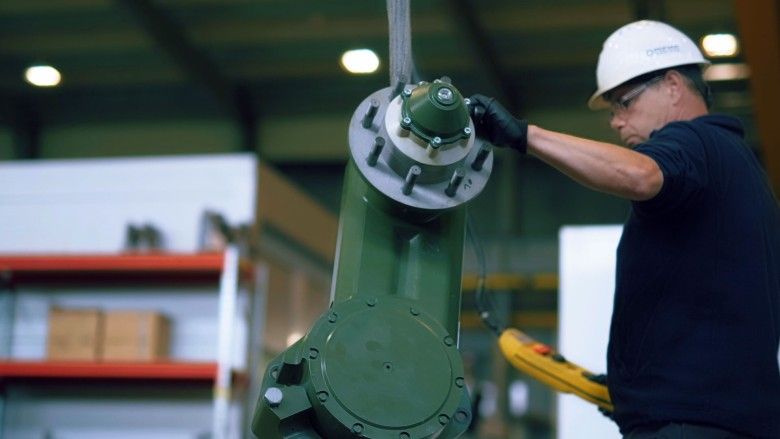
Installing a Krab SPH suspension module on an in-house test bench.
Photo. PONAR Wadowice S.A.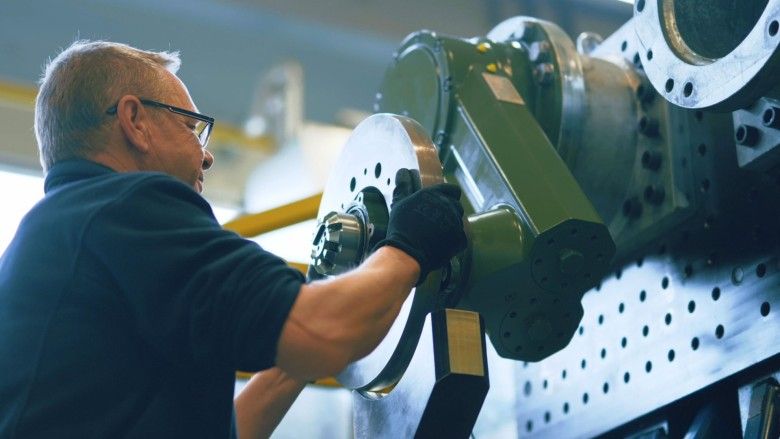
Installing a Krab SPH suspension module on an in-house test bench.
Photo. PONAR Wadowice S.A.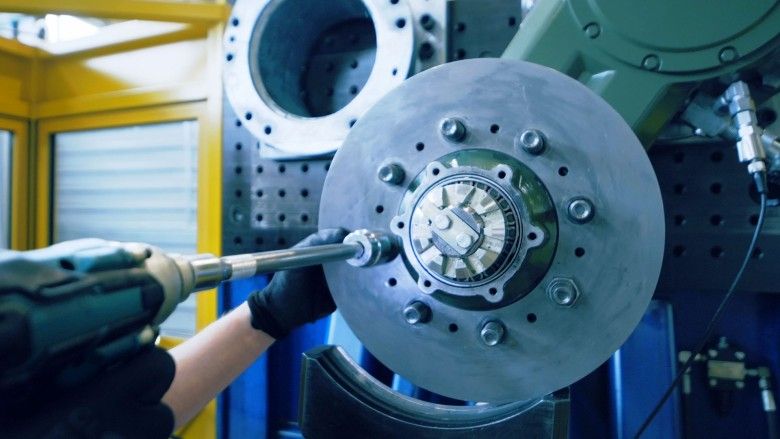
Installing a Krab SPH suspension module on an in-house test bench.
Photo. PONAR Wadowice S.A.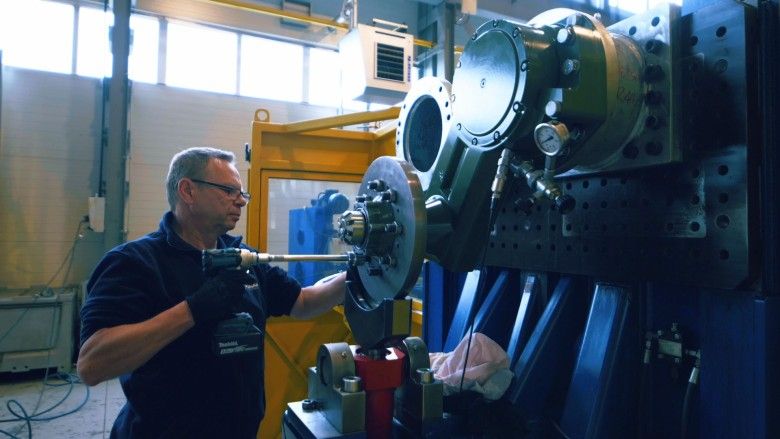
Installing a Krab SPH suspension module on an in-house test bench.
Photo. PONAR Wadowice S.A.
The WHP25 and WHP35 modules themselves are also evolving. “Currently, within our Research and Development Center, we are working on semi-active suspension arms, which the operator will be able to control directly from the vehicle, adjusting settings and pressure in the arm,” says Rosikowski. “This will affect vehicle stiffness, traction, and ground clearance,” he emphasizes. Today, the only vehicles in the Polish Armed Forces with such capability are Korean main battle tanks. In the coming years, PONAR intends to implement a fully Polish solution of this class. But the engineers’ ambitions do not end there.
“Similar to the tensioner, our ultimate goal is to develop Poland’s first fully active hydropneumatic suspension, which will automatically adjust the running gear settings to changing conditions and surfaces,” Rosikowski announces. Today, such solutions are used in luxury passenger cars. Few attempt to adapt them to combat vehicles due to cost, complexity, and technical risk. However, the potential benefits are significant, especially in vehicles where mobility in difficult terrain directly translates into crew safety and battlefield effectiveness.
“We are not afraid of hydraulic and mechanical challenges. We are already working on this concept,” says Rosikowski. The challenges are indeed numerous. The greatest difficulty lies in developing a fast and reliable control system, as well as hydraulically and electronically linking all suspension arms to function as a coordinated, unified system. In passive systems, such as WHP25 or WHP35, suspension modules are separate, closed elements. As Rosikowski summarizes, the development of active suspensions will mark a transition from pure hydraulics and mechanics to hydrotronics.
Given these plans, it will come as no surprise to readers that PONAR’s management is thinking two, sometimes even three steps ahead. As reported last year, the company is already working on hydropneumatic suspension for wheeled vehicles. “This is a completely new product line for us, but the experience we have gained with tracked vehicles is extremely helpful. We are also drawing on our expertise in building hydraulic cylinders and actuators,” Rosikowski emphasizes. He also expresses hope that the first results of research and development will soon be ready for presentation to the public and end users.
Engineers in one room
To achieve this technological leap, PONAR is expanding its competencies in electronics and cooperating with several Polish companies in the field. Structural changes have also been introduced to improve collaboration between specialists from different disciplines. As Rosikowski summarizes: “Recently, we have structurally and physically merged the offices of hydraulic, mechanical, electronic, and automation engineers. The goal is to ensure free information flow, create favorable conditions for brainstorming across engineering disciplines, and avoid siloed work.”
When Defence24.pl visited the Wadowice and Łaziska Górne plants last year to produce a video report, PONAR employed around 550 people. Today, that number exceeds 760. Roughly one-fifth are engineers and designers—a ratio that has remained unchanged for several years. “This is intentional. Thanks to this engineering core, we are able to move forward,” says Rosikowski. Employment growth is unlikely to slow in the coming years, especially as the market becomes increasingly receptive.
PONAR draws on the experience of several generations. Many employees are descendants of those who joined the company decades ago. Recently, the company completed the digitization of all components developed in its 60-year history. Designs once created on drafting paper and annotated by hand are now available in 3D form on tablets or personal computers. Few resources could serve as a better source of inspiration and knowledge for engineers.
The company’s management could, at least for a while, rest on its laurels and focus on current operations. Fortunately, a different philosophy prevails in Wadowice. “If we were to say: ‘now we only produce what we have already developed, current production support is enough, we won’t go further, we’ll cut costs,’ we would probably survive, but we wouldn’t be on an upward trajectory. We are growing by introducing new products,” says Rosikowski. In conclusion, he emphasizes the importance of human capital and organizational structure: “Together we can achieve a great deal by combining competencies and building interdisciplinary engineering teams for specific projects,” he summarizes.
Sponsored article. The partner of this material is PONAR Wadowice S.A.


