- WYWIADY
- WIADOMOŚCI
Is Poland ready to evacuate its population? RCB director: documentation already exists

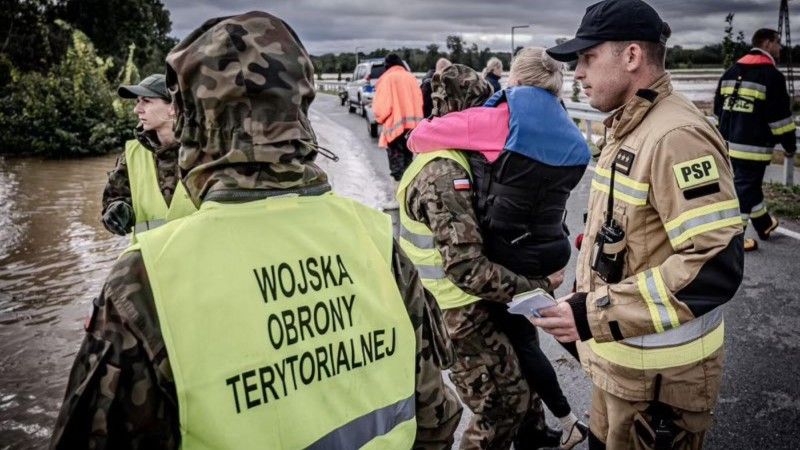
Is Poland ready for a possible evacuation of the population? Zbigniew Muszyński, Director of the Government Centre for Security (RCB), assures that documentation already exists at the voivodeship level and, if necessary, can be acted upon. In a conversation with InfoSecurity24.pl, the head of the RCB explains what stage the work on the National Evacuation Plan is at. He also clarifies why Poland will not replace SMS alerts with a mobile app and reveals what support his institution will soon receive.
Dominik Mikołajczyk: The Act on Civil Protection is now one year old. Did we make good use of that year?
Zbigniew Muszyński, Director of the Government Centre for Security (RCB): I’d start differently. The biggest success is that the Ministry of Interior and Administration has taken on this extremely difficult and important topic, and that this law was enacted. That finally made it possible to regulate many long-neglected issues. But one must understand that implementing such provisions is a process that requires time, as the experience of other countries shows. For example, Sweden and Finland have regulations on shelters dating back to the 1960s, and Switzerland to the 1950s.
We operated under different systemic conditions, and the fact that the Ministry has addressed this now is an extraordinary success. Judging such processes from the perspective of only one year is, in my view, a misunderstanding, because even the amendment to the Act on Crisis Management provides for evaluation only after two years. Summarizing such large projects on an annual cycle is unrealistic and can sometimes even be harmful.
”The Director of the Government Centre for Security shall develop the National Evacuation Plan” — that’s a literal quote from the law. How is the work going?
Of course, fulfilling the statutory requirements, we have taken steps. In cooperation with the General Staff, guidelines for the voivodeship Crisis Management Plans were created. A series of consultations took place and all voivodeships sent us the evacuation plans they had prepared.
The first version is always subject to very critical review. We provided our comments so that those plans would be as credible and close to reality as possible. The voivodeships are making changes. The law provides that these documents are to be agreed with the RCB, and that process is happening now.
And if today we had to use the evacuation plans, what would happen?
If an urgent need arose, the voivodeships would use the plans they have prepared. Each voivodeship has its own specifics—different population size, geographic location, or level of threat—so these plans cannot and are not copies of one another. But as I said, the documentation already exists, so one can act according to it, although such plans must be continually verified and improved.
As for the National Evacuation Plan you asked about, we are approaching the end of the work. However, we assume we cannot prepare a full nationwide plan until all regional plans are agreed. Everything must be compatible.
The security situation is constantly changing; the recent railway sabotages are proof of that. Do we need a redefinition of how we alert the public to threats?
The Act on Civil Protection contains chapters on alerting, and the RCB has clearly defined tasks in this area. The system is designed to be flexible and adapted to every situation, even one that has not yet occurred. We cannot think in terms of a closed catalogue, because that would not work in a new situation. I assure you the tools at our disposal are flexible and allow us to respond in real time.
Let’s go back for a moment to last September and the incidents involving breaches of Polish airspace by Russian drones. Voices appeared saying the RCB Alert was sent too late. The head of the Ministry of Interior said then that those events were an occasion to review procedures. From your perspective, did everything work as it should?
Actions at that time were carried out based on the procedures in force. The matter was the subject of many discussions and analyses. Ultimately, the issue was clarified by the Ministry of Interior spokesperson. The content of the alert warned people not to approach found devices, which aimed to protect citizens« life and health.
Nevertheless, in accordance with the Minister’s announcement, we reviewed procedures and conducted additional training at the county level across the country. The aim was to refresh knowledge of procedure SPO-13 (concerning warning and alerting the military and the civilian population about the threat of air strikes) from the National Crisis Management Plan.
Please remember that staff turnover in public administration is quite substantial, so reminding people how to act in specific situations is very necessary.
The RCB Alert is sent as SMS messages. Some say this is becoming a relic of the past. Perhaps Cell Broadcast technology, which is standard in many countries, should be used instead?
We do not plan to modernize the alert system by switching to Cell Broadcast technology. After consultations with telecom operators and the relevant services, we know this model is less secure and more susceptible to potential hacking. SMS is currently the most secure tool. Although this means of delivering information is sometimes considered outdated and fewer of us use SMS in everyday life, it still works.
Together with operators we are continually accelerating the distribution speed of Alerts, in certain conditions it is comparable to the speed of Cell Broadcast.
Or maybe we should move toward a dedicated application? Ideas have been floated in the past to preinstall such software on all phones sold in Poland.
Such an app could lead to exclusion of elderly people, who statistically use modern phones far less often. We therefore cannot abandon SMS and replace it with a technology that would limit the pool of recipients of our messages.
SMS technology is safe, better tested and reaches the widest possible audience, which is an absolute priority for us. Our goal is effectiveness and speed of reaching the public, regardless of platform.
Let’s talk about RCB’s latest „child.” Together with the Ministry of Interior and the Ministry of National Defence you prepared the Safety Guide. Looking at what you’ve managed to create, do you think we borrowed the right models from other countries, or are we today an example for others?
When preparing this guide, we analyzed many similar publications from around the world. There is no shame in drawing on the best practices. You don’t need to reinvent the wheel.
Our guide, however, is tailored to the needs of Polish society. We wanted a simple and short message. It’s meant to be a guide, not a book that nobody would read.
Do you take into account that—given changing threats—the guide will need updating after some time?
In my opinion, what has been developed will withstand the test of time. The principles in the guide are universal, they will be useful to any of us regardless of the type of crisis. But we do not rule anything out, and the digital version can be updated depending on how the situation evolves.
The Swedes translated their guide into many languages, including Polish. Is there a plan to do the same and create versions, for example, in Lithuanian, Czech or German?
I’ll start by saying that if our foreign partners ask us for an electronic version, of course we provide it. As for translations—the English version already exists and indeed there are plans to translate into other languages, including adapting the guide for people with special needs.
A few years ago, as part of a draft Act on Civil Protection prepared by the previous leadership of the Ministry, there were plans to dissolve the RCB. Today nobody has such designs, but is it time to go a step further? Maybe it’s a good moment to strengthen the role of the RCB even more?
From the perspective of the almost two years I’ve spent at the RCB, I must say I feel clear support from the Ministry of Interior and Administration and the Office of the Prime Minister, which, as I hear from people who have worked here longer, was not such a frequent practice in the past. The Ministry of Interior and Administration supervises us, and that really streamlines the work.
Answering your question: those in power see the need to strengthen the RCB. The problem of understaffing, previously raised in Supreme Audit Office (NIK) reports, has been understood and after the amendment to the Act on Crisis Management we will receive 28 new posts.
Speaking of the amendment to the Act on Crisis Management, when can we expect the legislative process to conclude? Work has been underway for many months, but the draft has not yet been put before the government.
Let’s remember that the amendment is primarily connected to the fact that we must implement the CER Directive (on the resilience of critical entities). That was the trigger for introducing the changes. This directive replaces the directive from 2008.
The whole philosophy, however, is to avoid losing the achievements we have built within the critical infrastructure protection system. We want this directive not to dismantle our entire system. It was easier for smaller states to implement these provisions. We, having a substantial legacy, must be cautious. That is why the agreement process took a long time.
But today we are already at the final stage of the work. We are only waiting for the signature of the Director of the Government Legislation Centre after a legal conference that ended on 23rd December. Then we will send the bill to the Council of Ministers.
Do you hope parliament will take up the bill still this winter?
I cannot of course promise or demand anything, but I believe work will now proceed very quickly. We received confirmation from the Government Legislation Centre that the draft passed through the legal committee. When the government adopts the bill, everything will be in the hands of parliamentarians and the President.
Thank you for the conversation.