












- ANALIZA
- WIADOMOŚCI
The grammar of war: how Putin’s language dissolves responsibility

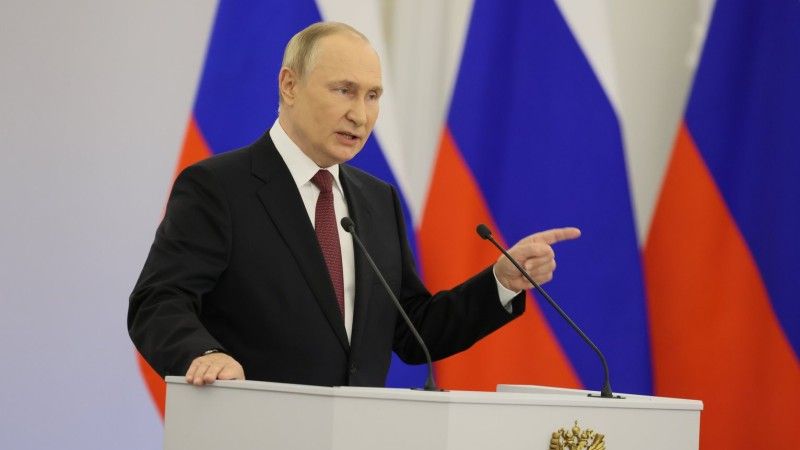
Despite the extreme concentration of power in the hands of Vladimir Putin, responsibility for key political decisions in Russia’s personalised autocracy is systematically blurred, shifted onto circumstances, history, and the collective will. In his rhetoric, war is not presented as a choice, but as an inevitability. This is no accident – it is the result of a deliberate linguistic strategy that obscures agency, diffuses responsibility, and legitimises violence as the outcome of history rather than the decision of a leader.
One of the least visible yet most consequential instruments of political power is grammar – not slogans or emotional rhetoric, but the deeper structure through which responsibility is assigned, displaced, or quietly removed. In the case of Vladimir Putin, this structure has undergone a gradual but highly consistent transformation over the past two decades: political decisions increasingly appear without a clear author. What initially presents itself as the will of a leader is reframed as the inevitability of history, and this is not a stylistic quirk but a stable and reproducible mechanism.
In the early 2000s, Putin’s language was markedly personal – „I believe,” „I will do,” „I am convinced,” – which reflected the political reality of post-1990s Russia, where the state was weakened and society demanded a figure capable of restoring order; the leader needed to be visible as the agent of control. Over time, however, this grammar shifts toward collective formulations – „we must,” „we decided,” „we will defend” – distributing responsibility across institutions, elites, and society, and eventually evolves further into something qualitatively different: „we were forced;” „circumstances required,” „it became necessary,” formulations in which the subject begins to dissolve entirely, leaving behind not a decision but an outcome that appears to have emerged on its own.
This shift reveals a deeper structural divide between two political grammars. In democratic systems, even when rhetoric is strategic or persuasive, the sequence remains broadly intact: an identifiable agent makes a decision, and action follows, which allows responsibility to remain traceable even when it is shared. In more centralised systems, the sequence is inverted: circumstances produce necessity, and necessity produces action, while the decision itself disappears as a discrete moment of choice. A key linguistic tool enabling this inversion is the systematic use of impersonal constructions, especially in Russian, where forms likeprishlos („it had to be done”) remove the subject altogether; the action is no longer framed as something someone chose to do, but as something that could not have been avoided. This is where language stops merely describing political reality and begins restructuring it, because once a decision is perceived as inevitable, the question of responsibility becomes secondary or even irrelevant.
See also 

The role of history in this system is not supplementary but foundational. In Putin’s speeches, history does not function as context, reference, or even justification in the conventional sense; it operates as an active force that drives the preset. His address of 21 February 2022, prior to the invasion of Ukraine, moves across centuries, invoking „historical Russia,” the collapse of the Soviet Union, and the decisions of Lenin and Stalin, constructing a narrative in which contemporary events are framed not as policy choices but as the continuation of an unfinished historical process. Within this framework, war is not presented as a political act but as a form of historical correction, which effectively relocates agency from the present to the past. History, in this sense, becomes a political subject, and once that shift occurs, the leader no longer appears as the origin of action but as its interpreter or executor.
See also

This becomes even clearer when placed alongside other leaders. In the rhetoric of George W. Bush, the language is institutional and explicit – „I have ordered,” „the United States will act” – making the link between authority and decision visible and legally legible. Donald Trump intensifies this pattern into hyper-personalisation, where the leader himself becomes the primary source of action – „I built,” „I warned,” „we will annihilate” – collapsing institutional distance into personal assertion. Barack Obama introduces a different configuration, where „we” functions as a moral community rather than a purely political one, and action is framed as a choice aligned with values – „because of who we are” – so that responsibility is shared but not dissolved. Even in the transitional rhetoric of Boris Yeltsin, despite institutional instability, there remains a visible connection between decision and decision-maker. In Putin’s case, however, agency is progressively impersonal, producing a system in which decisions are made by a narrow circle yet described as the outcome of forces beyond individual control.
The consequences of this shift are not abstract. When actions are framed as defensive rather than initiatory, necessary than chosen, and historically predetermined rather than politically decided, they become significantly easier to accept, both cognitively and morally. This reduces internal conflict within society, lowers resistance, and reframes participation not as involvement in a political project but as alignment with an unavoidable process. In this sense, language functions as a mechanism of moral calibration: it does not simply justify actions after the fact, but prepares the ground on which those actions will be perceived.

An additional complication lies in translation, where the core of this mechanism is often softened or lost. English versions of Russian speeches tend to introduce explicit subjects – „I” or „we” – where the original relies on impersonal constructions, unintentionally restoring agency that the source text had removed. This creates a distorted perception for international audiences, who encounter a more conventional structure of responsibility than actually exists in the original discourse. The result is not just a linguistic mismatch, but an analytical blind spot: the disappearance of the subject – and with it, the diffusion or responsibility – becomes less visible precisely where it matters most.
What emerges from this analysis is not simply a difference in rhetorical style, but a distinct method of legitimising power and violence. In Putin’s political language, decisions gradually lose their identifiable author and are absorbed into narratives of history, necessity, and collective destiny. This does not eliminate responsibility, but it relocates it into abstract domains where it becomes difficult to assign, challenge, or even fully perceive. The effect is cumulative: over time, the boundary between decision and inevitability erodes, and with it the expectation that decisions must have accountable authors.
At a broader level, this goes beyond any single country or leader. In Putin’s case, political language systematically transforms decisions into necessities, obscuring who made them and creating the impression of inevitability. This is a deliberate manipulation of narratives that legitimises the leader’s criminal choices, the populace that justifies them, and the atrocities carried out by the military on the sovereign soil of Ukraine. The crucial shift is not in what is done, but in how it is framed: actions no longer appear as choices, but as unavoidable outcomes. War is not declared – it emerges; responsibility is not denied – it dissipates. Understanding the grammar of power matters precisely because it does not change the facts of political action, but changes how those facts are perceived, rationalised, and ultimately remembered. When war is framed as historical or moral inevitability, accountability becomes optional, and violence appears not as crime, but as duty.

Comparative grammar of power
Parameter | Putin | Bush | Trump | Obama | Yeltsin |
Main subject | "we", "Russia", "history", impersonal forms | "I" + the United States | Predominantly "I" | "we" (citizens + institutions) | "I" + "we" |
Grammar of action | Impersonal/passive: "it became necessary", "we were forced" | Active: "I have ordered" | Hyper-active: "I decided" | Collective: "we must" | mixed |
Responsibility | Diffused through circumstances and history | Explicit presidential responsibility | Highly personalised | shared | Personal-political |
Role of history | Central, acts as driver | minimal | background | Moral reference | limited |
Role of people | Collective destiny | Object of protection | Support base | Democratic subject | Source of legitimacy |
Tone | Civilisational, historical | Legal-moral | Personal, assertive | Rational-moral | transitional |


