












- WIADOMOŚCI
Warsaw to host ESA's New Security Centre

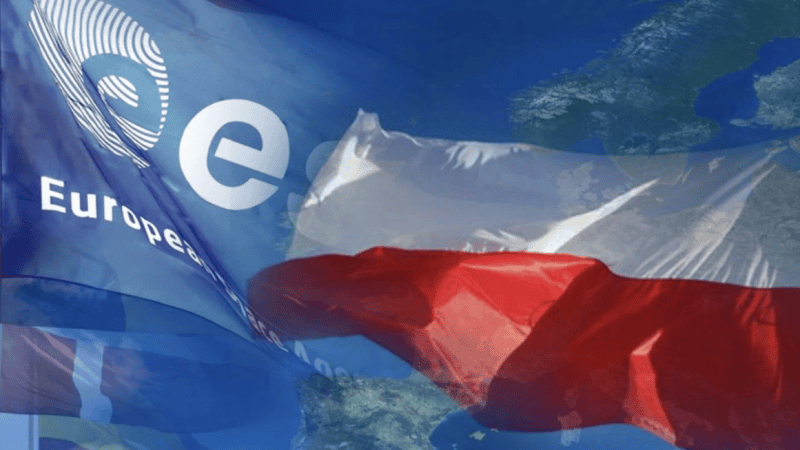
Photo. ESA
The decision to locate the new establishment in the Polish capital will significantly expand ESA’s presence in both the security domain and on Europe’s Eastern Flank.
The announcement was made in Warsaw on 13 July by ESA Director General Josef Aschbacher, alongside Polish Prime Minister Donald Tusk and Minister of Finance and Economy Andrzej Domański. It followed months of deliberations by a joint Polish ESA team, which assessed several potential locations. The process began at the November 2025 ESA Ministerial Council in Bremen, where Poland and ESA signed a letter of intent to establish a new centre focused on security.
Both sides had clear, converging interests. Poland sought to increase its contribution to ESA, particularly in security and resilience, while the Agency aimed to take advantage of Europe’s defence push to strengthen its role in continental security. Warsaw ultimately committed a record €731 million for the 2026–2028 cycle, nearly four times its previous contribution. This included over €100 million for European Resilience from Space, a new ESA initiative designed to mobilise and unite member states« dual use space capabilities.
The new Warsaw centre will mark another step in ESA’s ambition to play a greater role in European security. Its work will likely cover space security, dual use technologies, satellite communications, data and crisis management, space activity monitoring, and the operational use of satellite services. It will complement and expand ESA’s existing safety and security activities, particularly those conducted by the European Space Security and Education Centre in Belgium, established in 1968.

Locating the centre in Poland will have not only technological and operational consequences for the region, but also broader political, economic, and geopolitical significance. Although Central and Eastern Europe’s space industry has begun catching up with the continent’s established Western players, particularly since the rise of NewSpace, this shift has yet to be matched institutionally, where Western Europe still dominates.
All existing ESA establishments and facilities are located in the Agency’s founding countries, including France, the Netherlands, Belgium, Germany, the United Kingdom, Spain, and Italy. The Warsaw centre will therefore be the first established in a country that joined ESA after its creation, Poland became a member in 2012, and the first in Central and Eastern Europe. Its location will help rebalance the Agency’s geographical footprint, strengthen Poland’s and the eastern flank’s influence over its direction, and support the growth of a regional space ecosystem around a major new hub.
Strategically, this also sends an important signal to Russia, showing that European institutions are becoming increasingly anchored on the Eastern Flank, particularly those focused on security and defence. In this sense, the new centre will allow Poland, and by extension the wider region, to strengthen its security in and from space while pushing these objectives higher on ESA’s agenda.


