












- ANALIZA
- WIADOMOŚCI
15 years after the attack in Norway. The danger is still looming

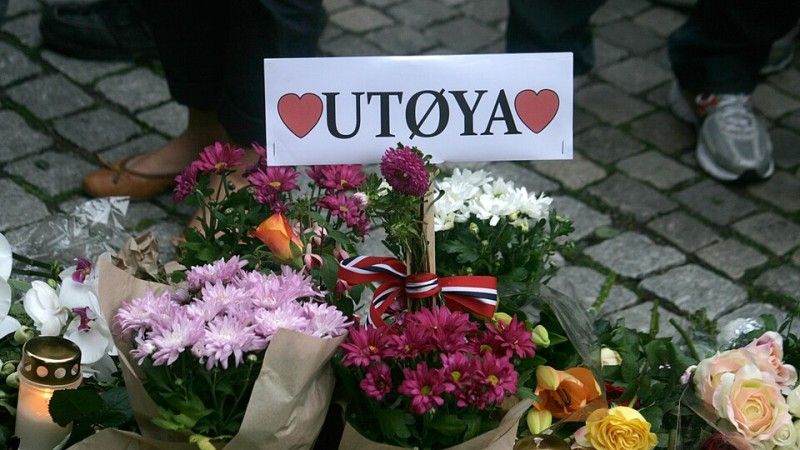
Photo. Rødt nytt / Wikimedia Commons
On July 22, 2026, Norway paused to honour the memory of the 77 victims of the right-wing extremist Anders Breivik. But beneath the surface of mourning and national solidarity lies a disturbing report from the Norwegian Police Security Service, which reads like a warning: the threat from right-wing extremism is greater today than in 2011, and Breivik continues to inspire radicals, especially among minors.
When Anders Behring Breivik detonated a bomb in Oslo’s government district on July 22, 2011, and then travelled to Utøya Island, where he shot dead 69 participants in the Labour Party’s youth camp, Norway experienced a shock that forever changed its sense of security. Seventy-seven victims, hundreds wounded, and an entire nation in mourning – this was the most tragic event in the country’s postwar history. For fifteen years, Norway has tried to heal its wounds, build resilience, and remember. However, in 2026, on the 15th anniversary of the attacks, a question arises that gives no peace: is Norway at risk of a repeat of history?
The answer formulated by Norwegian security services is alarming. On the eve of the anniversary, the Norwegian Police Security Service released a report stating that the threat from right-wing extremism is today greater than in 2011. Moreover, Breivik remains a source of inspiration for radicalising far-right extremists, especially among minors and young adults active on the internet. Prime Minister Jonas Gahr Støre, who was Minister of Foreign Affairs in 2011, during a ceremony on Utøya Island, warned of the growing threat of radicalisation among young people, pointing out that social media, artificial intelligence, and social isolation fuel extremism. Fifteen years after the attacks, the question of whether Norway is at risk of a repeat is no longer a rhetorical question but a real challenge facing this Scandinavian country.

Norwegian Police Security Service warns. Threat greater than in 2011
Just before the 15th anniversary of the attacks, the Norwegian Police Security Service published a report that shook public opinion. PST stated directly that the threat from right-wing extremists is today greater than in 2011. This is a terrifying statement, considering that it was in 2011 that Breivik killed 77 people. The services indicate that they are recording an increase in the number of people “inspired” by Breivik’s attacks. Moreover, Breivik’s actions and ideas contribute to the growth of radicalisation, especially among minors.
The PST report also reveals that since 2019, perpetrators of carried out or foiled terrorist attacks in the West have more often than before indicated Breivik as an inspiration. This means that Breivik’s legacy is not a closed chapter of history, but a living ideological source for a new generation of extremists. Prime Minister Støre, referring to these findings, emphasised that the wounds from the attacks are still deep, and Norwegian society did not appreciate how much they cost people and the community over these 15 years.
PST also draws attention to the changing profile of individuals susceptible to radicalisation. Increasingly, these are young people whose fascination with violence and mass destruction is as important as the ideology itself. Their radicalisation process is often more fragmented and based on personal weaknesses, such as isolation, loneliness, or substance abuse, making it more difficult to predict and counteract. This is a new challenge for Norwegian services, which must deal with a threat that no longer fits into old patterns.

New radicals. Minors in the web of extremism
One of the most disturbing conclusions from the PST report is the growing participation of minors in radicalisation processes. In July 2025, Norwegian police foiled a terrorist plot involving minors. A group of teenagers was planning an attack, and their preparations were advanced. This event highlighted that the threat no longer comes only from radicalised adults, but also from their own children, who are growing up in the digital age.
Prime Minister Støre warned that social media and artificial intelligence algorithms intensify polarisation and facilitate the production and dissemination of disinformation. Young people, who are particularly susceptible to influence, can easily fall into closed online groups where extremist content is presented in an accessible and engaging form. Breivik’s use of the internet to spread his manifesto before the attack was a precursor to this phenomenon, but today the scale and reach of such activities are incomparably greater.
Norway, like other Scandinavian countries, faces the challenge of protecting the younger generation from radicalisation without violating fundamental freedoms. PST, in addition to operational activities, emphasises prevention and cooperation with parents, schools, and youth organisations. According to reports, PST is currently monitoring about three thousand people whose radical views cause concern. This shows the scale of the problem Norwegian services are dealing with.

Society in the shadow of trauma. Memory and politics in the face of violence
The 15th anniversary of the attacks was a day of particular reflection for Norway. The ceremonies began in Oslo, where a new national monument to the victims was unveiled, and then moved to Utøya Island, where the names of all 77 victims were read out. The ceremonies were attended by King Harald V, Queen Sonja, Prime Minister Støre, survivors, and families of the victims. For many Norwegians, this day is still one of the most difficult of the year.
Prime Minister Støre, who was Minister of Foreign Affairs at the time of the attacks, in his speech emphasised that time does not heal all wounds. He drew attention to the continued political engagement of survivors who today hold important state positions as evidence that the determination to shape the future in a peaceful way prevailed over death and violence. At the same time, however, his words about the growing threat of radicalisation among young people showed that Norway cannot afford to forget or to delude itself that the threat has passed.
A dilemma faced by Norwegian society is the question of memory of the perpetrator. Many leaders, victims, and parents of the murdered still cannot bring themselves to utter his name. Prime Minister Støre, although he spoke about the extremist, deliberately avoided using the name Breivik. This is a conscious decision aimed at not glorifying the perpetrator and not giving him space in public debate. It shows, however, how deep the trauma is and how difficult it is to reconcile the need to remember the victims with the necessity to understand the sources of extremism.

Is Norway prepared for the future? Total defence and new challenges
In the face of growing threats, both from right-wing extremism and geopolitical tensions, Norway has declared 2026 the year of “total defence”. The government is mobilising local authorities to update crisis plans and prepare for emergencies, including a potential conflict. In May 2026, parliament adopted a Long-Term Defence Plan for 2025-2036, aimed at strengthening the country’s defence capabilities. In the face of the war in Ukraine and Russia’s growing activity in the north, Norway treats security as a priority.
The terrorist threat has a different character than conventional military threats. As PST indicates, Breivik still inspires new generations of extremists, and his attacks are a motivation for actions in the right-wing extremist environment. This means that even the best-prepared army cannot prevent an attack by a lone perpetrator acting in secret. Therefore, preventive, educational, and network monitoring activities aimed at early detection and stopping radicalisation processes are so important.
Norway, which for years was perceived as an oasis of peace and security, must now confront a reality in which the terrorist threat is real and can come from various sources. Fifteen years after Breivik’s attacks, the country is still learning how to live with trauma and how to protect its society from new forms of extremism. The question of whether Norway is at risk of a repeat of history has no simple answer. One thing is certain – Norwegian services and society are more aware of the threat than in 2011, but the threat has also become more complex and more difficult to predict.


