












- WIADOMOŚCI
Spy plane over Poland

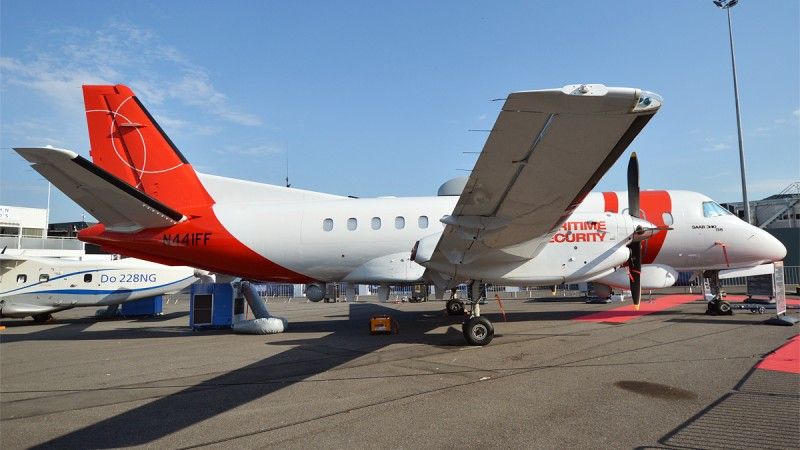
On Wednesday, 30 September, a spy plane belonging to a private company registered in Luxembourg operated in Polish airspace. It was a Saab 340B+ ISR. The aircraft took off from the base in Malbork and conducted a reconnaissance mission along the border with the Russian exclave, the Kaliningrad Oblast (known in Poland as the Królewiec Region).
Saab 340B+ ISR over Poland
On Wednesday, 30 September, a Saab 340B+ ISR spy plane operated over Poland. It took off from Malbork, conducting a reconnaissance mission along the borders of the Kaliningrad Oblast. During the mission, it flew at a safe distance from the Russian borders several times, also entering Lithuanian airspace and flying over the Baltic Sea. The presence of the aircraft was reported by Polish Military Radar at 10:15.
The Saab 340B+ ISR is a light reconnaissance aircraft designed for conducting imagery and electronic intelligence, monitoring troop movements, radars, and communications, patrolling borders, and gathering intelligence at a safe distance from the borders of the monitored territory.
Why is the flight operated by a private company?
Interestingly enough, the aircraft formally belongs neither to the NATO fleet nor to the Armed Forces of any member state. The flight is operated by CAE Aviation, a private company registered in Luxembourg.
The company in question performs surveillance flights for NATO countries, the European Union, EUFOR, or directly for the ministries of NATO and EU member states. However, surveillance flights are not CAE Aviation’s sole activity – the company also performs maritime surveillance flights (in the context of combating piracy, smuggling, or illegal fishing) and geophysical and exploration flights (e.g., surveys for the extractive industry and raw material exploration companies).
Other flights may include forest observation during wildfires or fire hazards, as well as supporting border control in the context of tackling illegal immigration or smuggling.

The reason NATO uses the support of private operators is straightforward – it is a matter of logistics (and to a lesser extent, though still relevant, cost). Regarding costs, the case is quite clear – the light Saab is much cheaper than NATO’s highly specialised equipment, which is not required for routine, low-priority missions. NATO therefore does not have to expend its own resources (which may be needed elsewhere) and does not need to augment its fleet with this type of aircraft, which would also represent an unnecessary expense.
Nevertheless, private operators do not replace NATO’s reconnaissance capabilities but merely supplement the fleet. Alongside its cooperation with private companies, NATO is expanding its capabilities with effective ISR platforms, an example of which is the announced purchase of the MQ-4C Triton – one of the most advanced surveillance unmanned aerial vehicles in the world, currently in service with the USA and Australia. A single unit can cost up to 240 million dollars, but its effectiveness and flexibility will more than compensate for the expense, ensuring a swift return on investment.


