












- WIADOMOŚCI
- KOMENTARZ
Brussels bets on the NASAMS anti-aircraft system. A joint contract worth billions

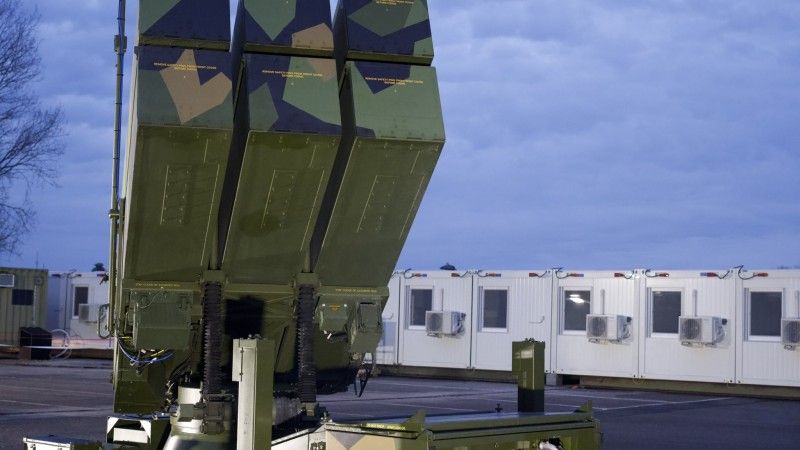
Kongsberg has signed a contract to supply NASAMS air defence systems to the Belgian armed forces. The agreement was signed with the Dutch Ministry of Defence, as both countries are carrying out the procurement jointly. The deal is valued at 10 billion Norwegian kroner (approx. €860 million). What exactly is Belgium buying, and why is this a significant, yet only partial, component of its air defence programme?
Kongsberg’s announcement did not disclose the exact number of systems ordered for Belgium. However, it is known that Brussels planned to purchase ten NASAMS systems (including one for Luxembourg), as well as 20 Skyranger systems, GroundMaster 200 radars, and command vehicles for a total of €3.1 billion.
Meanwhile, in 2024, the Netherlands ordered six NASAMS systems and four lighter NOMADS systems for 12 billion Norwegian kroner (equipped with AIM-9X or IRIS-T SLS missiles with a ground-launch range of over a dozen kilometres, intended for the protection of mobile land forces). Almost simultaneously with Belgium’s NASAMS purchase, the Netherlands ordered additional NASAMS and NOMADS components for 1.5 billion kroner.
Which missiles will be used by Belgian NASAMS?
The Belgian agreement with the Norwegian group does not include missiles, as the NASAMS system primarily utilises American-made ammunition: AIM-120 AMRAAM (estimated ground-launch range of over 25 km), AIM-9X Sidewinder, and the new AMRAAM-ER with a range of up to 50 km. The system can also use German IRIS-T SLS missiles, although this is not a widely adopted solution.
Belgium – like the Netherlands – is acquiring the missiles through the American Foreign Military Sales (FMS) procedure. Documents published by the US Defence Security Cooperation Agency (DSCA) “Transmittal” notifications show that the scale of the orders is extensive.
According to government documentation, Belgium gradually expanded its requests:
- November 2022 (Transmittal 22-63): Approval for the purchase of 120 AIM-120C-8 AMRAAM missiles and 10 guidance sections (value: approx. $380 million).
- March 2025 (Transmittal 25-0D): Expansion of the request to include 159 missiles in the newer AIM-120D-3 variant, 1 guidance section, and 1 test system (increasing the value by $509 million).
- October 2025 (Transmittal 25-1I): Another massive increase in the limit by up to 997 AIM-120D-3 missiles and up to 119 D-3 guidance sections (value increase of $3.131 billion).

Photo. Magnus Bjørnnes / KONGSBERG
The total estimated value of the Belgian FMS case for AMRAAM missiles has thus risen to $4.02 billion (of which the MDE – Major Defence Equipment – components alone account for $3.69 billion). The packages include a total of up to 1,276 AMRAAM family missiles (in C-8 and D-3 versions). It should be assumed that these will be used both in ground-based NASAMS launchers and to arm the Belgian fleet of F-16 fighters and the new F-35s. Belgian media have suggested that instead of some D-3 missiles, ground-launched AMRAAM-ER missiles might be delivered.
Belgium is also part of an agreement signed during the NATO summit in Ankara regarding the development of AMRAAM production capabilities in Europe. In September 2025, the purchase of over 550 AIM-9X Sidewinder Block II and Block II+ missiles for Belgium was also approved for $568 million; these can also be used in the NASAMS system. Belgian FMS purchases include the acquisition of a comprehensive spare parts package. It should be noted that the maximum amounts allocated for the potential purchase of AMRAAM and Sidewinder missiles (for both NASAMS and the F-35 fighter fleet, planned at 45 aircraft) represent a multiple of the contract signed by the Netherlands on behalf of Belgium for the delivery of the ground-based systems themselves.
Command Architecture and NATO Integration
The command and control architecture for both the Belgian and Dutch NASAMS systems will be quite extensive and will include Dutch-made Thales GroundMaster 200 radars. Meanwhile, the Norwegian Kongsberg has also been awarded a contract to supply RS4 weapon modules in the CUAS (Counter-Unmanned Aerial System) version for JLTV vehicles, which were ordered by the Netherlands and manufactured by the American company Oshkosh. It is worth noting that variants of the RS4 system are used in Poland – on Abrams SEPv3 tanks and Kleszcz reconnaissance vehicles.

Photo. Oshkosh/Kongsberg
The joint purchase of the NASAMS system by Belgium and the Netherlands is an example of the restoration of air defence in European nations. The Netherlands currently possesses only two NASAMS fire units (but will have the equivalent of at least six, with an expanded architecture). Belgium, on the other hand, has had no systems of this class at all since the withdrawal of Hawk systems over two decades ago without a direct successor. Until now, Belgian ground-based air defence has relied on very short-range systems: French Mistrals and, more recently, Polish Pioruns.
The NASAMS system is becoming an increasingly popular solution within NATO. It is currently used by the USA (to defend Washington, D.C.), Norway, Finland, Lithuania, the Netherlands, Spain, and Hungary. It was also purchased at the end of last year for half a billion euros by Denmark, which is concurrently introducing the German IRIS-T SLM and French VL MICA. Belgium’s joining further expands its user base in Europe. The modified command system used in NASAMS is also intended for use in the Ukrainian-European Freja air defence system project, with the capability to intercept ballistic missiles. Paradoxically, this programme could become the basis for further increasing NASAMS capabilities. Ukraine has been using standard NASAMS systems to defend its territory since 2022.


