












- WIADOMOŚCI
- ANALIZA
The Russian Army will grow even larger [ANALYSIS]

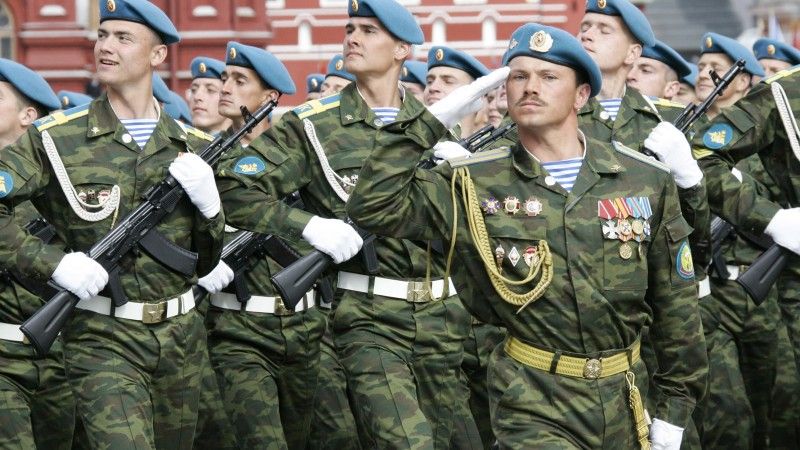
Photo. Russian soldiers.
On the occasion of Russia Day, celebrated every year on 12th June, President Vladimir Putin increased the authorized number of servicemen serving within the structures of the Ministry of Defence. So far, the names of 1,247 fallen naval infantry soldiers are known, including 214 officers. In reality, the number killed is probably twice as high.
From this text you will learn, among other things:
- how many servicemen Russia currently has on its authorized establishment;
- how many soldiers are performing conscript service;
- how many soldiers are fighting against Ukraine.
The war against Ukraine is inflicting enormous losses on both countries. By launching it and committing aggression against Ukraine, Russia is losing not only economically and politically, but above all demographically. It appears that the larger the Russian army becomes, the greater these losses will be.
This did not prevent the Kremlin, however, from increasing the number of authorized military posts by another 7,360. Since 12th June 2026, the ceiling has stood at 2,399,130 authorized positions, including 1,510,000 for military personnel and 889,130 for civilian employees of the armed forces.
For comparison, it could be brought up that in recent years the number of authorized positions has grown at the following pace:
- from 8th July 2016: total authorized strength of 1,885,371 positions, including 1,000,000 for military personnel and 885,371 for civilian employees of the armed forces;
- from 1st January 2017: total authorized strength of 1,897,694 positions, including 1,013,628 for military personnel and 884,066 for civilian employees of the armed forces;
- from 1st July 2017: total authorized strength of 1,903,051 positions, including 1,013,628 for military personnel and 889,423 for civilian employees of the armed forces;
- from 1st January 2018: total authorized strength of 1,902,758 positions, including 1,013,628 for military personnel and 889,130 for civilian employees of the armed forces;
- from 1st January 2023: total authorized strength of 2,039,758 positions, including 1,150,628 for military personnel and 889,130 for civilian employees of the armed forces;
- from 1st December 2023: total authorized strength of 2,209,130 positions, including 1,320,000 for military personnel and 889,130 for civilian employees of the armed forces;
- from 1st December 2024: total authorized strength of 2,389,130 positions, including 1,500,000 for military personnel and 889,130 for civilian employees of the armed forces;
- from 4th March 2026: total authorized strength of 2,391,770 positions, including 1,502,640 for military personnel and 889,130 for civilian employees of the armed forces.
All of the above ceilings concern only military personnel within Russia’s Ministry of Defence. They do not include servicemen of the military formations of Rosgvardia, the Federal Security Service, the Federal Protective Service, the Ministry of Civil Defence, Emergencies and Disaster Relief, or the Main Directorate for Special Programmes.
The number of authorized posts and the registered strength of the armed forces are, in most armies around the world, two different figures. In practice, registered strength is always lower than authorized strength. In Russia, since 2022, the decline in the registered number of servicemen has been caused by enormous irrecoverable losses in the war against Ukraine. Several hundred thousand Russian soldiers have already been killed in this war or wounded to such an extent that they could not return to military service.
These losses are being offset by a very active campaign encouraging people to take up contract military service. The incentives are mainly financial. For signing a contract, a Russian citizen receives 400,000 rubles from the federal authorities and from 400,000 rubles upward from local authorities. In Russia’s wealthiest regions, such as Moscow or St. Petersburg, this amount may exceed one million rubles. The monthly pay of a private soldier sent to the war in Ukraine starts at 220,000 rubles, depending on specialty and rank. An additional bonus system is applied for the performance of combat tasks. The average monthly wage in Russia does not exceed 80,000 rubles. However, one must remember Russia’s enormous disparities. In Moscow, average earnings exceed 150,000 rubles per month. This wartime pay mainly attracts people with relatively low levels of education and, for the most part, those living in the provinces.
In 2025, 422,704 soldiers signed contracts in Russia. More than 30,000 volunteers can be added to this figure. Unfortunately, it is not known how many of them came into the army from civilian life, and how many were already in the military and signed another contract for a further term.
Returning to the upper posts number limit, it seems that its increased level stems from continuous organizational change in the Russian Army. However, the actual number of soldiers remains one of the state’s most guarder secrets.
But even if one were hypothetically to assume that it is approaching the aforementioned one and a half million, then, according to President Putin, 700,000 of them are fighting in the war in Ukraine.
Another approximately 260,000 soldiers are performing compulsory military service. Russian conscripts currently have a guarantee that they will not be sent to the war against Ukraine unless they transfer to contract service. However, a conscript may switch to a contract as early as the first day of service. Previously, he first had to complete 12 months of conscript service before becoming a contract soldier. Conscripts serve in military units mainly on Russian territory. There they train under the supervision of professional soldiers and, after completing their service, enter the reserve. This allows the Kremlin to maintain a relatively large pool of trained reservists who can always be mobilized.
The remaining professional and contract soldiers, numbering up to half a million, serve in units on Russian territory. It should be remembered that, in giving the figure of 700,000 soldiers, President Putin did not include the Navy, the Strategic Missile Forces, the Space Forces, a large part of the Aerospace Forces and Air Defence Forces, the entire extensive military education system, or the central institutions of the Ministry of Defence, research and development units, and military administration.
Recently, on the occasion of Women’s Day 2026, which is celebrated with considerable fanfare in Russia, the Russian authorities stated that 37,000 women are currently serving in the Russian army as military personnel, while 263,000 women are employed as civilian employees of the armed forces.


