












- WAŻNE
- W CENTRUM UWAGI
- WIADOMOŚCI
Frigate hunts drones. The French are learning from Ukraine

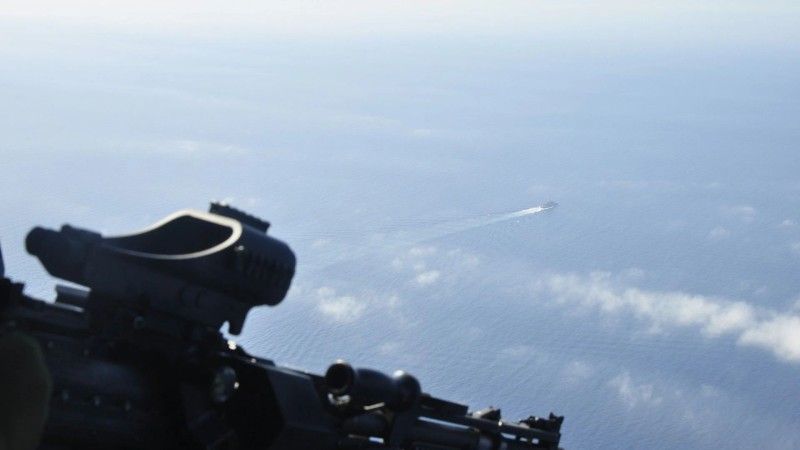
Photo. M. Marszałkowski/Defence24
During exercise Neptune Strike 26-2, the French frigate FS Alsace, part of the French carrier strike group (CSG), practiced procedures related to countering unmanned aerial vehicles. How are the French dealing with drone neutralization?
The editorial team of Defence24.pl once again, as the only media outlet from Poland, took part in the prestigious NATO exercise codenamed Neptune Strike. In the latest iteration of the exercise, the leading role was played by the French Navy, whose carrier strike group is currently deployed in the Mediterranean Sea. During the organized visit, the author had the pleasure of visiting one of the newest French FREMM-class frigates, which forms part of the escort of France’s only aircraft carrier, Charles de Gaulle.

Photo. Mariusz Marszałkowski
Alsace is a multipurpose frigate, but her design and equipment predispose her to the role of engaging air targets as part of AAW — Anti-Air Warfare missions. She also performs this role within the French CSG, although she is also capable of engaging surface targets as well as detecting and destroying underwater targets.

Photo. Mariusz Marszałkowski
In the exercise scenario observed by the author, Alsace served as the ship assigned to counter-drone tasks. The mission was carried out in cooperation with the Hellenic Air Force, which deployed Heron-1 unmanned aerial vehicles acquired from Israel under a leasing arrangement in 2022. Greek Herons are used in the maritime patrol role and, in late April, simulated an attack on the French carrier strike group.
Jak francuska marynarka wojenna zwalcza drony?
— Mariusz Marszałkowski (@MJMarszalkowski) May 4, 2026
Byłem z bliska świadkiem jak wygląda ćwiczenie tego zadania z pokładu 🇫🇷fregaty typu FREMM, będącej częścią grupy uderzeniowej lotniskowca Charles de Gaule. Niebawem więcej na łamaach @Defence24pl.
Tymczasem 🎥⬇️ pic.twitter.com/YHM4Ty4G2X
Time is of the essence
Alsace is heavily armed. Her primary armament consists of Aster 30 and Aster 15 missiles, launched from vertical launch systems located in the bow section of the ship. The first missile type has a range of up to 120 km and is intended to engage the most advanced targets; the second has a range of up to 30 km. The ship also carries gun armament: a 76 mm OTO Melara gun and three 20 mm Narwhal remotely operated guns, which serve as the last line of defense. 12.7 mm machine guns are also mounted on the ship’s sides.

Photo. Mariusz Marszałkowski
Despite her young age, the ship is one of the most combat-experienced vessels in the French Navy. During missions in the Red Sea in 2024–2025, the ship successfully repelled several attacks by both unmanned aerial vehicles and ballistic missiles launched by Yemeni Houthi militants. Ballistic missile interceptions were carried out using Aster 30 missiles, while UAVs were engaged with Aster 15 missiles and naval artillery. French Minister of the Armed Forces Sébastien Lecornu reported one case of a successful drone shootdown using the 76 mm gun.
📍Red Sea | Interception by a 🇫🇷 frigate of an aerial drone coming from Yemen, threatening maritime traffic.
— The 🇫🇷 Joint Staff - Military operations (@FrenchForces) April 18, 2025
➡️ Constant vigilance to ensure freedom of navigation and maritime security from Suez to Hormuz. pic.twitter.com/ARGCV6X3JL
In the counter-UAS scenario practiced, it was assumed that SAMs would not be used, and that the main burden of the task would fall on the shipborne NH-90 helicopter, which was to become the ship’s first line of defense against drones.
The threat was detected by onboard radar systems and by external sources, namely an E-2C Hawkeye aircraft operating from the aircraft carrier Charles de Gaulle, which provides information on the air situation.

Photo. M. Marszałkowski/Defence24
After an approaching object is detected — one that does not establish communications and has not previously filed a flight plan — an alarm is sounded and the helicopter is launched, with the task of intercepting the target. At the moment the object is detected by radar systems, it is not yet known what exactly is being dealt with. This is the most difficult and, at the same time, the most important moment of the operation. Rapid identification of a potential threat provides time to react. The later it happens, the greater the risk to the ship and to the entire group. This is especially important in peacetime and during crises, when there is no continuous combat posture and a threat may even emerge from civilian maritime vessels.

Photo. Mariusz Marszałkowski
The commanding officer of FS Alsace, Commander Matthieu Canonne, told the author that countering unmanned aerial vehicles is a major challenge for modern warships. This is not because the targets are difficult to neutralize, but because detection and identification constitute a major problem. This is precisely where dispatching helicopters comes in, as they are intended to be the most cost-effective means of countering drones.

Photo. Mariusz Marszałkowski
As the helicopter flies toward the target, it operates at high altitude, well above the flight path of the aerial target. After reaching the intercept area, the helicopter begins tracking the object, positioning itself behind it. The helicopter crew remains in constant contact with the ship’s crew, exchanging information in real time. Once the target has been positively identified and its intentions have been determined, the target-neutralization procedure begins. Neutralization can take place in various ways: using the onboard machine gun, handheld jammers, or — in the near future — inexpensive missiles and specialized interceptor drones. These latter elements are an obvious lesson drawn from the war in Ukraine, where helicopters are being used intensively as drone hunters.

Photo. Mariusz Marszałkowski
Why helicopters?
These aircraft can reach the target relatively quickly, guided by radar cues from ships. Once on station, the helicopter can match the target’s speed and accompany it until a decision is made to destroy it. Machine-gun ammunition is much cheaper than missiles or artillery rounds, meaning that neutralizing a drone from a helicopter is less expensive than the available alternatives. Thanks to radar systems and electro-optical sensors, the helicopter crew can also effectively extend the detection range and improve the situational awareness of the ship’s crew and the entire group.
What is important, however, is tactics and safety during the interception procedure: approaching from the rear and side hemispheres, never from the front; opening fire from a safe distance; all of this is intended to minimize the risk of losing the aircraft and its crew, for example in the event of detonation of the warhead carried by the UAV.

Photo. Mariusz Marszałkowski
The NH-90 aboard the ship is ready to conduct operations at any time. When housed in the hangar, it can be brought into action in QRA setting within 15 minutes of an alarm being sounded. In one variant of the scenario, the use of onboard armament to counter drones was practiced in case helicopter employment proved impossible. In this instance, the ship relied on optical sensors that tracked the target at a distance of 15 nautical miles from the vessel. After the target was identified and classified as hostile, a decision was made to open fire with the 76 mm gun. The target was neutralized with five rounds from a distance of about 2 nautical miles. M2 machine-gun crews were also positioned at firing stations on the ship’s sides.
Lessons drawn from Ukraine
Although the ship has been in service for less than five years, the French are already considering her modernization. As Commander Canonne noted, Aquitaine-class units were designed at a time when the greatest threats to warships were expensive, fast, and advanced missiles — both cruise and ballistic. It was with the defeat of those threats in mind that shipboard sensors, including fire-control radars, and the effectors themselves were selected.

Photo. Mariusz Marszałkowski
In recent years, cheap, mass-produced, slow-flying UAVs have become an increasing concern for military planners. Their main purpose is to saturate shipboard systems and force the expenditure of expensive effectors in the form of missiles and artillery rounds. In this case, the French want to draw on Ukraine’s experience by employing various electronic-warfare measures and acquiring new types of weapons, including interceptor drones as well as man-portable air-defense systems (MANPADS), which until now have not been carried aboard French warships. Polish Piorun systems could be of assistance here; according to our information, they are within the sphere of French interest.

Photo. Mariusz Marszałkowski
FS Alsace is a French Aquitaine-class frigate, built under the multinational FREMM program and commissioned in April 2021.
After the visit to the frigate, the next point on the itinerary was the aircraft carrier Charles de Gaulle.

This is another installment in a series of reports from aircraft carriers. So far, the Defence24.pl editorial team has visited representatives of these classes of ships from the United States (Gerald R. Ford), the United Kingdom (Prince of Wales), and Italy (Cavour). The author would like to thank the crews of FS Alsace and Charles de Gaulle for their hospitality, the crews of the NH-90 and AS-365 Dauphin helicopters for safe transport, and JFC Naples for the invitation.


