












- WIADOMOŚCI
Germany: “no” for GMARS, “yes” for American rockets. An Opportunity for Poland?

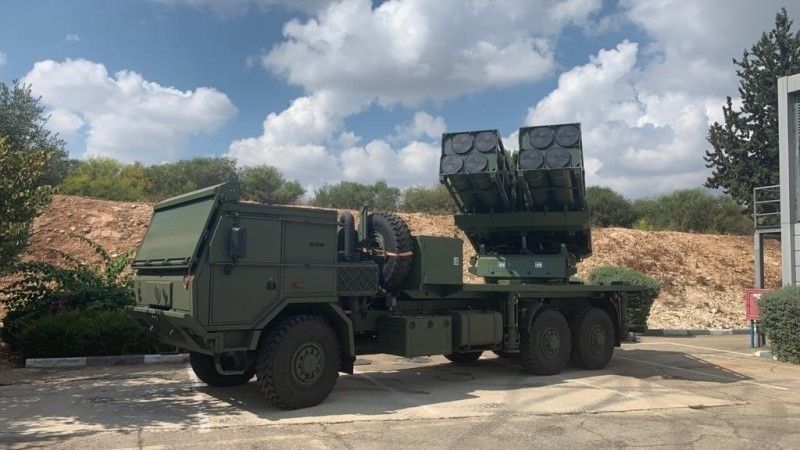
Photo. Elbit Systems
Germany wants to be able to fire US-made GMLRS rockets from Israeli launchers, yet it doesn’t plan to purchase GMARS rocket launchers based on the HIMARS system used by Ukraine. If US decided to enable non-US made Rocket Launcher Systems to fire GMLRS rockets, that could benefit Poland as well, with Warsaw already operating a number of Korean-made Chunmoo systems.
- US-made GMLRS is the most common guided rocket artillery munition used in NATO, yet it can be fired only with US launchers.
- Many countries, including Germany, Poland, Denmark, and the Netherlands, purchase non-US launchers, which now are capable of firing munitions from other countries, but not MLRS.
- Germany wants its PULS launchers to be capable of firing US-made GMLRS rockets. If this is successful, and if a similar approach is taken with Polish Chunmoo/Homar-K launchers, that would be a big benefit for Poland.
The German Ministry of Defence spokesperson has confirmed to Defence24.com that it will not purchase the GMARS system, which is based on American HIMARS and offered by German Rheinmetall in cooperation with Lockheed Martin. At the same time, the German MoD is interested in establishing compatibility between the PULS system it has purchased from Israel and the GMLRS rockets used by HIMARS and MLRS/MARS 2 systems.
Germany continues to strive for compatibility of the GMLRS rockets with the PULS system
said the spokesperson of German MoD in a response to inquiry of Defence24.com.
In that context, the spokesperson confirmed that it will be the Israeli-designed PULS that will replace MARS 2 (based on American-made M270A1 MLRS) in German Bundeswehr, and it is the objective system for German rocket artillery. PULS is a modern rocket artillery system, capable of firing various types of Israeli rockets with ranges from 40 km to 300 km (e.g. EXTRA, Predator Hawk, Accular and LORA). It has been purchased by Germany, Netherlands and Denmark and now a Europeanized version is being promoted as EuroPULS in coordination with KNDS Germany, former KMW.
At the same time, US-made GMLRS rocket systems, with over 10 000 being produced annually in the US, and further international manufacturing opportunities explored in Australia, Poland, Germany (Rheinmetall is exploring a cooperation with Lockheed Martin) and Australia, are the most common guided rocket artillery munition in NATO. It is also being used in Ukraine, both by HIMARS rocket launchers donated by the USA, and MARS 2/MLRS/LRU donated by Germany, UK and France. GMLRS rocket is guided by GPS/INS and can engage targets for up to 85 kilometers, which brings a range of tactical opportunities. Thus, it is not surprising that the German MoD wants to be able to use the GMLRS, despite the fact that it has opted for a different rocket launcher type.
The problem is that currently GMLRS can be fired only by US-made launchers: HIMARS (and its derivatives, like GMARS) or M270A1/A2 MLRS. From an operational point of view, it would be beneficial to ensure interoperability among various launcher systems (i.e., non-US launchers being capable of firing GMLRS), yet the US and industry, Lockheed Martin in particular, have been sceptical towards such a solution, as it could affect the LM position as a manufacturer of launchers.
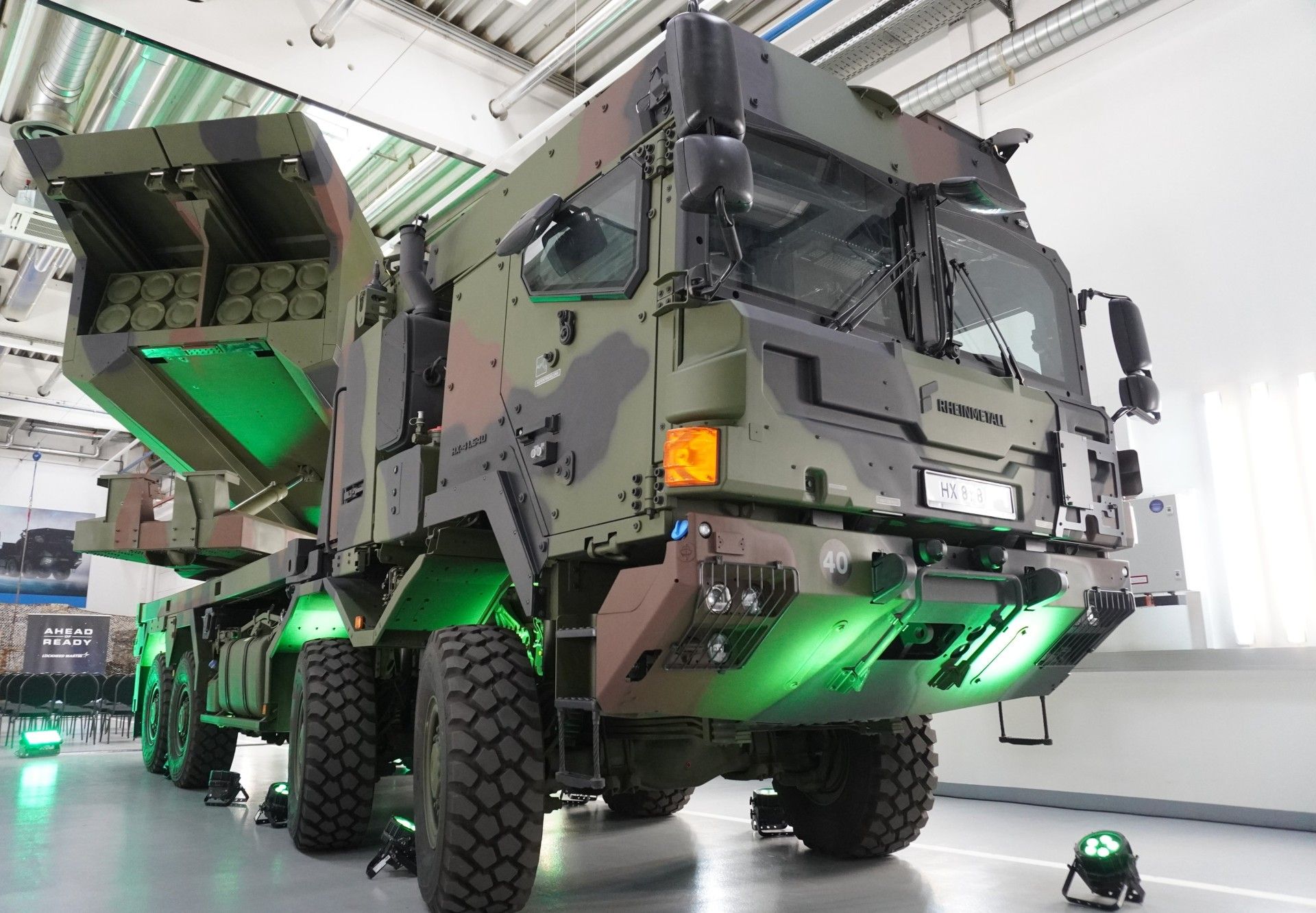
Photo. Lockheed Martin Europe/X
On the other hand, US Army Europe commander, gen. Christopher T. Donahue, sees the need for interoperability for launcher systems - and munitions interchangeability. As gen. Donahue said during the recent LANDEURO conference in Wiesbaden, Germany, an objective solution would be an optionally manned launcher capable of firing various missiles from all nations, with a unified command and control systems.
So, specifically, what we want to develop is a common launcher, a common launcher that is both offensive and defensive capable. We want a common fire control system so that any nation can use that fire control system. Right now, there are many nations that if they buy a platform and another nation buys that platform, they're not interoperable because of that lack of common operating system.
US Army Europe commander, gen. Christopher T. Donahue
To that end, US Army is seeking a project of Common Autonomous Missile Launcher (CAML), including a Medium variant capable of firing both rocket artillery (ground to ground, like GMLRS) and air defense missiles (like AIM-9X).
However, this is a solution that will need to be designed, and establishing a common C2 for air defence missiles (used to engaging fast moving aerial targets) and rocket artillery (fired at coordinates, without need for uplink in flight) also may take some time. Assuming the purpose of US Army Europe is ensuring munitions commonality, it would be advisable to support European countries« initiatives to ensure their existing launchers (or those that are to arrive in the near term) are compatible with GMLRS. This would enhance the magazine depth, which the war in Ukraine shows, is essential. And technically it could be easier than building a common launcher for all those systems, as the fire control systems for GMLRS require only passing static coordinates of a target to the rocket (and not the moving position of an aerial target, like it is with the air defence missiles). Particularly as the field artillery Fire Control Systems used by European countries, including Polish TOPAZ+ and German ADLER, have already gained a degree of interoperability, thanks to the ASCA initiative launched in 2017 by US Army Europe.
From the point of view of Poland, ensuring existing non-US launchers may become interoperable with GMLRS would also be beneficial. Poland already has over 80 Homar-K launchers, based on Korean Chunmoo, and their number is planned to exceed 200 in the near term, with as many as 290 launchers under contract and fully funded to be delivered until 2029. Unlike Germany, Poland is planning to operate both HIMARS and Chunmoo/Homar-K, as the country is planning for between 500 and 800 MLRS systems in its rocket artillery forces in total. For now, however, it is not certain that all the Polish MLRS force would have a common pool of munitions, and the purchase of further batches of HIMARS (in addition to 20 already operated in 1st Rocket Brigade) are delayed over discussions on technology transfer and funding.

Photo. plut. Ł. Piekutowski / 23pa
Regarding Homar-K, they are able to fire a range of Korean-made munitions, including CGR-80 rockets, which are planned to be produced on license in Poland from 2028-2029, and CTM-290 tactical missiles (and light 122 mm rockets in the near future), ensuring that they are capable of firing GMLRS would be an additional benefit for magazine depth as well. And the dimensions of Chunmoo/Homar-K launcher pod are similar to US MLRS/HIMARS, as Korea is using unguided 227 mm rockets similar to US-made M26A1/A2 as well. On the other hand, after HIMARS could be integrated with CGR-80 rockets, which also increases the magazine depth, both in various European scenarios and in the Pacific, as US forces in Korea use M270A1/A2 MLRS launchers, while the Republic of Korea Armed Forces are increasing their number of K239 Chunmoo MLRS and CGR-80 rockets.

The German MoD confirmation of interest in an integration of GMLRS in non-US made launcher (PULS) should serve as a catalyst. While, according to unofficial information, Lockheed Martin is unwilling to support such an integration for Polish Homar-K, and thus in all likelihood also for PULS, a common request by US Army Europe, Poland and Germany, perhaps supported by higher levels of Department of Defense and Congress, could persuade LM to change its stance. Ensuring GMLRS commonality both with PULS and Homar-K/Chunmoo would enhance magazine depths both in Europe and possibly Pacific theaters, enabling US Allies and also US Army forces deployed in those theaters. Technically it should be feasible, perhaps with some modifications to launchers, building on the success of the ASCA initiative. The question is, will it be possible to achieve the level of interoperability expected by both US Army Europe and its Allies.


