


- ANALIZA
- WIADOMOŚCI
Nawrocki in Manila: Black Hawks as the foundation of Polish-Philippine defence cooperation

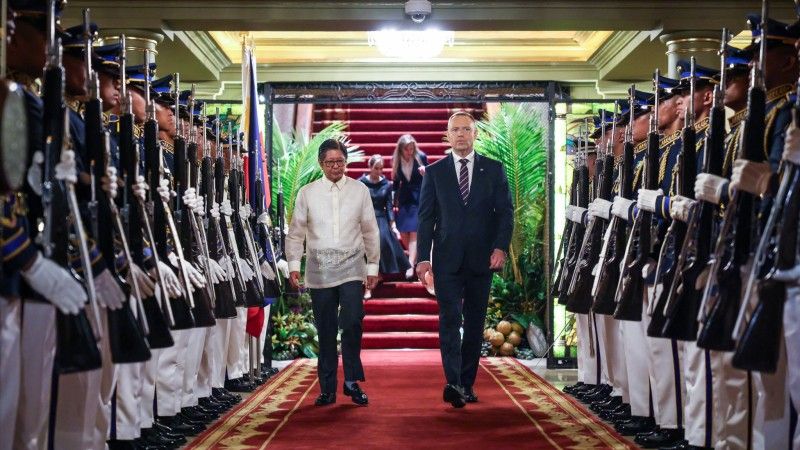
The first-ever visit by a sitting President of the Republic of Poland to the Philippines confirmed the growing importance of Warsaw’s relations with Indo-Pacific countries. Alongside economic cooperation, maritime security, the exchange of military experience and the development of defence-industrial cooperation featured prominently. The most tangible symbol of relations to date remains the S-70i Black Hawk helicopters manufactured in Mielec.
Karol Nawrocki’s state visit to the Philippines, held on 6–8 October 2026, marked an important step in strengthening Poland’s diplomatic and economic presence in Southeast Asia. Talks with President Ferdinand Marcos Jr. addressed security and defence, trade, investment and technological cooperation. The leaders also expressed interest in gradually building a strategic partnership.
For Warsaw, the significance of the visit extends beyond the bilateral dimension. The Philippines occupies an important place in the regional security architecture, and its location at the intersection of key maritime routes means that Indo-Pacific stability has a direct bearing on global trade. From Poland’s perspective, closer relations with Manila could expand export opportunities for the domestic defence industry and strengthen cooperation with countries across the region.

Mielec's Black Hawks as an example of practical cooperation
The most concrete aspect of Polish-Philippine defence relations remains cooperation involving the delivery of S-70i Black Hawk multi-role helicopters. During a visit to Colonel Jesus Villamor Air Base on 8 October, Karol Nawrocki viewed aircraft manufactured by PZL Mielec for the Philippine Air Force.
In total, the Philippines has received 48 S-70i helicopters under two contracts. In August 2026, delivery was completed under an order for 32 aircraft signed in 2022. The delivery of the final seven helicopters concluded the largest single Black Hawk contract in the history of PZL Mielec’s production of this variant. The facility belongs to the US-based Lockheed Martin corporation, but manufacturing takes place in Poland, giving the project a significant industrial and export dimension.
From Manila’s perspective, the helicopters are part of efforts to expand the armed forces’ transport and operational-support capabilities. For Poland, the contracts demonstrate the potential to maintain long-term industrial relationships with partners outside Europe. Deliveries of military platforms can mark the beginning of many years of cooperation encompassing logistics support, maintenance, personnel training and the further adaptation of the operator’s operational capabilities.

From arms purchases to systemic cooperation
An important element of the visit was the agreement to further develop defence cooperation. In a joint statement published on 8 October, Poland and the Philippines reaffirmed their intention to implement the 2013 agreement on the development of bilateral relations in the field of defence. They also emphasized the importance of military education, training, capacity-building, logistics support, and cooperation on armaments and defence-industry technology.
Another important point of reference is the first meeting of the Joint Polish-Philippine Defence Cooperation Committee (JDCC), held in Warsaw on 21 July 2026. Through this mechanism, both sides identified areas of cooperation intended to move relations beyond general declarations towards more regular institutional contacts.
The joint statement identifies several particularly important areas: dialogue on defence policy, military training and education, cybersecurity, intelligence sharing, logistics and defence-industrial cooperation. Maritime security also features prominently, including maritime domain awareness and the protection of infrastructure, ports and shipping.
Cooperation is not intended to be limited to trade relations and equipment deliveries. It is also to cover areas in which the two countries can exchange experience and develop institutional capabilities. For Poland, this offers an opportunity to strengthen ties with Philippine defence institutions; for Manila, it provides a chance to broaden the network of partners supporting the modernization of its armed forces.
The prospects for cooperation on maritime security are particularly noteworthy. As an archipelagic state, the Philippines depends heavily on the security of shipping routes and the protection of port infrastructure. Amid tensions in the South China Sea, monitoring maritime spaces, exchanging information and securing infrastructure are matters of not only technical but also strategic importance.
This does not mean that Poland will become one of the principal actors shaping the regional military balance. It can, however, develop cooperation in selected areas where technology, industrial experience and knowledge-sharing matter. The key condition is to translate political understandings into concrete programmes, institutional arrangements and projects implemented by the relevant entities.

Poland in the Indo-Pacific: strategic and economic dimensions
The development of relations with the Philippines should be viewed in the broader context of Poland’s engagement in the Indo-Pacific. The joint statement issued after the visit envisages gradual steps towards establishing a strategic partnership, based on tangible progress in political, security, economic, technological and social fields. At this stage, therefore, this remains a declared objective rather than a completed process of institutionalizing relations.
Poland’s accession in July 2026 to the Treaty of Amity and Cooperation in Southeast Asia (TAC) is also significant. The Philippines supported Warsaw in this process. Participation in the treaty provides an additional basis for developing contacts with ASEAN countries and supporting cooperation between Europe and Southeast Asia.
From the defence industry’s perspective, it will be particularly important to build on existing relations to develop further projects. The S-70i example shows that Polish facilities can participate in major programmes in Asian markets. It does not, however, guarantee future orders in other armaments segments. These will depend on the needs of the Philippine armed forces, the terms of competing offers, available budgets and competition from other suppliers.
The visit also had a clear economic dimension. Alongside political talks, the President took part in the opening of the 5th Polish-Philippine IT Business Summit and meetings with business representatives. Although this is not directly a defence-related area, the development of technological ties could create broader conditions for industrial cooperation, including in fields relevant to security.
Declarations and next steps
Karol Nawrocki’s visit to Manila produced two types of outcomes. The first is already tangible: existing cooperation in the production and delivery of S-70i Black Hawk helicopters, together with the industrial relationship being built on that foundation. The second concerns the future and includes agreed directions for deepening defence cooperation, as well as a political declaration of intent to establish a strategic partnership.
Manila is geographically distant from Warsaw, but it is an important partner in terms of diversifying Poland’s political and economic relationships. In the long term, success will depend not on the number of high-level visits alone, but on the ability to deliver joint projects. The Black Hawk deliveries demonstrate that this model of cooperation is possible. The next task is to extend it to other areas of security and defence.
In my view, Karol Nawrocki’s visit to Manila should be seen not as a one-off diplomatic success, but as a test of Poland’s ability to pursue a consistent policy towards the Indo-Pacific. Amid growing great-power competition and the increasing importance of maritime-route security, Warsaw should not limit its activity in the region to political declarations and occasional high-level visits. What is needed is a strategy that brings together diplomacy, the promotion of the defence industry and lasting institutional cooperation.
In this context, the Philippines is an interesting partner. It has concrete modernization needs, is developing cooperation with external partners and is attaching growing importance to protecting its security interests. Poland, for its part, has experience in modernizing its armed forces and possesses industrial potential exemplified by the PZL Mielec facility. This does not mean Warsaw can compete with the largest arms suppliers in every market segment. It can, however, consistently develop cooperation in selected areas where its offer meets the Philippine partner’s actual needs.

The greatest challenge remains translating political declarations into concrete results. Black Hawk deliveries have created a solid foundation for further engagement, but they do not in themselves guarantee cooperation in other fields. The key factors will be new projects, regular dialogue between the institutions responsible for defence, and the ability to sustain relations regardless of the schedule of political visits.
The real measure of the visit’s success will therefore not be the announcement of a strategic partnership itself, but the gradual substance given to it. If Poland can use this opening to develop lasting industrial ties and security cooperation, Manila may become an important point of reference for a broader Polish presence in Southeast Asia. Otherwise, the visit will remain primarily an event of symbolic significance.


