












- WIADOMOŚCI
- KOMENTARZ
Russia is testing Europe’s intelligence services

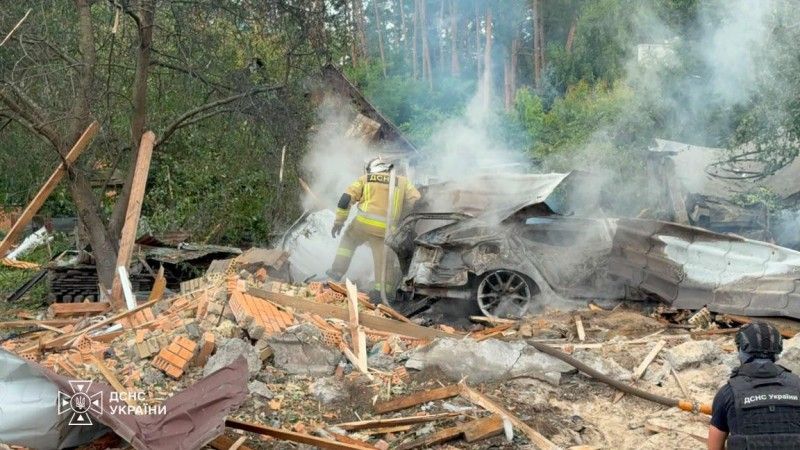
Photo. State Emergency Service of Ukraine
Russian sabotage operations in Europe are already being prepared and they will intensify. Their purpose is clear: to undermine support for Ukraine, disrupt defence production and logistics, create fear inside European societies and prove that Russia can strike NATO countries without crossing their borders with regular forces. This is why intelligence and counterintelligence cooperation is becoming one of the most important elements of European security.
Britain’s MI6 and France’s DGSE remain the strongest intelligence services in Europe, but today this is not enough. The most important information often comes from smaller agencies that operate closer to Russia, understand its methods and have been dealing with Russian intelligence activity for years. Poland, Estonia, Lithuania, Latvia, Denmark, Sweden and Ukraine are therefore not secondary partners. They are often the first states to identify new recruitment methods, new targets and new networks.
Denmark is only the latest example. PET has warned that Russia is actively preparing sabotage operations and that companies connected with the defence industry and support for Ukraine are among the potential targets. Russian services are trying to recruit ordinary people online and use them as proxies. At first, the tasks may appear simple: photograph a facility, check security, observe deliveries or identify access points. Later, the same person may be asked to set fire to a warehouse, damage infrastructure or support another operation.
We have already seen the same model in Poland and the Baltic states. In many cases, people detained in connection with sabotage or preparation for sabotage have been Ukrainian citizens or individuals using Ukrainian passports. This must be stated clearly, but equally clearly it must be explained that nationality of the perpetrator does not determine who controls the operation. Russia deliberately recruits Ukrainians, Belarusians, Russians and EU citizens. It gives Moscow deniability and allows Russian information operations to redirect responsibility towards Ukraine. A Ukrainian passport does not make the operation Ukrainian.
At the same time, Ukraine has not always shared all available information about individuals involved in criminal activity, Russian recruitment or suspected sabotage networks. This is a serious problem. A person monitored in Ukraine can appear shortly afterwards in Poland, Lithuania, Germany or Denmark. If information remains inside one service or one country for too long, Russia gains an advantage. Intelligence sharing therefore cannot depend only on political declarations. It has to work quickly and permanently.
The confrontation between the SBU and HUR in Kyiv shows exactly why this matters. Two of the most important Ukrainian security structures ended up in an armed confrontation, three HUR personnel were wounded, and both institutions presented different accounts of the incident. This is not a normal institutional dispute. Ukraine is fighting Russia, while at the same time its two key services are forced to explain why their own armed personnel were shooting at each other. Whatever the final findings of the investigation, this directly concerns trust, coordination and the exchange of information between institutions that should be focused on the same enemy.
The same problem applies at the European level. Russian sabotage is not a Polish problem, a Danish problem or a Baltic problem. It is one campaign conducted across many countries. Arson, reconnaissance of defence factories, attacks against transport infrastructure, suspicious activity around military logistics and recruitment through Telegram or other online platforms should be analysed together. Moscow does not divide its campaign according to European administrative borders. European services cannot do this either.
Russia has two main objectives. First, it wants to make the delivery of weapons, ammunition and equipment to Ukraine more difficult and more expensive. Second, it wants to show that NATO territory is not beyond its reach. A warehouse can burn in Poland, a defence company can be observed in Denmark and infrastructure can be targeted in the Baltic states without a single Russian soldier officially crossing the border. This is exactly why such operations are useful for Moscow.
There will therefore be more arson attacks, more reconnaissance and more attempts to recruit disposable agents. Europe cannot protect every railway junction, warehouse, bridge, port or defence plant with soldiers. The attack has to be stopped earlier: during recruitment, reconnaissance, financing and preparation.
This is where cooperation between Western intelligence services and the services of Central and Eastern Europe becomes essential. MI6 and DGSE bring global capabilities, technology and networks. Poland, the Baltic states and Ukraine bring proximity, experience and knowledge of Russian methods. Russia is already fighting this campaign as one system and urope must finally respond in the same way. Of course, the main goal should to extremely penetrate the Kremlin. Let’s keep this idea.


