- WIADOMOŚCI
They flew into Poland and landed in Moscow. Two planes of the Algerian air forces

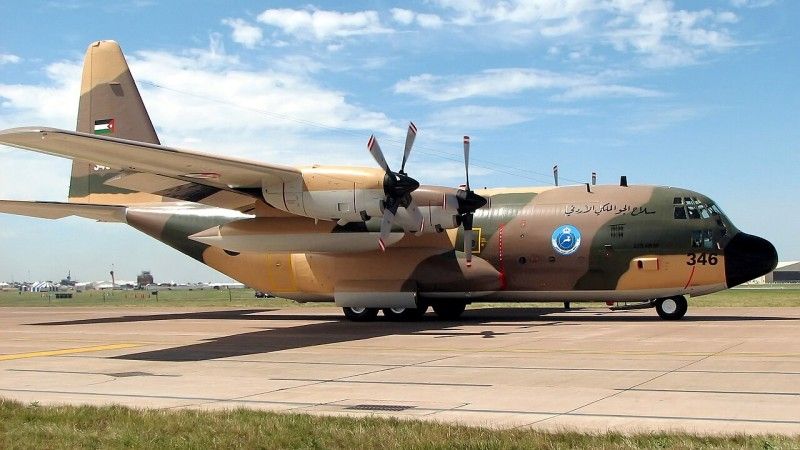
On Thursday, 24 September, the Algerian Armed Forces once again entered Polish airspace. These were two transport aircraft – a Lockheed C-130H-30 Hercules and an Il-76MD.
Algerian military aircraft over Poland
On Thursday, 24 September, two Algerian Air Force aircraft reappeared over Poland. These were military transporters – a Lockheed C-130H-30 Hercules and an Il-76MD. They flew over Poland and landed in Moscow. Polish Military Radar reported the appearance of the aircraft in Polish skies at 07:07.
This is not an unprecedented situation. In September alone, we have already reported several times on Algerian aircraft flying over Poland. There has been a lone Hercules and a lone Ilyushin. Yesterday they flew as a pair, and the day before yesterday, one of the machines arrived from Belarus.
Officially, the purpose of the Algerian aircraft’s arrival in Russia remains unknown. However, considering the intended use of these planes, we can presume that they are related to the transport of weapons, military equipment, spare parts, technical personnel, or delegations involved in military-technical cooperation – which officially exists between Algeria and Russia, as we have reported in previous materials.
We also do not know whether Russia is purchasing weapons from Algeria or vice versa – although logic suggests the latter is more likely.
Close airspace to Algeria?
The consistent policy of isolating Russia on the international stage – together with the sanctions policy against the Kremlin – would suggest that the airspace over Poland should be closed to aircraft flying from Algeria. Such a solution has also been suggested by some internet users monitoring the increasingly frequent flights of the Algerian Air Force over Poland.
At the same time, however, opposing voices have appeared online, pointing to the fact that passenger aircraft from Turkey (which is a NATO member), for instance, fly over Russia, and therefore closing the airspace to Algeria would be a misguided move.
And here lies the crux of the matter – passenger aircraft are not the same as heavy military transporters regularly commuting between Algiers and Moscow. Turkish Airlines’ passenger planes do not carry ammunition, weaponry components, or spare parts for various military vehicles or installations.
Such a move towards Algeria might seem overly harsh, yet from the perspective of the logic behind current political decisions, it is entirely natural. For if military aircraft are flying from Algeria to Russia to conduct a specific transaction – purchase, sale, or delivery under other terms – which is covered by EU sanctions policy, then the EU’s role should be at least to hinder them. Why is this not happening?

When in doubt, follow the money...
For some reason, the flights of the Algerian military over Poland are tolerated by the European Union. Perhaps no one sees a threat in them and they are indeed insignificant – perhaps, at the same time, decision-makers assume it is better not to sour relations with Algeria, disregarding image issues related to an extremely inconsistent policy towards Russia.
However, there is a slightly deeper layer to the whole matter – money and gas. Algeria is responsible for 18.2% of EU pipeline gas imports and 8.1% of LNG, so it is not just some random African state that can be easily angered or have a finger wagged at it. Naturally, it is difficult to imagine that a flight ban for Algerian military aircraft would trigger such consequential reactions from the Algerian side, but a reasonably prudent approach is to avoid unnecessary escalation – after all, Europe has no shortage of problems on any level.
On the other hand, the European Union also has leverage over Algeria in the event of any escalation – as it accounts for nearly 50% of Algerian foreign trade, which de facto constitutes a significant asymmetry. The European Union is far more important to Algeria than Algeria is to the EU, so its political dominance should not pose a major problem for Brussels.
Once again, it only remains to answer the question “what for?” – and whether the potential logical continuity of political decisions is worth risking an additional conflict, even if it is one won before it starts.

Would a flight ban actually change anything?
A flight ban for military aircraft travelling to Russia would have a primarily diplomatic dimension. It would send a clear signal – to both Algiers and Moscow – that European policy is internally consistent and will not be easily trifled with. However, would introducing a flight ban for military aircraft from Algeria actually change anything?
Such a move would not necessarily weaken Russia, although it would be inconvenient. Algeria would be forced to find new routes, flying longer, burning more fuel, and occasionally planning additional stopovers. All of this increases the cost of the operation. Additionally, the transport of heavy military cargo to Russia (or from Russia) would be seriously hampered, and the air bridge between the two countries would become much less effective.
And that is essentially it. The entire additional cost on a national scale is marginal, and the true value of a flight ban concerns only the diplomatic sphere – and likely, out of pure pragmatism and cold political calculation, the best move for the EU (and Poland) is to make no move at all in this matter. It is worth watching the skies, however, and noting both the scale and the intimacy of Algerian-Russian cooperation – to remain aware of “who is flying with whom.”