












- ANALIZA
- WIADOMOŚCI
Aegean air domain rivalry — Escalation or controlled pressure?

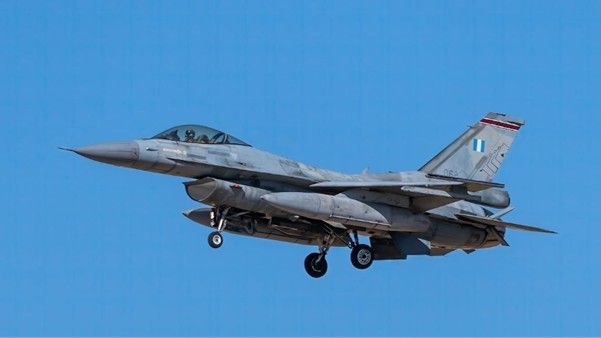
The long-standing Greek–Turkish rivalry has moved into a phase of tensions in the air domain.
After a period of relative quiet in terms of direct incidents over the Aegean Sea, Turkey has once again been testing the resilience of the Greek armed forces, regularly violating Greek airspace. At the same time, both states are intensively modernizing their air forces. As a result, the air domain is no longer merely an area of symbolic disputes but has become one of the key arenas of military and technological rivalry between Greece and Turkey.
2025 - a turning point
This dynamic was confirmed in 2025, which saw a sharp escalation of airborne activity. According to official statistics from the Hellenic National Defence General Staff (ΓΕΕΘΑ), 225 cases of violations of Greek airspace were recorded in 2025, involving 366 Turkish aircraft. By comparison, Greek authorities recorded not a single comparable case in 2024.
Aegean Sea airspace regime
The most intense activity occurred on 12, 19 and 22 December, when Greek air sovereignty was repeatedly breached involving armed F-16 fighters and an ATR-72 aircraft.
The principal area of operations was the southeastern Aegean Sea — the region of a long-standing dispute over the extent of Greek air and maritime jurisdiction. Greece claims a ten-nautical-mile airspace zone around its coast, whereas Turkey recognises only six miles, as it does for territorial waters. This discrepancy is one of the causes of the recurring air incidents and the sustained heightened aerial activity in the area.

Greek restraint, Turkish resolve
Greece, however, refrains from escalation and from responding symmetrically to Turkey. Its reaction to incidents is limited to identification and interception of Turkish aircraft in accordance with established procedures and international regulations. The defensive character of Athens« actions may stem from concern about the direct use of force and the shooting down of Greek aircraft.
Turkey has for years communicated clearly that even a short violation of its airspace will be met with an immediate defensive response. It demonstrated this in 2015 when it shot down a Russian Su-24 bomber conducting combat operations near the borders of the Republic of Turkey. In doing so Ankara effectively delineated its own „red lines,” showing that provocations in its air domain can have real consequences.
Typhoon versus Rafale
The violations of Greek airspace coincide with an intensive modernisation of Turkish Air Force. In October, Ankara purchased 20 multi-role Eurofighter Typhoon combat aircraft under an agreement with a consortium led by the United Kingdom. The roughly £8 billion contract includes a broad suite of weaponry — including MBDA Meteor air-to-air missiles — as well as logistical and training support. Although first deliveries are not scheduled until 2030, the prospect of acquiring Typhoons already strengthens Ankara’s operational assurance.
Perceiving Ankara’s purchase as a direct challenge to its air superiority, Greece is considering bolstering its 24 Rafale F3R fighters. Options include acquiring additional aircraft in a more advanced F4 configuration and, in the longer term, a developmental F5 variant, unofficially referred to as the „Super Rafale.” Parallel to these plans, fifth-generation fighters are gaining increasing importance.

Fifth generation as a new dimension of air rivalry
In this area Turkey is developing the indigenous KAAN fighter, intended to become the backbone of its future air capabilities. The platform is being designed as a twin-engine stealth aircraft with internal weapon bays, aimed primarily at beyond-visual-range combat. The fighter is expected to achieve air superiority through, among other things, extended reach, the ability to conduct precision strikes, and enhanced combat power supported by artificial intelligence. Ankara has already ordered a sixth KAAN prototype, which will serve the next stage of testing and bring the programme closer to full operational readiness.
Likewise, the Hellenic Air Force is entering the fifth-generation era. Under the Joint Strike Fighter programme, Greece has purchased 20 F-35A Lightning II aircraft, which are expected to arrive by late 2028. For Athens, this is not only an opportunity to develop its own air forces but potentially to obtain a qualitative advantage over Turkey, which was suspended from the programme in 2019.
Escalation or controlled pressure?
Although the current trend may appear worrying at first glance, this year’s increase in violations of Greek airspace does not necessarily indicate entry into a phase of outright escalation. It is better interpreted as Ankara’s deliberate and controlled maintenance of operational pressure. The aerial activity in this case has a demonstrative and testing character rather than constituting direct preparation for armed conflict.
Moreover, in the long term the Greek–Turkish rivalry may even deliver net benefits. The current tensions are prompting both states to invest more intensively and to procure new military equipment, which in turn strengthens NATO’s southeastern flank. Paradoxically, the phenomenon has a positive dimension — it does not generate direct losses and, over time, contributes to the strengthening of military capabilities and Alliance deterrence.
Author: Magdalena Ciupińska


