












- WIADOMOŚCI
From “not our war” to “our business”: Western Europe and Russia after 2022
Russia’s war against Ukraine shattered western Europe’s long-held illusions, forcing a painful reassessment of Moscow-from profitable partner to systemic threat reshaping Europe’s security order.
The end of comfortable illusions
Until fairly recently, in most capitals of western Europe Russia was not seen as a fundamental threat, but as a difficult yet indispensable partner. An authoritarian state, certainly, brutal towards its own citizens and peripheral neighbours, but at the same time predictable, operating within familiar patterns and—crucially—profitable. It supplied energy, absorbed western investment, opened markets for major corporations and allowed political elites to believe that trade, dialogue and patience were more effective tools than confrontation. War in Europe seemed a relic of the 20th century, while warnings coming from Warsaw, Vilnius or Helsinki were often dismissed as symptoms of historical obsession.
For central European states, the Baltic countries and Scandinavia, this western vision was profoundly alien. Their historical experience pointed in a very different direction: Russia was not a „difficult partner”, but an imperial project that, when conditions allowed, would always resort to violence. For years, this perspective was marginalised. Russia’s war against Ukraine did not merely confirm it; it forced the west into a sudden and painful reassessment of its most basic assumptions.
The United Kingdom: From Londongrad to a New Cold War
This process began earliest in the United Kingdom. For decades, London pursued a policy of cool pragmatism towards Russia, characteristic of a former empire: not our business, so long as our core interests remain untouched. The British capital became one of the main financial hubs for Russia’s elites, a safe harbour for oligarchs who, thanks to the British legal system, could secure fortunes extracted from Russia itself. „Londongrad” was not just a journalistic cliché, but a functioning model of coexistence between business, politics and authoritarian power.
The rupture came not with tanks, but with poison. The murder of Alexander Litvinenko, followed years later by the attempted assassination of Sergei Skripal and his daughter in Salisbury, made it unmistakably clear to the British public that Russia was not merely violating international law, but conducting acts of state-sponsored terror on British soil. From that moment, the „Russia problem” ceased to be abstract. The full-scale war against Ukraine merely completed the shift. Britain became one of Kyiv’s most consistent allies, driven not by sentiment but by the conviction that Russia is a revisionist power that understands only the language of force. Crucially, this shift has been broadly cross-party, which gives it a degree of durability rarely seen in foreign policy.

Germany: The Painful Collapse of "change through trade"
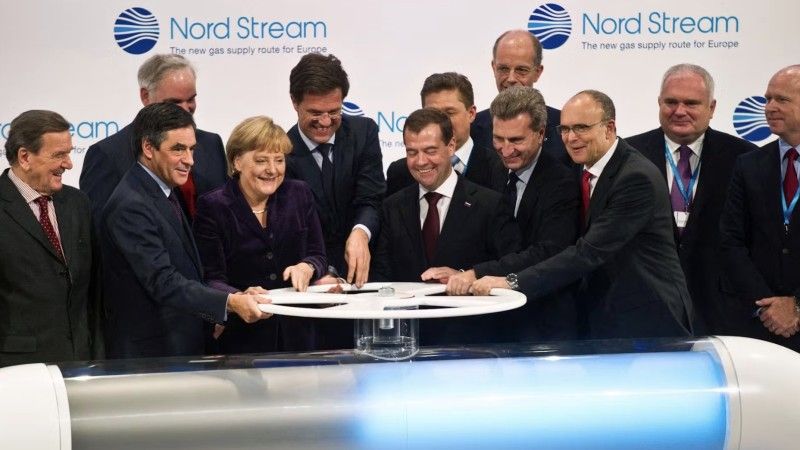
Nowhere was the shock more dramatic—and more painful—than in Germany. For decades, German policy towards Russia rested on the belief that intensive economic cooperation would produce political moderation. The doctrine ofWandel durch Handel was not merely a strategy; it was part of Germany’s postwar moral self-definition. Nord Stream became its most potent symbol, and ultimately the clearest proof of its blindness to the realities of Russian power. Criticism from central and eastern Europe was routinely ignored or treated patronisingly as an emotional response from countries „trapped in history”.
At the same time, German public debate was paralysed by the memory of the second world war. War as such was viewed as an absolute evil, irrespective of context or responsibility. Pacifism became a component of political identity, while the Bundeswehr functioned more as a symbol than as a credible instrument of deterrence. Russia’s aggression in 2022 shattered this construction. Chancellor Olaf Scholz’sZeitenwende was not simply a shift in security policy; it marked the collapse of a worldview in which war was no longer supposed to return to Europe. Germany redefined Russia as its principal threat, but German society remains deeply divided between a sense of responsibility towards Ukraine and fears of escalation and economic cost.
France: The end of sentiment for Russia
France’s relationship with Russia had long been shaped by culture as much as politics. Russia was seen as a land of great literature, music and philosophy, and as the heir to a political project that fascinated much of the French intellectual elite in the 20th century. This was reinforced by the Gaullist vision of Europe as a strategic actor stretching „from the Atlantic to the Urals”, in which Russia was imagined less as an adversary than as a potential partner balancing American power.
The war in Ukraine brutally exposed the naivety of this narrative. French elites were forced to acknowledge that Russia is neither a romantic „other” nor a civilisational challenge, but an empire prepared to use mass violence against its neighbours. Paris still seeks to preserve its role as an autonomous strategic actor and occasional mediator, but at a fundamental level Russia has moved from the category of a difficult partner into that of a systemic threat.
Italy: From ambivalence to realism
Italy long occupied an ambivalent position in this debate. Leftwing nostalgia, sections of the right’s admiration for strongman politics, and business pragmatism combined to produce a view of Moscow as a counterweight to what was often portrayed as the arrogance of Brussels and Washington. The war, however, forced Rome into a clear choice. Despite internal tensions and political divisions, Italy remained within the mainstream of support for Ukraine, recognising that the cost of neutrality would ultimately be higher than the cost of solidarity within Nato.
The rest of the West: A shift in the centre of gravity
A similar, if less dramatic, transformation took place across the rest of western Europe. Spain, the Netherlands, Belgium and Austria had long treated Russia as a distant geopolitical issue, one that did not require a fundamental rethink of their own security policies. The war in Ukraine forced a reckoning. The Benelux countries and Spain increased their military and logistical engagement, while traditionally neutral Austria was compelled to debate the limits of its neutrality. Across western Europe, Russia moved from the margins of strategic thinking to its very centre.
Scandinavia as Europe's anchor of strategic memory
Within this new but potentially fragile consensus, the Scandinavian states may play a particularly important role. Their significance lies not only in military capabilities or geography, but in a consistent understanding of Russia as a structural, not temporary, threat. Unlike much of western Europe, Scandinavia never fully embraced the illusion of an „end of history”. Awareness of Russian pressure, hybrid warfare, airspace violations and cyber operations persisted even during periods when much of the continent assumed stability was permanent.
See also 

This continuity of experience gives Scandinavia the potential to act as a guardian of Europe’s strategic memory. At moments when Berlin, Paris or Rome may again be tempted by the normalisation of relations with Moscow, voices from Stockholm, Helsinki or Copenhagen can serve as a reminder that Russian imperialism is not an aberration of a single leader, but part of a longer historical pattern. Like Poland and the Baltic states, Scandinavia contributes not emotion, but memory to Europe’s security debate—and it was precisely the absence of such memory that enabled many of the west’s earlier misjudgements.
What could reverse this shift?
The durability of this transformation remains uncertain, because its most serious threats no longer lie in Moscow, but in Washington and Europe’s ballot boxes. The prospect of American isolationism and a conditional approach to alliance commitments acts as a cold shower for European elites. Without the US security umbrella, many politicians in Berlin, Paris or Rome may once again succumb to the temptation of „freezing” the conflict and returning to business pragmatism.
Equally important are political shifts within Europe itself. The rise of populist and radical forces, on both the right and the left, fuels narratives of war fatigue, relativisation of Russian responsibility and the idea that the west itself is to blame for escalation. Calls for peace „at any price” tend to grow louder during economic downturns, when long-term security is sacrificed for short-term electoral comfort.

Poland's reason of state as Europe's new mainstream
Paradoxically, what for years was dismissed as Poland’s obsession with Russia has now become the dominant current in European security thinking. This is not the result of ideological conversion, but of a brutal encounter with reality. The question that remains is not who was right, but whether Europe will be able to retain this clarity when the war fades from daily headlines and political pressure to „return to normal” inevitably grows.
If Europe once again comes to see Russia as a problem that can simply be waited out, history will remind it—as it always does—that such a bill is paid in blood.


