- WIADOMOŚCI
Beyond Washington and Beijing: Germany courts Brazil

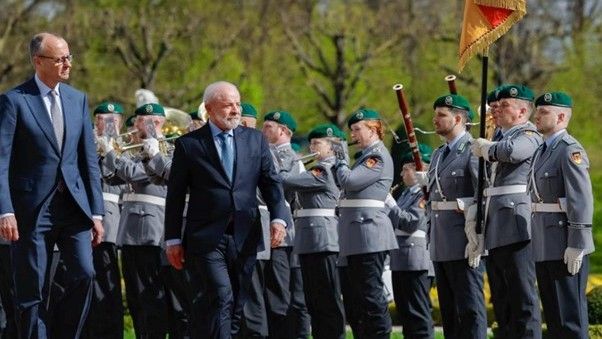
Photo. @bundeskanzler/X.com
To reduce reliance on the US and China, German Chancellor Merz and Brazilian President Lula forge a stronger industrial, defence, and critical-minerals partnership.
At the ongoing Hannover Messe, which features Brazil as the partner country, Chancellor Friedrich Merz and President Luiz Inácio Lula da Silva have elevated the bilateral relationship from mere diplomatic symbolism to concrete industrial policy. The timing of this shift matters. According to Destatis, China reclaimed its position as Germany’s top trading partner in 2025, while the United States fell to second place after a 5 percent drop in bilateral trade. Chancellor Merz’s broader diplomatic outreach, spanning India, the Gulf, and Brazil, is therefore part of a calculated effort to reduce Berlin’s overreliance on both Washington and Beijing.

The primary vehicle for this strategy is the EU-Mercosur trade agreement. Slated for provisional application on 1 May 2026, the deal will create a commercial bloc of approximately 700 million people. Merz intends to use this agreement to significantly boost German-Brazilian trade, which exceeded €20 billion in 2024, and has endorsed a shared ambition to double that figure in the coming years. The foundation is already solid: according to Berlin, roughly 1,300 German-affiliated companies currently operate in Brazil, generating approximately a tenth of the country’s total industrial value added.
Critical minerals form the strategic core of this partnership. President Lula reminded his German hosts that while only 30 percent of Brazil’s mineral wealth has been mapped, the country already holds major global positions in niobium, graphite, rare earths, and nickel. In response, Merz offered advanced German technology for mineral extraction and the development of value chains tied to electric mobility and wind power. Lula’s terms, however, were unambiguous: Brazil refuses to be treated as a mere warehouse for raw ore. It demands localised processing, technology transfer, and industrial upgrading.
The bilateral package also encompasses climate and energy cooperation. Germany announced a €500 million contribution to a Brazilian Development Bank (BNDES) climate fund, while Lula promoted Brazil’s vast biofuels and renewable energy sectors as essential tools for driving down costs and decarbonising heavy industry. For Berlin, these initiatives are not merely an exercise in climate diplomacy. They are directly tethered to Germany’s long-term industrial security.

Finally, a burgeoning defence-industrial relationship adds a further dimension to the partnership. The joint declaration adopted in Hanover outlines concrete cooperation on defence products, with Lula publicly identifying tanks, air defence systems, and drones as priority areas. This is by no means a substitute for Germany’s foundational role in NATO or its alliance with the United States, but it is a telling signal. It demonstrates that Berlin is actively expanding its network of reliable partners at a time when export markets, energy resources, raw materials, and technology supply chains are increasingly deployed as instruments of geopolitical power.