












- WIADOMOŚCI
Germany holds Ukraine line despite political headwinds

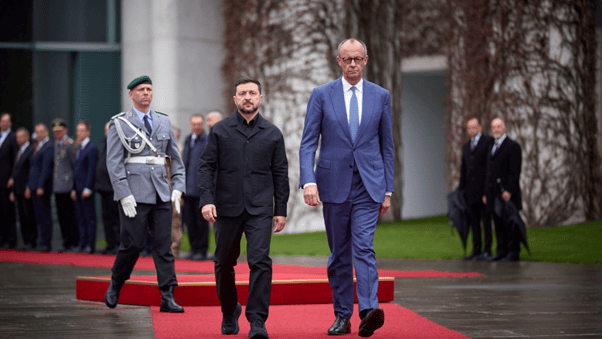
Photo. @ZelenskyyUa / X
Germany now frames its military support for Kyiv as strategic self-interest, but a sluggish economy and energy shocks threaten to fracture domestic consensus.
Germany has chosen resolve over hesitation. During Ukrainian President Volodymyr Zelenskyy’s April 14 visit to Berlin, the Merz government translated political promises into a concrete package. This includes funding for hundreds of Patriot missiles and additional IRIS-T launchers, joint drone production, hundreds of millions of euros for Ukrainian deep-strike capabilities, and a pioneering battlefield data-sharing agreement between their respective defense ministries.

That final element may prove the most significant. Berlin is no longer framing its backing of Ukraine purely as an act of solidarity. It is increasingly positioning it as a matter of strategic self-interest. By helping finance Ukrainian arms production, Germany gains direct access to invaluable combat data on systems like the IRIS-T, PzH 2000, and RCH 155, while simultaneously tapping into Kyiv’s hard-won expertise in drone warfare and digital battlefield management. Consequently, Berlin is openly presenting its military aid as a direct investment in Europe’s own defense industrial base.
For now, Berlin is holding the line despite deteriorating domestic conditions. The government reports it has provided approximately €55 billion in military support and €39 billion in bilateral civilian aid since 2022, with an additional €11.5 billion earmarked for Ukraine in 2026. To cement this long-term commitment, Germany is also relaunching formal intergovernmental consultations with Ukraine after a 22-year hiatus.

Yet, the headwinds are undeniable. The IMF recently downgraded Germany’s 2026 growth forecast, and the government is grappling with a fresh energy price shock triggered by the war in Iran. According to recent ZDF polling, 58% of Germans now cite rising fuel and energy costs as a major personal burden. The AfD is already exploiting this economic squeeze, openly calling for a return to Russian energy. While Germany remains steadfast in its aid for now, the looming question is whether Berlin can sustain public consent for an expensive Ukraine policy if the country’s economic mood continues to sour.


