- WIADOMOŚCI
Does anybody remember the Three Seas Initiative? The case for a new intermarium

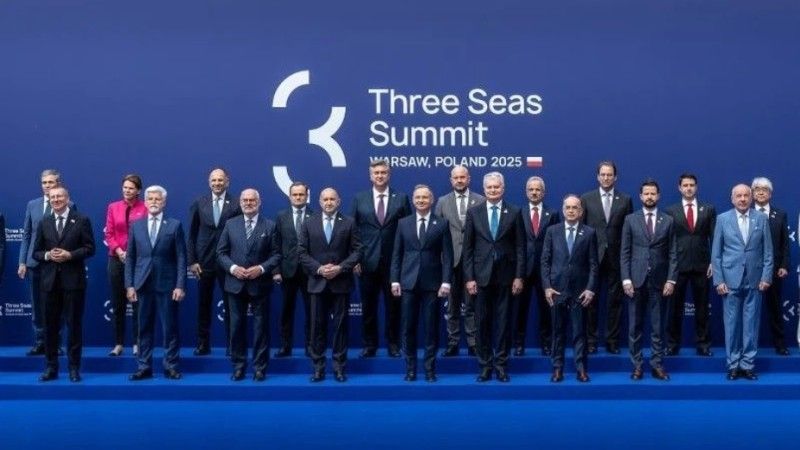
Despite its unprecedented potential, the Three Seas Initiative has faded from view and has not delivered the transformative role once hoped for in Central and Eastern Europe. The forum has reached its natural ceiling, proving effective in the realm of infrastructure but little beyond. Yet the region needs a format that can channel the geopolitical unity of its more like-minded members, particularly on NATO’s Eastern Flank. This opens the door to revisiting the Intermarium concept, which inspired the Three Seas at its inception and could now drive deeper diplomatic and security cooperation.
From the Interwar Intermarium to the 21st Century Three Seas Initiative
Let’s start from the very beginning. The ideational roots of the Intermarium (Latin for „Between-Seas”) can be traced back to the era of the Polish–Lithuanian Commonwealth, a multi-national political entity that stretched from the Baltic Sea almost to the Black Sea, encompassing the territories of present-day Poland, Lithuania, Latvia, Belarus, Ukraine, and Moldova. For centuries, it successfully resisted expansion from both East and West, until it was eventually crushed under the pressure of rising Prussia (later Germany) and the Russian Empire, and fully partitioned by them together with Austria in 1795.
More than a century later, after Poland regained independence in 1918, one of the architects of the Second Republic, Józef Piłsudski, formulated the geopolitical concept of Intermarium. He envisioned a federation of Central and Eastern European states based on three key constatations:
- that imperial Russia, in whatever form, posed a lasting threat to the region;
- that the security of the states was interdependent, with the fall of one endangering all;
- that only regional unity could provide a counterweight to Russian power.
It could be viewed as a path to geopolitical emancipation for a region squeezed for centuries between various incarnations of German and Russian empires. However, the newly independent Intermarium countries instead often perceived it as an expression of Polish imperialism and a desire to dominate the region.
Disunited and distrustful countries fell prey to German imperialism after 1939, only to be captured by its Soviet version for another four decades after 1945. Following the dissolution of the Soviet Union, most of the Intermarium countries—with the exception of Belarus, Ukraine, and Moldova—succeeded in integrating with Western European and Transatlantic structures, experiencing an era of unprecedented growth and prosperity that continues to this day.
In the last decade, this forgotten concept inspired the Three Seas Initiative, launched in 2015 by Polish President Andrzej Duda and Croatian President Kolinda Grabar-Kitarović. From its inception, the forum focused on infrastructure development, specifically transport, energy, and digital connectivity among countries located between the Adriatic, Baltic, and Black Seas.
The 3SI aspired to empower a region that was historically underdeveloped compared to Western Europe and integrate it more holistically, especially along the neglected vertical (north-south) axis. The major motivation was undoubtedly to give 3SI countries more weight within the European Union, helping them catch up to its historical core and create new avenues for regional growth.
Since its creation, the 3SI has experienced two defining moments. The first one was undoubtedly American backing for its initiation as witnessed by Donald Trump’s participation in its second summit in 2017. American support elevated the political importance of the forum in Europe and encouraged its members to develop it.
The second was the Russian invasion of Ukraine, and subsequent Ukrainian de facto entry into the group as the participant-partner. The Intermarium countries were reminded once again of their geopolitical proximity and shared threat, prompting them to focus on cutting energy ties with Russia and enhancing logistics support for Ukraine.
How the 3SI Looks Today?
Today, the 3SI has expanded to 13 member states, with Greece joining and Moldova becoming a partner-participant at the 2023 summit, while the 2025 summit granted this status to two Balkan states: Albania and Montenegro. Only member states in 2024 accounted for 3.23 trillion USD in GDP (roughly 1.5 times larger than Russia’s, and one-sixth of the EU’s total GDP), while being populated by about 120 million people (slightly smaller than Russia’s, and a bit more than one-quarter of the EU’s).
As noted earlier, the forum is preoccupied with regional infrastructure development. Currently, there are 148 interconnection projects under the Three Seas Initiative totaling 111 billion euros. Most of them (51%) are devoted to transport, followed by energy (39%), and digital infrastructure (10%). In terms of funding, the biggest contributor is the EU with 46% from various funds, while 27% comes from national funding. Only 8% is covered by the Three Seas Initiative Investment Fund launched in 2019, with the size of 928m EUR.
As a result, the 3SI serves as a forum that facilitates the implementation of critical infrastructure projects mostly within and by the EU. It is there to help the 3SI EU member states advocate for, mobilize, and realize them in a coordinated and thus more effective manner.
Key among these is Via Carpatia, a landmark highway project connecting Klaipėda in Lithuania with Thessaloniki, Greece. This road-based integration will be complemented by rail one. Rail Baltica will provide the Baltic States their first large-scale mainline standard gauge connection with the rest of the EU, while the Rail-2-Sea project will link the Baltic Sea (port of Gdańsk, Poland) to the Black Sea (port of Constanța, Romania).
Collectively, these will forge a new North-South European road-rail corridor, transforming transportation dynamics throughout the region. Ukraine will be directly integrated into this rail network through the construction of standard gauge (1435 mm) track lines on its territory, with the first line already completed.
Today, integrating Intermarium infrastructure has an explicit defense dimension, serving as a crucial enabler for a resilient security system. Enhancing the region’s independent logistical and energy capacities will facilitate faster movement of troops and supplies between allies, while also acting as a deterrent against Russia.
Losing Momentum and Reaching its Limits
Despite its undeniable importance for the region, the 3SI has recently shown signs of losing momentum and reaching its limits. These constraints prevent it from evolving beyond an infrastructure development forum at a critical juncture when the region needs much more comprehensive and profound cooperation.
American interest in the initiative waned during the Biden presidency, which prioritized reset and realignment with the old European centers of power. Moreover, this time Trump’s return may not necessarily bring a breakthrough. In fact, he was notably absent from the April 10th 3SI summit in Warsaw, despite an invitation from President Andrzej Duda, represented only by Secretary of Energy Chris Wright.
This time may prove especially different given Trump’s ambiguous position on Russia, his plans to reduce US presence in Europe, and proposed defense aid cuts for NATO’s eastern flank. Simply put, 3SI countries must prepare for the possibility that US support for the initiative will be at best symbolic.
The steady decline in American interest and engagement in the Three Seas Initiative has, unfortunately, been mirrored by Poland’s uneven internal consensus regarding the initiative’s validity and significance, which in turn has undermined the consistency of Polish leadership. As the major engine and focal point of the 3SI, Poland’s active engagement is indispensable; without it, the initiative would be difficult to sustain in geographical, economic, or diplomatic terms.
The forum’s development, therefore, heavily depends on Polish political will, which has proven rather inconsistent. The forum’s development thus hinges heavily on Polish political will, which has proven inconsistent. Since its inception, the 3SI has been highly politicized within Polish discourse, largely associated with the Law and Justice (PiS) party, while the opposition-now in government-has leaned toward the traditional European powers, particularly of the Weimar Triangle. It suffices to say that diplomacy hates inconsistency, which has already proven very detrimental to the initiative’s momentum.
However, what has been holding the initiative back over recent years are irreconcilable political differences between its members that define its natural limitations. What makes the 3SI strong in the infrastructural realm simultaneously weakens it in the geopolitical one. The forum currently includes 13 member states with varying perceptions of security, and most importantly, different assessments of the threat from Russia.
In this context, the positions of Hungary and Slovakia stand out, as they still view Russia as a partner. Other countries like Austria or Bulgaria also display pro-Russian leanings. Such a divergent array of geopolitical orientations dilutes and fragments the forum’s potential.
Resorting to the Geopolitical Intermarium
While the Three Seas Initiative initially aspired to evolve into a geopolitical force, its subsequent trajectory has shown that it is best suited to infrastructure development, rather than broader political or security ambitions.
But when the wider Intermarium forum reaches its natural ceiling, there arises space for a smaller and deeper framework—one to be taken up by the states most willing and most aligned in their security outlook. This pushes us to revisit the forgotten geopolitical dimension of the Intermarium.
It could be conceived as a Three Seas Initiative 2.0, or as its second, more unified tier. The original 3SI would continue its mission, growing in membership, projects, and scope, and driving the region’s infrastructural integration internally and externally. Yet above it, a smaller and more coherent geopolitical grouping would emerge, one that closely coordinates its diplomatic and security efforts.

A genuine geopolitical initiative should therefore include only those countries whose threat perception of Russia is structural and enduring—rooted in historical and geostrategic realities that make policy shifts unlikely, regardless of changes in government. Slovakia provides a cautionary example of how fragile such commitments can be when they are not underpinned by permanent strategic considerations.
We are really talking about like-minded states: Romania, Poland, the Baltics, Finland, and Sweden—the backbone of NATO’s Eastern and Northern Flanks. If the Scandinavian countries were brought in, it would push the idea beyond the old Intermarium, adapting it to contemporary realities. Their integration into the original Three Seas Initiative would add a strong infrastructural base to this geopolitical vision.
But what real opportunities would stem from this new Intermarium concept? First, it would strengthen the region’s collective voice in the European Union, in transatlantic relations, and globally—at a critical juncture for a region historically marked by fragmentation. It could also maximize the Intermarium’s influence over ongoing peace negotiations, while increasing its bargaining power in advocating for stronger sanctions on Russia, keeping the United States engaged, and pressing for greater commitment from other EU countries.
The instruments to achieve this not only perceived but real unity may vary. It could take the form of a treaty, a convention, or even coordinated declarations designed to send a message—both to Russia and to other European states, as well as globally—that we identify ourselves as a coherent geopolitical bloc with well-defined interests. These interests would remain anchored within the frameworks of NATO and the EU, but with an added layer of closer regional cooperation and commitment.
Diplomatically, such a framework would involve regular, and ideally institutionalized, consultations on security and defence matters, including emergency situations. The potential for this was recently demonstrated by the rapid diplomatic response of the Intermarium countries to the Russian drone attack on Poland. Regular and ad hoc collective consultations would allow the bloc to articulate a united diplomatic position on key issues, to react swiftly to emerging crises, and to shape both the agenda and broader discourse on unfolding events. In this way, the group could more effectively steer both the EU and NATO in a favorable direction and secure its core interests.
These diplomatic coordination mechanisms should be complemented by tangible security and defence cooperation. The Intermarium countries ought to draw on one another’s comparative advantages and apply them across the region. For example, Sweden and Finland are widely recognized for their excellence in civil defence. The Baltic, Polish, and Romanian systems could benefit significantly from this Scandinavian expertise, both through knowledge transfer and through practical incorporation of best practices.
See also 

These countries should also acknowledge their complementary security needs and pursue joint military initiatives, such as:
- joint procurement, resource pooling, and technology sharing, particularly for the most costly and ambitious projects (missiles, satellites, jet fighters);
- enhanced Baltic Sea cooperation and task division to avoid duplication and fragmentation;
- specialization in hybrid warfare prevention, given the region’s heightened vulnerability to Russia;
- closer collaboration in special forces operations and intelligence sharing;
- coordinated efforts to build a »drone wall« given the ever-increasing threat of Russian attacks and provocations.
Such efforts must incorporate Ukraine’s wartime lessons and innovations, while allowing Ukraine to engage as deeply as current conditions permit. Although it could not yet become a full member, Ukraine is integral to the Intermarium, and its existence and alignment with the region are prerequisites for the security of all.
The Door Poland Must Open
Some may say that there is no need for another initiative in a region already covered by formats like the Bucharest Nine or the Visegrád Group. The problem is that these frameworks, while constructive, are weakened by the divergent geopolitical outlooks of their participants. The value of this proposal lies in fact that it would include only the states with genuinely aligned geostrategic interests.
In the end, the success of such a framework rests largely on Poland’s readiness to lead, as has been the case with the Three Seas Initiative. Poland must take the first step and remain engaged. This requires its political elites to see that different diplomatic tracks are complementary, not contradictory: Warsaw can deepen ties with the United States, with Western Europe, and with its Intermarium partners at the same time.
It goes without saying that Poland and the region should play on many fiddles. Diplomacy is the art of keeping many doors open and choosing the right entry at the right time. Entering and maintaining the Intermarium’s door today could bring tangible benefits for the region.
Author: Kacper Kremier