












- ANALIZA
- WIADOMOŚCI
Escalation on the Arabian Peninsula: Strike on a strategic oil pipeline and an incident near Mecca

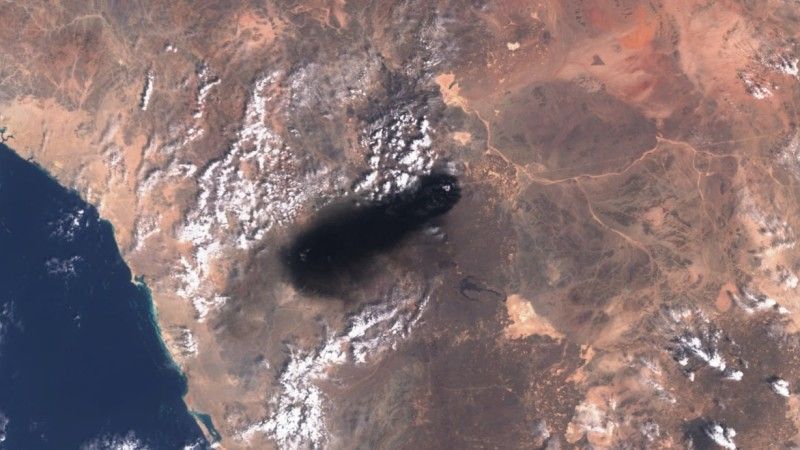
Photo. European Union/Copernicus Sentinel/Wikimedia Commons
Tensions on the Arabian Peninsula have risen sharply following a series of attacks targeting critical infrastructure and a site of particular significance to the Islamic world in Saudi Arabia. These actions, for which Iran-backed Yemeni Houthi rebels are being blamed, carry serious consequences for both the global energy market and the stability of the entire region.
Strike on the East–West Pipeline
Saudi Arabia’s oil infrastructure has become the main target of the latest strikes. The Houthis reported attacking three pumping stations at the port of Yanbu on the Red Sea coast, which is connected to the East–West Pipeline. As a result of the shelling and for security reasons, the Saudi authorities decided to suspend oil pumping and temporarily take the pipeline out of service.
This represents a blow to Saudi fuel exports, as the pipeline enabled the transportation of approximately 4 million barrels of oil per day while bypassing the Strait of Hormuz, which was blocked by Iran at the beginning of the conflict with the United States and Israel. The shutdown of the facility forced Saudi Arabia to cancel some oil deliveries to Europe. Experts warn that storage reserves in Yanbu will last for only 5 to 7 days of exports, posing a risk of serious disruptions to global markets.
Supply crisis and the situation of Poland's Orlen
The suspension of Saudi oil exports announced in recent days has direct and tangible consequences for the European fuel sector, including the Polish company Orlen. In recent years, Saudi Aramco has become the largest supplier of crude oil to the Polish company, accounting for approximately 40 percent of the oil processed across all refineries within the group.
Despite the reduction in supplies, Orlen maintains that the situation remains stable. In official statements, company representatives assured the public that the continuity of refinery operations in Poland, the Czech Republic, and Lithuania is in no way threatened and that current demand is being fully met. To compensate for the missing 40 percent of Saudi oil, the Polish energy giant has ordered 16 additional crude oil shipments. These cargoes are expected to arrive at ports from, among other countries, Norway, the United Kingdom, Kazakhstan, and Azerbaijan. A long-term contract with Norway’s Equinor, concluded as recently as August, has also proved to be a strategic safeguard for Orlen.

Attempted attack on Mecca
Alongside the strikes against oil infrastructure, the Royal Saudi Air Defense Forces reported intercepting and shooting down a drone heading towards Mecca, the holiest city for Muslims. The aircraft was reportedly destroyed south of the city before it could breach the restricted airspace. Although the Houthi rebels themselves denied responsibility for the attack, describing the accusations as a “disgusting lie,” this was already the second attempted strike in the Mecca area (the first took place in July 2017).
The international military coalition led by Saudi Arabia issued a statement firmly warning that the security of holy sites constitutes an absolute “red line” and that crossing it would be met with the necessary deterrent measures. The incident sparked widespread outrage across the Muslim world, with condemnation coming from, among others, Qatar, which described the attempted attack as a “shameful provocation.”
Response of the Polish Ministry of Foreign Affairs
Polish diplomacy also officially addressed the events on the Arabian Peninsula. In a published statement, the Ministry of Foreign Affairs of the Republic of Poland categorically condemned the drone attack targeting Mecca, describing it as unacceptable.
The Polish ministry assessed that such acts of aggression directly contribute to increasing chaos and instability in the Middle East. The Polish Ministry of Foreign Affairs issued a clear appeal in its statement:
“We call for respect for the special status of religious sites and symbols and for refraining from attacking them, especially in the face of such serious challenges to global security and the economy as those we are currently facing.”


