- ANALIZA
- WIADOMOŚCI
France and Greece - A new military alliance

The French defence industry is one of the strongest in Europe, and France itself is trying to portray itself as a leader of European security. It is therefore no surprise that it attracts the attention of many countries, including Greece. For Athens, which in recent years has been steadily modernizing its armed forces and strengthening its position in the region while competing with Ankara, Paris has become the most important military and political partner.
A new chapter in relations between the two countries was opened by the signing of the Greek–French defence cooperation agreement on 28 September 2021. The accord provides, among other things, for a mutual commitment to assist in the event of armed aggression against one of the parties, as well as the deepening of military, industrial and technological cooperation. In practice, this means strengthening the political and military alliance between two states that share a similar view on security in the Mediterranean region.
For several years now, Greece has been implementing a coherent modernization concept based on French technologies and training. The integration of French officers into the operational planning structures in Athens has standardised procedures with the French naval and air forces. As a result, a South European pillar of NATO is emerging with a stable and significant Mediterranean component, capable of independent operations in the Aegean basin. This is beneficial for both sides. Paris consolidates its position, while Athens strengthens its role in the region.
Belharra, Rafale and Exocet – symbols of the French presence
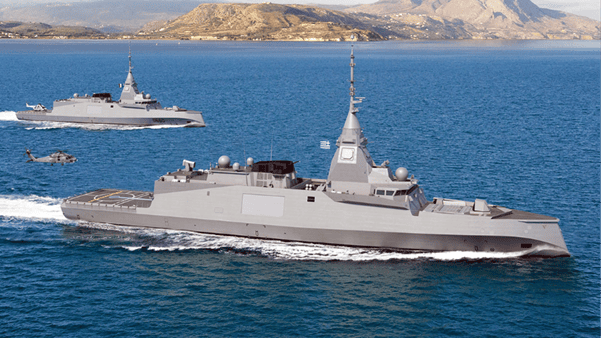
The defence agreement resulted in a series of contracts for the purchase of modern French weapons systems. In 2021–2022 Greece ordered 24 Dassault Rafale fighters from France, significantly boosting its air force and defence capabilities. One of the main pillars of the cooperation, however, became the 2022 contract with Naval Group for three FDI (Frégate de Défense et d’Intervention) frigates. In September 2025 the Greeks also confirmed the decision to purchase a fourth frigate, thereby expanding the earlier agreement with Paris.
Some of the purchased equipment will soon reach the Greeks; they will have to wait for the remainder — no later than 2030. The Belharra frigates delivered to Greece will be equipped with a modern suite of radar systems (including Sea Fire) as well as anti-air and anti-submarine weaponry. The Hellenic Navy will be the second user of the Belharra frigates after France. In May this year, an intergovernmental agreement was also signed for 16 Exocet Block III anti-ship missiles, which will significantly increase Greece’s maritime deterrence and coastal defence capabilities.
Military cooperation between Athens and Paris increasingly also concerns energy security. Greek waters and the exclusive economic zone are becoming key for gas pipelines and LNG terminals, and French frigates will be their main guarantor of security. This shows that NATO’s theoretical defence on the southern flank begins not on land but at sea — in the region of Cyprus, Crete and the Peloponnese.
Industrial strengthening – Naval Group Hellas
Franco-Greek relations are not limited to arms purchases. They also aim at long-term industrial cooperation and the development of local capabilities. In 2023 Naval Group Hellas, fully owned by the French company, was officially opened in Athens. Its task is to coordinate local industrial projects, support the operation of the FDI frigates and develop research and technology in cooperation with Greek businesses.
Naval Group Hellas is not just an office in Greece, but a pillar of Greece’s industrial integration into the European defence supply chain. Joint projects with Greek companies such as Salamis Shipyards and Hellenic Aerospace create a cooperation model that Paris wants to implement in other EU countries (including Poland). It is a way to transfer French technological potential without losing control over supplies. It is, in fact, a model intended in the longer term to reduce Europe’s dependence on American suppliers.

Mutual interest
Both Paris and Athens view their partnership as part of a broader strategy to build Europe’s strategic autonomy. Greece, still rebuilding after years of economic crisis, is consistently seeking to strengthen its position in Europe and actively supports EU initiatives such as ReArm Europe. In addition, strained relations with Turkey for many years are the main reason why Greece’s defence spending in 2024 reached about 3.1% of GDP, placing it 5th among member states. In this situation the alliance with France is of crucial importance for Greece — it is not only a symbol of strategic partnership but also a guarantee of support from one of Europe’s strongest military powers.
The Mediterranean is becoming for both states an area of rivalry and cooperation at the same time. For France it is a buffer vis-à-vis the Sahel and West Africa; for Greece it is a line of defence against Turkish pressure and instability in the Middle East. Paris and Athens understand that whoever controls the southern flank influences the transport of raw materials, the curbing of illegal migration and the conduct of NATO operations.
As Greek Prime Minister Kyriakos Mitsotakis himself says:”France is one of Greece’s closest partners. In the field of defence and security we have forged a very important strategic partnership that is constantly deepening.”
The French defence industry uses its relations with Greece as evidence of the effectiveness of a European alternative to American suppliers. Rafale, Exocet and Belharra are today symbols of European industrial sovereignty. Paris treats Athens as a testbed for cooperation within the framework of EU common defence. Moreover, the project’s success could act as an impetus for new contracts in the Balkans (Croatia), West Asia (Armenia) and North Africa (Morocco).
For France the defence agreement with Greece also has a strategic dimension. The frigate contract and other weapons systems constitute an important signal to international markets. They strengthen the position of Naval Group and confirm the competitiveness of the French defence industry. At the same time Paris seeks to build broad political and military support among Mediterranean countries, and it has already won Athens« backing.
A future-proof format
The Greek-French defence pact is a very close political-military cooperation, not just a diplomatic gesture. It formally emphasises the capacity for a joint armed response to external aggression, which in practice means a French security umbrella for Greece. Of course, for Turkey it is a signal that any attack in the Aegean or Cyprus area would be met with a response from Paris. Such a hypothetical situation is unlikely to occur, and relations between Macron and Erdoğan are currently the best they have been in months. Nevertheless, the alliance has resonated.
France is also using its cooperation with Greece to consolidate its position within the framework of European strategic autonomy (President Macron’s favourite phrase), creating a Paris–Athens axis intended to balance the influence of Washington and Berlin — while at the same time competing with Italy for position.

Turkey, however, does not share the optimism about the tightening Greco-French cooperation. Greece’s growing armaments and very significant French support could in future provide Turkey with a reason to escalate tensions in the region. For now, everything indicates that as long as the partnership brings benefits to both France and Greece, it will be continued and developed.
Paris knows how to combine European ambitions with pragmatism, as seen in its relations with New Delhi and Astana. Meanwhile Greece is becoming one of the main bastions for building military capacity in Europe. If the European Union is to seriously contemplate strengthening its own capabilities, the Paris–Athens axis will be one of its pillars.
Authors: dr Aleksander Olech, Magdalena Ciupińska