












- ANALIZA
- WIADOMOŚCI
- WAŻNE
French Barkhane: success or failure in the Sahel?

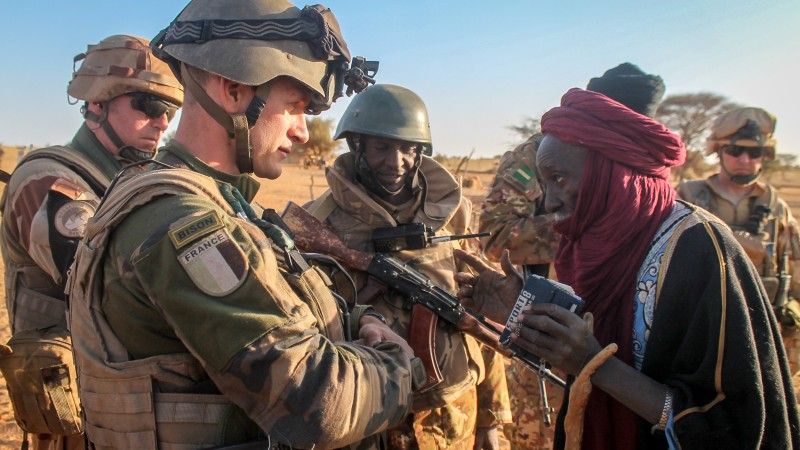
Operation Barkhane was the largest French antiterrorist mission in Sub-Saharan Africa and a key element of European security policy in the Sahel. Launched in 2014, it aimed to stabilise the region by supporting local forces and limiting jihadist expansion. A decade later, France withdrew, raising questions about the effectiveness, costs and long-term consequences of the mission.
There has been a long history of the French Republic’s involvement in Africa. It has entailed many aspects in which Paris has pursued objectives of a political, military, economic, but also social character. One of the largest military missions, both in terms of the number of French soldiers involved and the area in which they operated, is Operation Barkhane, which officially came to an end on 9th November 2022, according to a statement made by French President Emmanuel Macron.
Barkhane began in mid-2014, being a continuation of Operation Serval, targeting Al-Qaeda structures in the Islamic Maghreb. As far back as 2013, at the request of the Malian government, France decided on a military intervention aimed at neutralising the terrorist environment present in the Sahel region. The main objective of the French military deployment was to support local military forces in the fight against terrorism, coordinate the international coalition and support humanitarian action in favour of the local population.
The aim of the article is to systematize knowledge and investigate the activities of French entities, also within the EU missions, obliged to fight against terrorism in the Sahel, carrying out the largest antiterrorism operation in Sub-Saharan Africa. In the author’s opinion, some actions and projects were incorrectly planned and not adjusted to the scale of the challenge. France, almost 10 years, was not only forced to withdraw all soldiers from the most vulnerable regions, but also was not able to secure and stabilise peaceful and democratic governments, e.g. in Niger.

Functioning of the mission
The French army carried out operations in partnership with the countries of the Group of Five for the Sahel (G5 Sahel), which comprises: Burkina Faso, Chad, Mali, Mauritania and Niger. The strategic objective of France was to help the Sahel countries achieve military self-reliance so that they could provide security and stability in the region without the assistance of foreign forces. Humanitarian support missions were closely linked to the military aspect of the operation, as favourability shown by the local population towards the international coalition preventing the creation of new locations where terrorists could find refuge.
The French operation against terrorism in the Sahel was a difficult and demanding mission due to the vast area of activity. French troops had to operate on the territory of five countries, the total area of which is comparable to that of the EU countries. Until the beginning of June 2021, around 5100 French soldiers were involved in the operation, mainly in Mali, Niger and Chad (with the command headquarters located in the capital of Chad, N’Djamena), supporting and training the forces of the G5 Sahel countries.
In addition to French forces, around 3000 troops from the G5 countries took part in Operation Barkhane, depending on the actions taken. The costs of the mission after eight years were estimated to be quite extensive, ranging between EUR 650 million and EUR 1 billion per year. Another important aspect was support for the local population. In 2020, more than 130 combat and 100 civil-military operations were carried out, which improved, among others: access to water, energy and education in the region.
As part of European cooperation with the Malian military, France organised a special group called Task Force Takuba to support operations in the Liptako-Gourma region, where the Islamic State in the Greater Sahara (ISGS) and the Group for Support of Islam and Muslims (Arabian: Jama’a Nusrat ul-Islam wa al-Muslimin, JNIM) pose the greatest threat. Task Force Takuba was characterised by a high degree of autonomy, which greatly enhanced its operational activities.

Gradual French withdrawal
At the beginning of June 2021, President Emmanuel Macron announced a reduction in the number of French forces in the Sahel region, thereby initiating a paradigm shift in the Barkhane mission, resulting in losing its status as a foreign operation (French: les opérations extérieures, OPEX). In an initial phase, it was planned to gradually reduce the number of troops from 5100 to around 2500. Ultimately, the withdrawal of French troops took place throughout 2022, and on 9th November 2023, Macron formally announced Operation Berkhane as fully completed.
The deteriorating situation in the region and the impotence of the French military meant that the scenario of changing the operational model had been considered for a long time. The tactics and system used at that point to fight terrorists did not translate into increased stability in Mali, the country most affected by the activities of radical military organisations. The unstable political situation in Mali, which resulted, among other things, in a coup d«état in May, became an ideal pretext for changing the commitment of French forces in the Sahel, thereby leading to their reduction.
Moreover, the upcoming presidential elections at the time also had a strong influence on the decision, as the majority of French society was opposed to Operation Barkhane due to the high financial outlay on the state budget and its low effectiveness. Another reason was the escalating discord between Paris and Bamako, provoked, among other things, by France’s reluctance to enter into talks and negotiations with terrorists, pushed by the Malian government.
In the end of 2022, the presence of the French military forces was banned in Burkina Faso and this country followed Mali’s hard path. Moreover, both states agreed to host the Wagner Group (Russian Mercenaries – private military company) that clearly showed the strong relation between two Sahel countries and Russia.

French support for international missions
The United Nations Multidimensional Integrated Stabilization Mission in Mali (MINUSMA) was also supported by the French military. Around 14,000 personnels, consisting of soldiers and police officers, were involved in MINUSMA – the decade-long operation officially ended on 30th June 2023, with the adoption of Security Council Resolution 2690.
In addition, French forces were involved in EU operations in Africa. Established in 2013, at the request of the Malian government, the European Union Training Mission in Mali (EUTM Mali) was part of the security and development efforts of the EU in the Sahel region. The assistance provided by EUTM Mali consisted in developing the operational capabilities of Malian forces through military advice, training, education and mentoring. The mission activities were under the control of the legitimate civilian authorities of Mali and did not include combat operations. Ultimately, all foreign military missions were banned on the territory of Mali and Burkina Faso in 2023.

Challenges ahead
It must be stressed that after nine years of the Barkhane military operation, the balance of the French presence is negative. Although the French tactics can be called successful, the improvement and stabilisation in the region are hardly noticeable. The concentration of French efforts on military operations, while largely neglecting the political and social aspects, made any long-term and significant improvement difficult to discern, and any effects and successes were only temporary.
From May 2021 to July 2023, French forces struggled with military coups in Mali, Burkina Faso, Niger, Guinea, Chad, and Sudan. All French military engagement in the Sahel was significantly decreased, and Paris ceased to be the number one partner for the above-mentioned countries, both militarily and economically. After many years of trying to secure the Sahel region, the French forces had to withdraw due to the ability of terrorists to carry out constant attacks, and the commencement of the cooperation with Russia initiated by African juntas.
Conclusions
Barkhane represented a high priority foreign operation for the French Republic, which recognised the only chance to counter international terrorism through a military presence in West Africa. The optimism shown by Paris after the successes of Operation Serval, which turned into Barkhane, proved too premature. The multi-annual presence of international troops, the use of high-end military equipment and the training provided to the armies of the G5 Sahel countries have had a positive impact, however terrorists are moving into Niger, Burkina Faso, Sudan, Nigeria, Senegal and Côte d’Ivoire.
The decision to withdraw from Mali and then from the region—a move which France was de facto forced to make—has a number of implications for international involvement in the region. This is very dangerous for Europe, which is not ready for another wave of migration, as well as the international threat of terrorism. Despite the ineffectiveness of the French, they have maintained a relatively secure situation in the Sahel region.


