












- KOMENTARZ
- WAŻNE
- WIADOMOŚCI
France vs the United States. Rivalry in South America

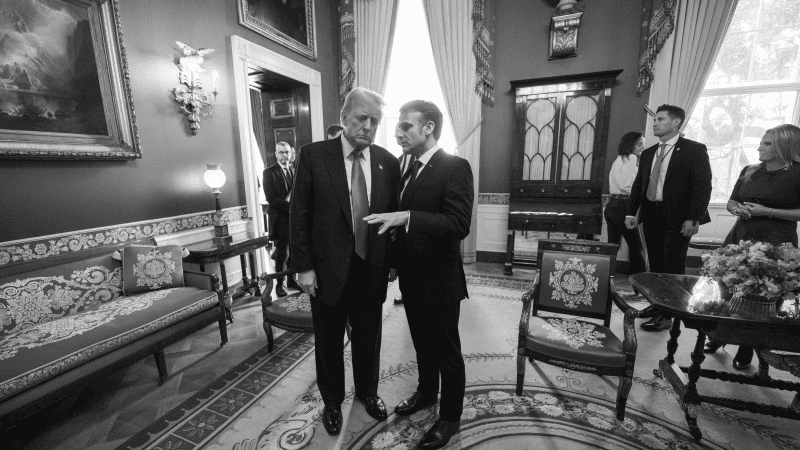
Actions taken by the United States in South America have triggered alarm in Paris. France is increasingly signalling that it will not passively observe the destabilisation of the region and will defend its interests in Guyana, Suriname and French Guiana. This time, the pressure is not coming from Moscow or Beijing, but from Washington.
In the Senate, within the Committee on Foreign Affairs, Defence and the Armed Forces, there is open anger and concern over the consequences of US policy towards Venezuela, Greenland and, more broadly, the northern part of South America. President Emmanuel Macron has publicly stressed that France has lost part of its key alliances and must redefine its role in the region. In the background, there is a growing fear that the United States will act unilaterally, with little regard for partners or international law.
Paris does not hide the fact that the scenario of American pressure on Guyana, Suriname and French Guiana has become both a strategic and immediate problem. This is not only about Venezuela, but about the entire north-eastern belt of South America, which has gained importance in recent years in terms of resources, energy and politico-military influence. French senators openly speak of the risk of „destabilising the neighbourhood” and undermining France’s presence in the region. In this context, French Guiana is no longer an exotic overseas department, but a centre of emerging rivalry.
France is not operating in South America in a vacuum. Significant forces are stationed in French Guiana. The Armed Forces in Guiana (FAG) number around 2,100 personnel and include land, naval and air components. The core units are the 9th Marine Infantry Regiment and the 3rd Foreign Infantry Regiment, deployed in Saint-Jean, Maripasoula, Saint-Georges and Camopi. This is supported by the naval base in Dégrad des Cannes with patrol vessels, and the air base in Cayenne with CASA CN-235 transport aircraft and Puma and Fennec helicopters. There is also the Mont Venus radar and a military command centre at the Kourou spaceport. These are not symbolic forces. Their tasks include border control, combating illegal gold mining, smuggling and illegal fishing, and above all, protecting the Guiana Space Centre, which is critical for both France and Europe.
France has not only military presence in the region, but also operational experience, infrastructure and the ability to sustain long-term military activity. In practice, Paris has the tools to react – and to react quickly – to any attempt to undermine stability in its immediate environment, including in Guyana and Suriname. In the past, France has also signalled readiness to respond militarily to threats from Venezuela.
An additional complicating factor is the intelligence cooperation with the United States. France has provided Washington with satellite data and reconnaissance information to monitor the situation in Venezuela. This was intended to support situational awareness, not to prepare for direct action. Paris was not informed about plans for a direct operation, which now raises serious questions about transparency in US dealings with European partners.
In Paris, the argument is increasingly voiced that US actions violate international law and introduce unpredictability and instability into a region that had previously been relatively stable. Concerns now extend beyond Venezuela to include French Guiana, Suriname and Guyana, which may become areas of competition or collateral impact. For France, this is unacceptable, as it directly challenges its sovereignty and credibility as a state capable of defending its own territory, including its overseas departments.
In practical terms, this means that Franco-American rivalry is entering a new phase. For the first time in years, it is not focused on the Middle East, Africa or the Indo-Pacific, but directly on South America and an area that is part of the European Union. France does not intend to step back, either politically or militarily. This is no longer a contest over influence. It is a contest over presence, control and the ability to act independently in a region that has suddenly moved to the centre of US military, political and resource-driven interest.


