












- KOMENTARZ
- WIADOMOŚCI
- WAŻNE
From F-35 to $1 trillion investments. Washington and Riyadh are reinforcing alliance

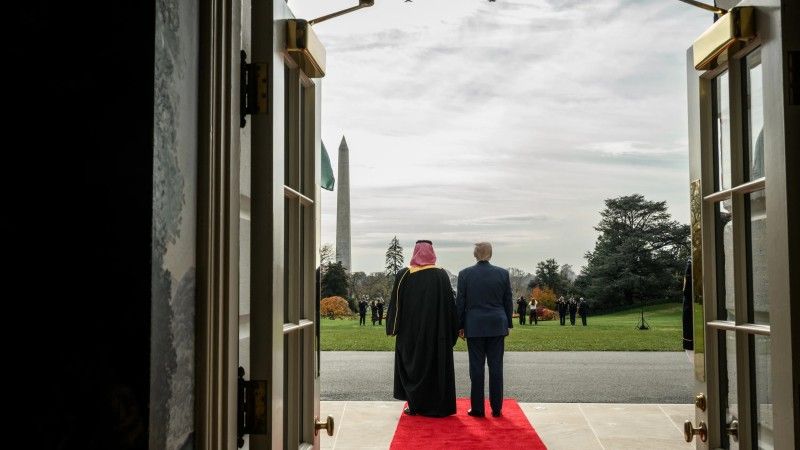
This week the world could see the real example of the deepening ties between Washington and Rijad. Behind the luxury and symbolic gestures Donald Trump and Mohammed bin Salman (MBS) discussed the security and economic relations, focusing on bilateral defence pact as well as Saudi-Israeli normalisation process.
The turning point came when Donald Trump announced on Monday that he will sell Saudis forty-eight F-35 fighter jets. Thanks to that Kingdom of Saudi Arabia (KSA) become the first Arab state to own these advanced multirole fighters. Moreover, on Tuesday both parties signed the Strategic Defence Agreement aimed at strengthening deterrence across the Middle East. However, it is important to note that this arrangement should not yet be regarded as a pact committing the United States to actively defend the Kingdom, like NATO art.5.
Importantly, Donald Trump named Saudi Arabia as the major non-NATO ally status, which enables KSA the access to intelligence information, broader possibility to purchase American weapons and approach to common research. Historically, U.S. administrations have maintained that gateway to advanced American military technologies would be dependent on the progress in normalising relations with Israel. However, at least during this meeting, rapprochement between Riyadh and Tel Aviv does not appear to be a priority for President Donald Trump.
In terms of business, Crown Prince announced that Saudi Arabia will increase the investment in U.S. at the level of $1 trillion. Among signed agreement it is worth to indicate strategic partnership covering artificial intelligence and civilian nuclear agreement. Rijad to would like to obtain the U.S. nuclear technology but without Washington’s consent for the enrichment process.
However, still there is not a huge progress in terms of Saudi joining to Abraham Accords. Riyadh says yes to normalisation, but only in conjunction with two states solution. As MBS mentioned: „We want to be part of the Abraham Accords, but we want also to be sure that we secure a clear path to a two-state solution”. Currently, Sauds are distancing themselves from this vision as it could provoke discontent within the Arab community and, indirectly, pose a threat to the dynasty’s legitimacy.
Undoubtedly, Saudi-U.S. relations show a marked reversal compared to the approach during President Biden’s tenure. With Donald Trump in office, the bilateral relationship is evolving toward a pragmatic and transactional framework. Nevertheless, still there are a lot of topics that will come back in the future - the normalisation of Saudi-Israeli relations, combined with further advanced agreements – related to defence pact and the Saudi possibility to enrich the uranium.
Beyond the personal dimension, the visit contributes to strengthening the Kingdom’s global position - as an ally of the U.S., and the leader of the Arab community. It also proved that Saudi Arabia is not only the custodian of Islam’s holiest sites but a country that matters in the international relations.


