












- WIADOMOŚCI
- OPINIA
G2 – the calm before the storm?

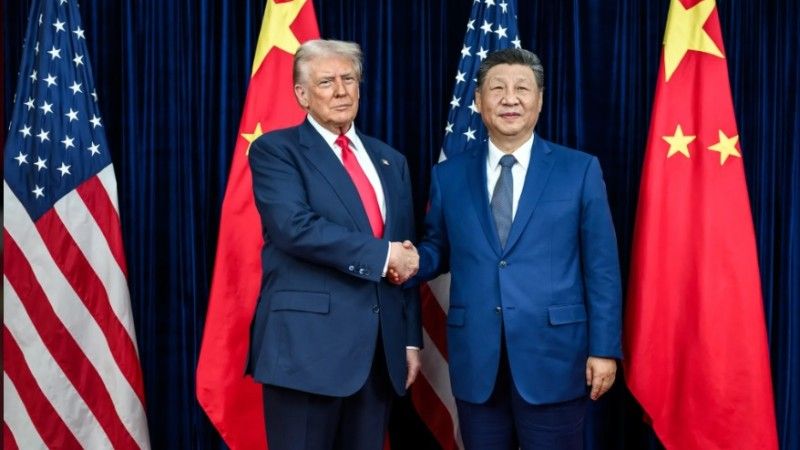
The confrontation between the United States and China has long seemed inevitable. But Donald Trump – a businessman by all account – proposed creating a rather exclusive club for the world’s two largest economies. Why fight when there is room not only for cooperation, but even for shaping a new world order – side by side?
Since the start of Donald Trump’s second presidency, the world has been bracing itself for a tectonic shift in American foreign policy. Not a fan of the EU or the post-Cold War multilateral order, Trump is far more drawn to the idea of a concert of powers. But first, he had to define what a superpower actually is. For the American president, there is one metric that applies to everything: money. Trump likes to remind voters that no economy can compete with America’s. Yet even the world’s largest economy needs a benchmark to show its true scale – the one just below it. Trump is convinced that China is the only real rival to the United States in economic terms, and the relationship between the two countries is far from stable.
Why? On the one hand, the American leader needs to push the relationship to the edge to achieve his long-term domestic goals, such as bringing jobs back to the U.S. On the other hand, Trump deeply believes – as he wrote in The Art of the Deal – that keeping pressure high during negotiations produces the best possible outcome.
On top of that, Donald Trump frequently claims that Xi Jinping is his personal friend. He is convinced that leaders are the personification of their countries: the U.S. cannot have a good relationship with any state if the heads of state do not get along. That is why Trump wants to strengthen his personal bond with Xi – this is the American, or rather Trump-style, way of diplomacy, in stark contrast to the more reserved and hierarchical Asian manner. Trump talks a lot, sketches out ambitious plans, often without any firm „yes” from his counterpart. He is accustomed to the politics of fait accompli. China, however, stays mostly silent and keeps its distance from Trump’s occasional „love-bombing.” The shadow cast by its interests is much longer.
Trump’s approach also assumes that the world’s richest countries should be the ones to address global challenges and establish regional spheres of influence – on the condition that they maintain a kind of benevolent indifference toward one another: no deep cooperation, but no open hostility either. The world is their playground, and only two superpowers together can pressure actors resistant to any other form of influence. Trump believed that China, with its influence over Russia, was essential to any peace process in Ukraine. That is why he raised the issue during his meeting with Xi in South Korea.
The informal G2 duopoly is a proposal for a bipolar world – a new world order. But it is not a Cold War–style bipolarity based on confrontation and hostility. For Trump, it is a temporary arrangement – but not a short-term one. Beneath the surface, tension between the two countries is likely to remain for good. Yet for their own sake, and of course for global stability (and the economic benefits that come with it), G2 is meant to function as a new mode of coexistence.
Since his inauguration, Donald Trump appears to have reoriented U.S. foreign policy toward China – with an inevitable confrontation somewhere on the horizon. This perspective, casting China as the principal adversary, also appears in Project 2025. Not to mention that the chief architect of America’s China policy, Elbridge Colby, is himself inclined toward a more realist – and potentially confrontational – stance.

With all this in mind, G2 is meant to postpone that confrontation and gauge the other side’s intentions. It creates space for negotiation and provides a mechanism for managing conflicts in which the U.S. and China stand on opposing sides. And it is not just about Ukraine – the key issue is, of course, Taiwan, which was surprisingly absent from official statements after the Trump–Xi talks.
Seen this way, it becomes clear that there are many issues that bring the U.S. and China together – sometimes even more than those that divide them. Besides attempting to reshape the global order and build regional spheres of influence, neither country intends to let others join this exclusive G2. Both prefer to focus on their own development – even if competition never disappears.
This rivalry was evident from the earliest days of Trump’s second administration and survived the test of the tariff-based trade war. Trump wanted to see how far China would go, while China watched how much he would let slide. For the American president, this approach – even if not always politically convenient – was a form of active negotiation. And Trump, as a businessman, tends to respect those who push hard in pursuit of ambitious goals.
While China’s approach to G2 remains cautious, Xi Jinping has hit „pause” on rare-earth mineral export controls – giving Donald Trump an instant success to showcase at home. And although the American president is openly willing to keep the dialogue going – relying largely on his personal relationship with Xi – some in his inner circle see China strictly as a threat that must be addressed sooner rather than later.
G2 is still in its early phase, but if it depends solely on Trump–Xi relations, this formula for rapprochement may remain stuck at this stage, never developing into deeper cooperation. Why? Because although it is agreed that G2 consists of the U.S. and China, there is no guarantee that the balance between them will remain unchanged. And while both economic powers will keep distancing themselves from others by leveraging their advantages – not only natural resources – the rivalry between them will only intensify, even if neither side admits it openly.
Donald Trump needs time and room to approach China more strategically – which is why he is in a hurry to bring regional wars involving the United States to an end. All so that he can devote his full attention to creating and executing a winning strategy in the big game – and remain number one in G2


