












- ANALIZA
- WIADOMOŚCI
India’s Triple Game – USA, EU and Russia: A Summary of 2025

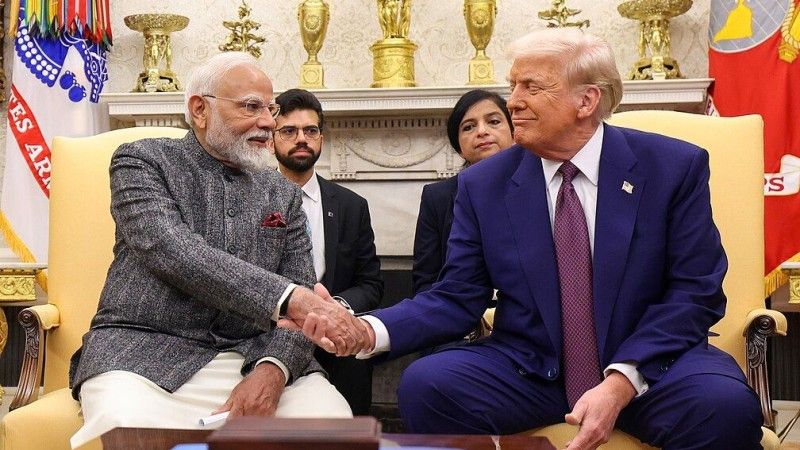
India’s foreign policy in 2025 is defined by balancing among several powers, primarily the US, EU and Russia. In the long run, this strategy could prove advantageous for New Delhi.
One of the core principles of India’s foreign policy since regaining independence in 1947 has been the pursuit of good relations with as many countries as possible, while avoiding unequivocal alignment with any single side in global conflicts. In recent years, this approach has once again come to the fore – this time within a triangular configuration involving the United States, the European Union, and Russia. The end of 2025 brought the failure to conclude a free trade agreement between the EU and India, a development that could be seen as a symbolic encapsulation of this eventful year – though neither side has abandoned hope. Just weeks earlier, Russia’s Vladimir Putin celebrated the success of his visit to New Delhi. At present, India’s relations with the United States appear to be the most strained, although even there some cautiously positive signals have emerged.
Difficult negotiations with the United States
The United States remains India’s most important trading partner, with annual trade amounting to approximately USD 210 billion. It was precisely on this front that India suffered its most significant diplomatic setback this year. Expectations linked to the return of Donald Trump – well regarded by Prime Minister Narendra Modi – proved illusory. After several months of difficult negotiations, in August 2025 the United States imposed tariffs on Indian goods at a level of 50 percent – the highest in the world. The accompanying rhetoric, suggesting that India was profiting from the war by purchasing discounted Russian oil, was poorly received in New Delhi. Equally unwelcome were claims that the United States, and President Trump in particular, had played a decisive role in de-escalating the India–Pakistan conflict in the spring of this year. The sudden rapprochement between Washington and Islamabad further aggravated Indian sensitivities, especially given the exceptionally successful state of U.S. – India relations during Trump’s previous term and almost equally positive period under the Biden administration.
Toward the very end of the year, however, a glimmer of hope appeared. In mid-December, Modi and Trump held what was described as a „very warm” telephone conversation, accompanied by announcements of a potential improvement in relations. On December 27, a spokesperson for India’s Ministry of External Affairs confirmed that dialogue was ongoing with the United States to negotiate „a fair, balanced, and mutually beneficial bilateral trade agreement.”
See also 

The European Remedy
India sought to offset the deterioration in trade relations with the United States by deepening cooperation with the European Union. In response to Trump’s initial announcements of tariff increases, New Delhi and Brussels declared their intention to conclude a Free Trade Agreement (FTA) by the end of 2025. Negotiations – already ongoing for nearly two decades! – accelerated markedly, and in September and October it appeared plausible that an agreement could indeed be finalized by year’s end. Much of this optimism, however, was of an „official” nature.
Subsequently, contentious issues emerged, including the EU’s Carbon Border Adjustment Mechanism (CBAM) and access to the Indian automotive market. It was decided to set these aside and focus instead on announcing a swift success based on „easier” topics. Even this approach ultimately failed. The negotiations will not be concluded by December 31, 2025, and it is highly unlikely that this will occur in the coming months.
Nevertheless, relations between India and the EU continue to improve, and the negotiations will eventually be concluded, followed by the signing and ratification of the FTA—although the path remains long. Resistance is not limited to the Indian side; in Europe, too, the number of critics of the agreement is likely to grow. According to press reports, European Commission President Ursula von der Leyen and European Council President António Costa will be the chief guests at India’s Republic Day celebrations in New Delhi on January 26, 2026. An EU–India Summit will also take place on that occasion, with the FTA as its central topic. In Indian diplomatic tradition, Republic Day invitations are extended to particularly important partners, underscoring the significance India currently attaches to its relationship with the European Union.
India's friend Putin
Playing on yet another front, India welcomed Russian President Vladimir Putin on December 4–5 with an almost surprising degree of pomp. Indo-Russian relations, traditionally strong, acquired a new dimension following Russia’s aggression against Ukraine. As Moscow lost access to Western markets, it began selling oil to India, which now accounts for USD 60 billion of the USD 70 billion in bilateral trade. This development has drawn sharp criticism from Western countries and, as noted earlier, was used by Trump as justification for raising tariffs on Indian goods.
Toward the end of the year, India began sending mixed signals regarding a possible reduction in oil purchases. The United States imposed sanctions on Reliance, which buys oil from Rosneft, but – according to news agencies – agreed to a one-month exemption. This suggests that while American pressure is real, there remains room for negotiation and limited concessions.

The Longer-Term Perspective
In the short term, the outlook does not appear favorable for India: maximum U.S. tariffs, the failure of negotiations with the EU, and relations with Russia at a level that can scarcely be expanded further – benefiting Moscow more than New Delhi. Yet in India’s case, a short-term perspective is rarely the appropriate one; the country is simply too large to operate within cycles measured in months.
From a longer-term vantage point, all three actors – the EU, the United States, and Russia – as well as others such as Japan and the United Arab Emirates, seek to maintain a presence in India and deepen cooperation. Each, however, aims to get the greatest possible advantage from this engagement. This explains the United States« aggressive tariff policy and the EU’s accelerated FTA negotiations: a shared desire to be present in India, to sell as many goods as possible, and to pursue new investments. Russia has arguably achieved as much as it can at present, though it continues to seek new areas of cooperation, including nuclear energy.
This dynamic irritates Western partners, yet Europe has increasingly recognized that the most effective way to weaken Russian influence in India is not through pressure, but by replacing it – by offering better products at more competitive prices. On the very day of Putin’s visit to New Delhi, advertisements for French military equipment appeared in the Indian press. This is the path the European Union has chosen to follow, aiming for mutual benefit.


