












- WIADOMOŚCI
Japan’s expanding arms export

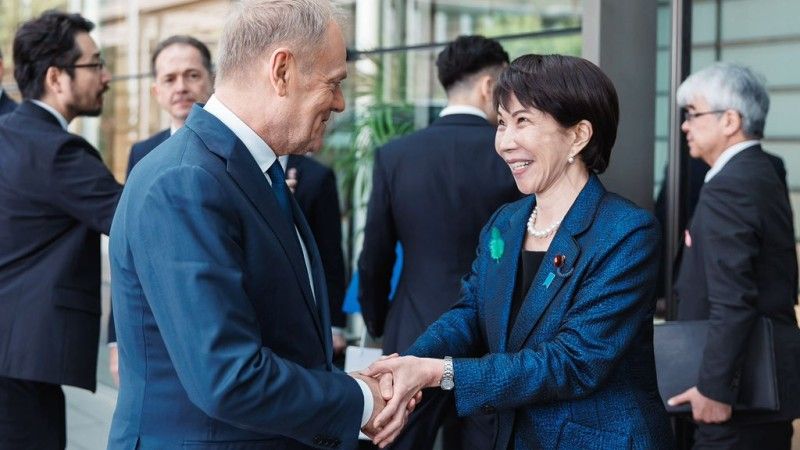
Photo. @donaldtusk / X.com
More and more countries are investing in Japanese weaponry due to the ease of arms export. Could there be an alternative to the US?
Since World War II, Japan has been, more or less, isolating itself from global arms markets. The country itself spends $60 billion on its own defence industry. This week, Prime Minister Sanae Takaichi’s ruling party has approved changes regarding the rebirth of the country’s military industrial base. It is said that Japanese defence contractors – Toshiba and Mitsubishi Electric – are already hiring staff and adding capacity in response to rising demand.
The Polish military and the Philippine navy have emerged as potential new customers. The first export will likely consist of used frigates. They are to be sent to the Philippines in order to support the state in maritime confrontation with Beijing in the South China Sea, two Japanese officials report. For now, China’s foreign ministry did not respond to questions about Japanese support in the region. Ministry spokeswoman Mao Ning has, however, mentioned that Beijing was concerned about changes in Japanese arms export policy. She said that Tokyo should “act prudently in military and security areas.”

Poland and Japan can both be interested in plugging the gaps in each other’s arsenal. They could also cooperate in the areas of anti-drone and electronic warfare systems. While no information about an official arms deal has surfaced, we know that Poland and Japan have recently raised relations to the highest level — comprehensive strategic partnership. Except for the expansion of cooperation in the economy and energy sectors, both parties drew attention to the need to develop cooperation in the security sector.
The change in Japan’s approach to arms export provides a chance to lessen Europe’s dependence on US products. The unpredictability of Trump’s foreign policy, including threats of invading Greenland and leaving NATO, demands a response from Western leaders. Much like the need to severing the dependence on Russian energy at the beginning of the war in Ukraine, Europe now needs to seek diversification and independence from US arms.

Japanese ease of arms export has not been a sudden decision. It’s a long process that began more than a decade ago when the late Prime Minister Shinzo Abe eased a near-blanket ban on exports to encourage joint arms development with Japan’s allies. The decision was made in response to China’s growing military power in the region. Now Takaichi’s decision has eased the export even more. Some of the Japanese defence companies claim they are ready to adapt to the changes.
Air defence systems builder Toshiba told Reuters that it plans to hire about 500 people in the next three years and is also constructing new testing and manufacturing facilities. Reuters has also reported that Mitsubishi Electric is hiring for an overseas sales role covering fighter aircraft and other military exports.

The US has long dominated global military supply chains. According to a March report by the Stockholm International Peace Research Institute (SIPRI), between 2021–2025 the US has accounted for 95% of Japan’s defence imports, 85% of Australia’s and Britain’s purchases and 77% of Saudi Arabian buys. Japan is trying to build a supply chain in Asia that does not require the involvement of the United States. It is not the only state interested in large-scale arms export in the region. South Korea is already the largest defence supplier to Poland and the Philippines. Japan, however, is the world’s fourth largest economy, so its potential is even greater.


