












- ANALIZA
- WIADOMOŚCI
Lee Jae Myung's first year: Stabilisation through pragmatism

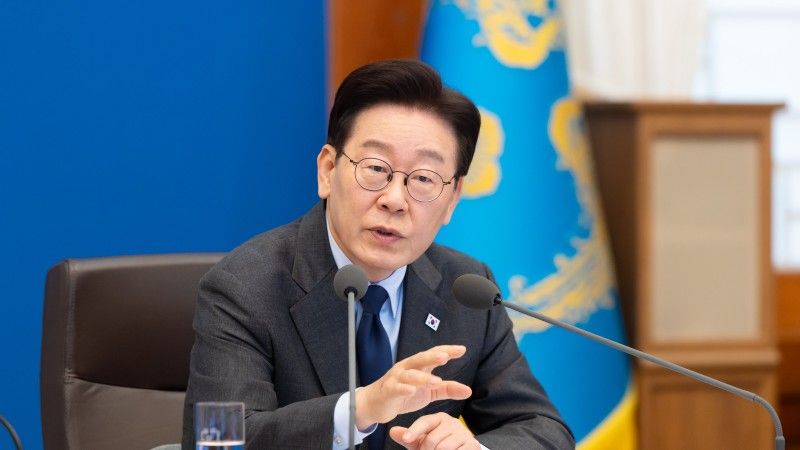
Photo. @KOREA / X.com
Lee’s first year was less about launching a new political era than about stabilising a country shaken by a constitutional crisis. His administration sought simultaneously to restore democratic legitimacy, revive economic confidence, and reposition South Korea internationally through a strategy he termed „pragmatic diplomacy”.
Democratic recovery and the politics of legitimacy
Lee Jae Myung entered office under extraordinary circumstances. His presidency was born from one of the most severe political crises in South Korea’s democratic history. The declaration of martial law by President Yoon Suk Yeol on 3 December 2024 triggered a constitutional crisis that culminated in Yoon’s impeachment and removal from office. Consequently, the first challenge facing the new administration was not the implementation of an ambitious reform agenda, but the restoration of political stability, public trust, and confidence in democratic institutions.
In this respect, Lee’s first year can largely be viewed as a success. South Korea avoided prolonged political paralysis or institutional breakdown. Democratic governance was restored through constitutional procedures, reinforcing the resilience of the country’s democratic system. Equally important was the role played by civil society. Citizens mobilised rapidly against the martial law decree, gathering in front of the National Assembly and other sites to defend democratic institutions. The significance of these events was reflected in the nomination of South Korean citizens for the 2026 Nobel Peace Prize, with supporters arguing that the peaceful defence of constitutional order provided an important example at a time when democratic backsliding has become a global concern.
The Lee administration has actively incorporated this narrative into its political messaging. Government officials and President Lee himself have portrayed South Korea as a model of democratic resilience, emphasising the ability of citizens and institutions to overcome an attempted authoritarian reversal through peaceful and constitutional means. This narrative has become an important component of the administration’s broader effort to restore international confidence in South Korea after months of political uncertainty.
At the same time, Lee has sought to reshape the relationship between government and citizens through an unusually direct style of communication. Long known for his intensive use of social media, he has continued this approach as president. Frequent posts on X and other social media platforms and direct communication with the public have become hallmarks of his governing style. Supporters argue that these practices have increased transparency. Some observers have even suggested that this may establish a new standard of openness that future governments will find difficult to reverse.
Nevertheless, democratic recovery should not be equated with democratic consensus. While the constitutional crisis has been resolved, political polarisation remains a defining feature of South Korean politics. The governing Democratic Party and the opposition People Power Party continue to clash over judicial reforms, institutional changes, and the interpretation of recent political events. Thus, the deeper challenge of overcoming polarisation and rebuilding a broader political consensus remains unresolved.

Economic recovery: Between AI optimism and structural vulnerabilities
If democratic recovery was the immediate political challenge facing Lee Jae Myung upon taking office, economic recovery quickly became the administration’s central governing priority. Following months of political uncertainty and growing concerns about slowing growth, the new government sought to restore confidence among investors, businesses, and consumers while laying the foundations for South Korea’s long-term economic competitiveness.
The administration’s economic strategy has combined short-term measures aimed at stimulating domestic demand with a more ambitious vision centred on artificial intelligence, advanced manufacturing, and industrial transformation. The most visible indicator of renewed confidence has been the performance of South Korea’s stock market. Within a year of Lee’s inauguration, the benchmark KOSPI index experienced one of the strongest rallies among major global economies, rising from below 3,000 points to above 8,000.
The Lee administration introduced a series of corporate governance reforms, including strengthened fiduciary duties for directors, enhanced protections for minority shareholders, stricter audit requirements, and measures designed to combat stock market manipulation. These reforms have been welcomed by many investors and have contributed to the perception that South Korea is becoming a more attractive and transparent market.
At the same time, the government has made artificial intelligence one of the pillars of his long-term economic vision. The administration has launched an AI strategy, including plans for massive investment in AI infrastructure, semiconductor production, advanced manufacturing, biotechnology, defence technology, and digital innovation. Large-scale public and private investment funds have been proposed to support these sectors, reflecting the government’s belief that technological transformation is essential if South Korea is to avoid the economic consequences of demographic decline and maintain its position among the world’s leading industrial economies.
However, assessing the administration’s economic achievements requires caution. South Korea continues to face uncertainty arising from trade tensions, geopolitical instability, and changing U.S. economic policies. The administration’s own growth forecasts remain relatively modest despite the optimistic narrative surrounding AI and technological transformation.

Pragmatic diplomacy: Rebuilding Korea's international position
Beyond domestic stabilisation and economic recovery, one of the defining features of Lee Jae Myung’s first year has been an effort to restore South Korea’s international standing through what the administration describes as „pragmatic diplomacy”. Rather than pursuing a strongly ideological foreign policy orientation, Lee has emphasised national interests, economic security, and strategic flexibility. This approach emerged partly in response to a rapidly changing international environment characterised by intensifying U.S.–China rivalry, growing uncertainty surrounding American foreign policy under President Donald Trump, ongoing regional security tensions, and increasing concerns over supply chain resilience and energy security.
The cornerstone of South Korea’s foreign policy remains its alliance with the United States. During its first year, the Lee administration maintained close coordination with Washington on security, trade, and advanced technologies, while simultaneously seeking greater strategic autonomy. While the alliance remained strong, the last year also exposed several sources of tension in U.S.–ROK relations. Unilateral tariff measures introduced by the United States, or concerns surrounding the treatment of Korean companies operating in the U.S. led to broader uncertainty associated with the Trump administration. These developments, alongside discussions on Korean nuclear-powered submarines and greater strategic autonomy, reflected Seoul’s growing desire to reduce vulnerabilities in an increasingly uncertain security environment.
Perhaps the most visible success of Lee’s diplomatic strategy has been the continuation and expansion of rapprochement with Japan. Despite his earlier reputation as a critic of Tokyo’s approach to historical issues, Lee has adopted a pragmatic stance, maintaining regular summit diplomacy and expanding cooperation in areas such as economic security, energy, and AI. Symbolic initiatives, including a joint agreement to identify through DNA testing Korean victims of forced labour who died in a wartime mining accident in Japan, have demonstrated a willingness to address sensitive historical issues without allowing them to derail broader cooperation. However, the relationship remains constrained by unresolved disputes over history and territory. The cancellation of a planned joint maritime search and rescue exercise (SAREX) in late 2025 following renewed tensions over historical issues illustrated how quickly longstanding disagreements can resurface. The exercises were finally resumed on June 7, 2026, with one ship from each country participating, plus a Japanese helicopter. As a result, while bilateral relations are currently among the strongest in years, they appear to rest less on a reconciliation than on a pragmatic management of differences driven by shared strategic interests.
Lee has simultaneously sought to stabilise relations with China. His January 2026 visit to Beijing – the first by a South Korean president in six years – was intended to signal a desire for normalisation and renewed cooperation. The visit produced a number of tangible outcomes, including progress on free trade negotiations and agreements covering technology, trade, transportation, and investment. However, significant differences remained. China avoids explicitly supporting South Korea’s objective of North Korean denuclearisation, while unresolved disputes regarding cultural exchanges, economic competition, and regional security continue to limit the scope of bilateral rapprochement. As a result, Lee’s China policy can be characterised as careful management of differences.
Beyond East Asia, the Lee administration has actively expanded South Korea’s network of strategic partnerships. A particularly important development was the elevation of relations with Poland to the level of a Comprehensive Strategic Partnership in April 2026 during Prime Minister Donald Tusk’s visit to Seoul. The agreement significantly broadened future cooperation in defence, advanced technologies, AI, semiconductors, infrastructure, energy, and research and development.
The Lee administration has also devoted increasing attention to Southeast Asia as part of its broader strategy of diversifying South Korea’s diplomatic and economic partnerships. Seoul has sought to strengthen ties with ASEAN countries through expanded cooperation in trade, investment, and technology. The elevation of relations with Singapore to a Strategic Partnership in late 2025, followed by Lee’s state visits to Singapore, the Philippines, and Vietnam in 2026, underscored the importance of Southeast Asia in South Korea’s foreign policy.
Taken together, these initiatives reveal a foreign policy centred on diversification rather than on alignment. Rather than choosing between Washington, Beijing, and Tokyo, Lee has sought to strengthen ties with different partners while minimising geopolitical risks. Whether this balancing act can be sustained as strategic competition intensifies remains uncertain. Nevertheless, the first year of the Lee administration suggests that pragmatic diplomacy has become the organising principle of South Korea’s external engagement, allowing Seoul to rebuild international confidence while positioning itself as an increasingly influential middle power in a fragmented global order.
Security policy: Managing risk in a more dangerous world
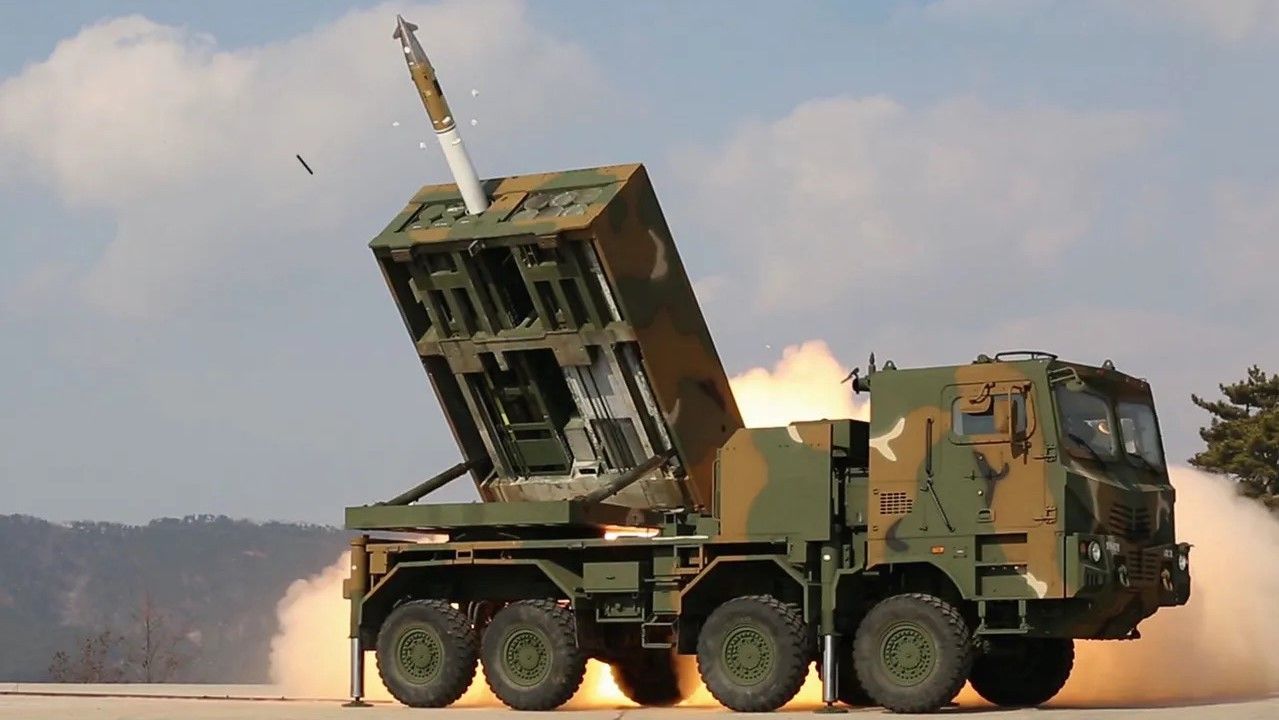
While Lee Jae Myung’s foreign policy has been defined by pragmatism and diplomatic engagement, his administration’s security policy has been shaped by a growing recognition that South Korea faces a more complex and unpredictable environment than at any point in recent decades. Traditional military threats from North Korea remain significant, but they are increasingly intertwined with challenges related to economic security, energy dependence, and geopolitical instability.
One of Lee’s key objectives has been reducing tensions with North Korea and restoring the possibility of dialogue. In contrast to the more confrontational approach of his predecessor, the new administration has emphasised peaceful coexistence, confidence-building measures, and the resumption of inter-Korean communication. Lee has repeatedly stated that his government respects North Korea’s political system, rejects any policy of regime change or unification by absorption, and seeks to rebuild trust through practical actions rather than rhetorical confrontation. The administration has also expressed its willingness to facilitate renewed dialogue between Pyongyang and Washington, positioning South Korea as a mediator and „pacemaker” in future diplomatic efforts.
However, the results of this approach have so far been limited. North Korea has shown little interest in restoring relations with Seoul and has continued to deepen its rhetoric portraying the two Koreas as separate states. Kim Jong-un’s regime has maintained its rejection of inter-Korean engagement while focusing on strengthening military capabilities and expanding strategic cooperation with Russia. Incidents such as the unauthorised civilian drone flights into North Korean territory further complicated Seoul’s efforts to reduce tensions.
At the same time, the administration has increasingly framed economic security as an essential component of national security. The crisis triggered by U.S. strikes on Iran and Tehran’s retaliatory actions provided a particularly powerful reminder of South Korea’s dependence on imported energy resources. Concerns regarding disruptions to oil and liquefied natural gas shipments through the Strait of Hormuz exposed vulnerabilities not only in the country’s energy sector but also in strategically important industries such as semiconductors and advanced manufacturing. These developments have reinforced government efforts to diversify energy sources (e.g., by tripling oil imports from Canada), strengthen strategic reserves, and reduce dependence on vulnerable transportation routes.

Korea's emerging identity as a democratic middle power
Beyond individual policy achievements, the first year of Lee Jae Myung’s presidency has been marked by an effort to redefine how South Korea understands its role in the world. The administration has consistently presented the country not merely as a successful economy or an ally of the United States, but as a democratic middle power capable of shaping regional and global developments.
Unlike major powers that seek to shape international politics through military or economic dominance, middle powers typically rely on diplomacy, coalition-building, and soft power. Lee’s strategy of maintaining strong ties with the United States while simultaneously improving relations with China, Japan, selected European and ASEAN countries reflects this logic. Rather than choosing sides in an increasingly polarised international environment, South Korea has sought to expand its diplomatic flexibility and present itself as a stabilising actor capable of engaging with multiple partners. This approach reflects both geopolitical necessity and an ambition to increase Seoul’s international influence beyond the constraints traditionally associated with its position between larger powers.
This strategy consists of several elements. First, presenting democratic resilience globally as a Korean success. Second, positioning South Korea at the forefront of technological transformation. Third, cultural influence. The Lee administration has continued to support the international expansion of Korean popular culture, tourism, and creative industries while increasingly linking cultural diplomacy with technological innovation. In official narratives, K-pop, K-dramas, and even „K-democracy” are presented as complementary sources of soft power that enhance South Korea’s international reputation. This reflects a broader understanding of influence in which cultural attraction, technological excellence, and democratic legitimacy reinforce one another.

Conclusions
One year after taking office, Lee Jae Myung can point to a number of tangible achievements. His administration successfully restored political stability, rebuilt confidence in democratic institutions, revived investor optimism, and expanded South Korea’s diplomatic engagement with key partners. At the same time, it articulated an ambitious vision of the country as a democratic middle power, a leading AI economy, and a globally influential cultural actor.
Yet the first year of Lee’s term should be understood primarily as a period of stabilisation and strategic reorientation rather than a completed transformation, marking the beginning of a new, multifaceted vision for South Korea’s domestic governance and international engagement. Political polarisation remains deeply entrenched, economic growth continues to depend heavily on the semiconductor sector and energy imports, relations with North Korea show little sign of improvement, and intensifying geopolitical competition presents growing challenges for Seoul’s strategy of pragmatic balancing.
Nevertheless, the administration has largely succeeded in achieving its most immediate objective: restoring confidence in South Korea at home and abroad after a period of profound political uncertainty. Whether this initial stabilisation can be translated into lasting economic, political, and diplomatic transformations will ultimately determine the legacy of Lee Jae Myung’s presidency.


