












- WIADOMOŚCI
Lukashenka shows up in Indonesia

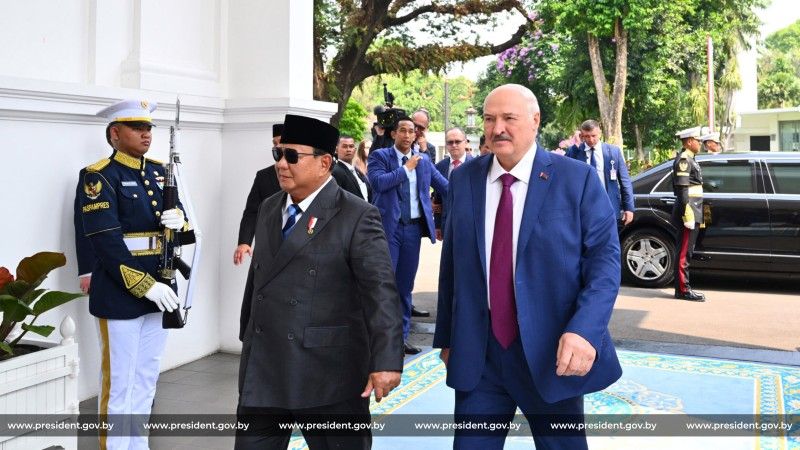
Photo. President of the Republic of Belarus / https://president.gov.by/en
After 2020, Alyaksandr Lukashenka was supposed to be politically marginalised and reduced to a dependent executor of the Kremlin’s will. His visit to Indonesia shows something different: the Belarusian leader is still looking for space outside Europe, building contacts with the Global South and trying to prove that Minsk should not be seen only as an extension of Russia.
Lukashenka was received in Jakarta with full state protocol. The meeting with President Prabowo Subianto, the formal welcome ceremony, the honour escort, bilateral talks and the Indonesia–Belarus Cooperation Roadmap for 2026–2030 all matter for Minsk beyond the documents themselves. Belarus wants to show that despite sanctions, Western isolation and dependence on Russia, it still has access to major non-European partners.
Indonesia is not a random destination. It is Southeast Asia’s largest economy, a growing global player, a major food-security market and a state with a tradition of multi-vector diplomacy. For Lukashenka, this means room to discuss fertilisers, agricultural machinery, manufacturing, supply chains, technology and access to wider Eurasian trade links. For Indonesia, the relationship with Belarus appears mostly pragmatic: agriculture, food security, trade, industry and economic diversification.

It is also worth noting that Indonesia is not peripheral in defence politics. It is one of France’s important arms customers and a partner country of France’s military parade. This makes Lukashenka’s visit more symbolic. The leader of a sanctioned state is received with honours in a country where Western capitals, including Paris, are also trying to build influence. It shows that outside Europe, the isolation of Minsk has clear limits.
Lukashenka is working on several tracks at the same time. He remains dependent on Russia, develops relations with China and searches for openings in Asia, Africa and the Global South. His aim is clear and obvious: to show that Belarus has not been fully locked inside Russia’s sphere and that Minsk can still conduct its own foreign policy, even within limits set by the Kremlin. The visit to Indonesia does not change Belarus’s strategic dependence on Moscow, but it helps Lukashenka tell the world that he is not simply standing under Putin’s boot.


