












- WIADOMOŚCI
New icebreaker deal deepens U.S.-Finland Arctic ties

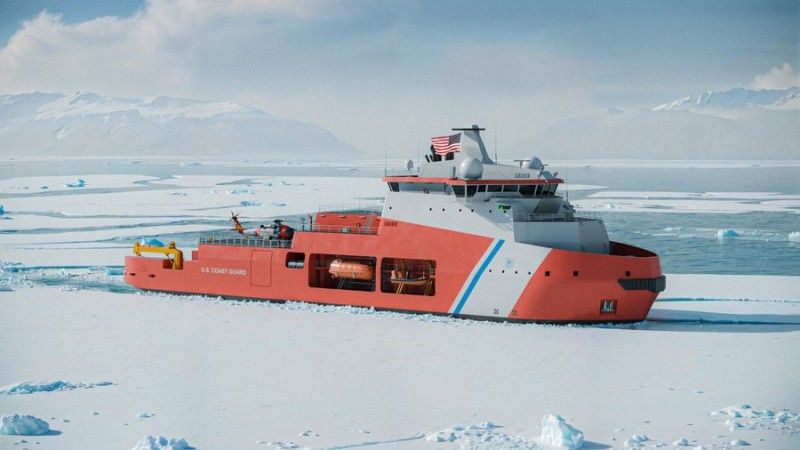
The U.S. Coast Guard will acquire new Arctic Security Cutter (ASC)-class icebreakers. Finland will play a role in strengthening U.S. forces in the polar region.
The U.S. Coast Guard fleet will expand significantly. Currently operating the heavy icebreaker USCGC Polar Star and the medium icebreakers USCGC Healy and USCGC Storis, the service will acquire five additional ASC-class icebreakers (a new class) ready to carry out missions “in the world’s harshest maritime conditions.”
Fleet Expansion
In February this year, it was announced that the new icebreakers would be built by the American company Davie Defense (part of the British Inocea group). The agreement has now been finalised, and the contract between the United States Coast Guard and the company in question will be worth $3.5 billion.

Photo. Davie Defense
Under the agreement, three vessels will be built at Gulf Copper facilities in Galveston and Port Arthur, Texas, while two will be constructed at a subsidiary in Finland. The first of the new icebreakers is to join the U.S. Coast Guard in 2028. The total number of icebreakers in the U.S. Coast Guard fleet is expected to reach 11.

Production Not Only in the USA
The agreement has also raised questions about why the Americans are not opting for full production on U.S. territory.
“We had to start by leveraging foreign capacity and Finland’s proven shipbuilding expertise so that we can bring more work back to the United States and rebuild our defence industrial base — and that is exactly what we are doing (…)” Admiral Kevin E. Lunday, Commandant of the Coast Guard, said recently during a hearing of a House of Representatives subcommittee on the service’s fiscal year 2027 budget. As reported by Defense News, the February agreement — according to Adm. Lunday — is consistent with the trilateral agreement signed in 2024 by the United States, Canada, and Finland. It was then, in Washington, that the ICE (Icebreaker Collaborative Effort Pact) agreement was concluded, calling for joint work on new icebreakers.


