












- WIADOMOŚCI
- ANALIZA
New regime, new order? Russian-Syrian relations after one year


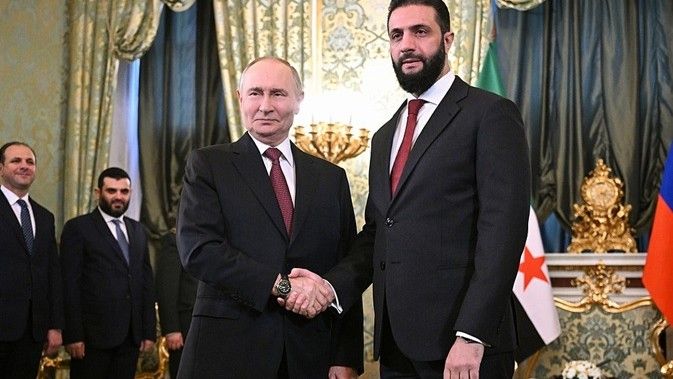
Syria till the end of 2024 was one of the most important Russian ally in the Middle East. Nevertheless, last December marked an important turning point when the coalition of jihadist organizations took the power, forcing Bashar al-Asad to espace.
From the very beginning new government has shown the idea to diversify the foreign relations. However, from Kremlin’s perspective Syria is too important to abandon the main military bases located in this country – Tartus Naval Base and Khmeimim Air Base. These facilities play a strategic role for Moscow as it allows to protect the interests in the Middle East, as well as to balance the engagement of other actors in the region.
Russian-Syrian relation before December 2024
From Moscow’s perspective the importance of the bilateral relations was evident during the Security Council sessions where Russian representatives voted in line to protect the interests of the Syrian regime and to strengthen the legitimacy of the Bashar al-Asad within the international community.
Furthermore, ties between Damascus and Moscow were enhanced through extensive military cooperation (including sales and transfer of weapon, joint military exercises as well as operation of the Russian military bases). Additionally, it is important to highlight the economic aspects, such as the import of Russian oil (even after policy-level changes, Moscow remains among Syria’s leading oil suppliers) and cooperation on infrastructure projects. This comprehensive partnership serves as the real evidence that Syria was and continues to be the crucial regional partner, primarily because of its strategic location on the Eastern Mediterranean – which has become even more significant since the full-scale aggression against Ukraine, as it is key logistics route.
The importance of Syria’s role was demonstrated by the operational Khmeimim Air Base and the utilization of the Tartus naval facility. These assets enabled Russia to maintain the freedom of manoeuvre in the Middle East and more broadly in Africa, while also securing NATO’s southern flank. What is more, Moscow was able to exert the influence of other majors« actors such U.S., China and key regional superpowers –Türkiye, United Arab Emirates and Saudi Arabia.

Jihadist rebellion and the overthrow of a dictator
Nevertheless, the fundaments of the partnership between Moscow and Damascus have been evolving shortly after the Bashar al-Asad escaped to Russia. Because of the regime changes, Ahmed al-Sharaa (former leader of the Hajat Tahrir asz-Szam – a jihadist, terrorist organisation) was chosen as the temporary president at least for 5 years – until it will be possible to organise democratic elections. New head of the state, right from the beginning advocated for a clear shift toward diversifying foreign partners, seeking to rebuild relations with the United States, European Union, and neighbouring states in the Middle East region.
Al-Shara does not want to rely Syria’s future reconstruction solely on its relationship with Russia – instead he strives to broaden cooperation with various countries to accelerate the stabilization process and rebuild Syria’s image on the international stage. The new leader attempts to manoeuvre between competing actors to maximize advantages while trying to maintain sovereignty and territorial integrity. However, the government’s change in Damascus demonstrates the need for Moscow to adjust its policy toward its long-standing ally.
Syria before civil war
From 1971 till 2024, Syria was ruled by the authoritarian Ba’ath Party. At that time, the most influential person was the leader of the Alawite Muslim minority Hafez al-Asad and his son – Bashar al-Assad. In 1963, the Ba’ath Party seized power through a coup d«état, introducing a state of emergency. Although it was lifted in 2011, widespread dissatisfaction with the Ba’ath Party triggered a wave of social protests that ultimately evolved into the Arab Spring. Syrians took to the streets to pressure those in power to implement reforms, intended to lead to the democratization of the state, and to improve economic situation.
The demonstrations were quickly and brutally suppressed – the protesters were accused of inciting extremism and plotting a coup. The lack of improvement in the internal situation, due to rising living costs and violations of human rights, led to the outbreak of a civil war, which continued with varying intensity practically until December 2024.

Russian presence in Syria
Russian involved in the Syrian civil war in 2015, supporting mainly the air force units, as well as carrying out attacks on positions, vehicles, and warehouses that belonged to ISIL. Through the intervention Moscow wanted to stabilize the internal situation within the borders of the most important regional ally, as well as prevent Washington the overthrow of the al-Assad regime and replacement him, with the new pro-Western politician.
Despite the new regime in Damascus, Moscow seeks to continue the presence in the Middle East as it guarantees the military support for units operating in the Mediterranean Sea. As for now, in Syria, Russia maintains one military location, namely the Khmeimim Air Base, and partially utilizes the Port of Tartus.
Khmeimim air base is located closely to the Latakia airport on Syria’s western coast by the Mediterranean Sea. Its status was regulated based on the agreement between Russian and Syrian representatives signed in August 2015. Under this accord, Moscow is entitled to use the facility for a period of 49 years, with an option to extend the term by an additional 25 years. Nevertheless, shortly after the overthrow of Bashar al-Assad’s regime, Russia began evacuating equipment and some personnel from Syria. Satellite images from December 2024 showed the loading of advanced S-400 and S-300 air defence missile systems and Ka-52 helicopters onto An-124 aircraft to transport them from Syria to bases in eastern Libya controlled by Russian-allied military leader Khalifa Haftar.
The naval port in Tartus serves as a multifunctional facility, capable of handling various types of cargo – from bulk goods and containers to liquid raw materials from tankers with a displacement of up to 120,000 tons. It accommodates both civilian and military vessels. From the outset of the Syrian civil war, this facility was under intensive exploitation from Russians. In 2013 they have established a Permanent Operational Naval Unit in the Mediterranean Sea. Naval port played a crucial role during the Russian intervention in 2015, enabling armament supply, logistics support and the control over the Mediterranean See and NATO’s southern flank.
Following the al-Asad escape, the Russian warships left Tartus. Initially they remained close to the cost as shortly after the regime transition the situation was instable. In the middle of September, vehicles and other equipment began to accumulate on the quay in Tartus, likely withdrawn from Hmeimim and transported there following the rebel offensive. At this stage, Moscow does not have a direct access to naval base infrastructure. However, satellite imagery, confirms the maintenance of a symbolic presence – at least one combat unit continuously operates around Syrian territorial waters. In January 2025, two Russian cargo ships, Sparta and Sparta II, were recorded docking in the military section of the Tartus port.
Currently, both sides are negotiating the details to partially maintain the Russian military infrastructure in Syria. However, until today such arrangement has not been reached, and the situation has not been changed despite the last meeting between Vladimir Putin and Ahmed al-Sharaa in the middle of October. Syrian president highlighted that Damascus would honour past deals made with Russia, although still detailed conditions remain unknown. Russia is most concerned with preserving the ability to use these military facilities to carry out its own operations.
Following the overthrow, Russian moved the military equipment from Syria to bases in eastern Libya which confirm that Kremlin is in the process of redefining its presence in the Middle East and North Africa region, seeking to maintain at least a partial air presence, albeit under changed political conditions. Such moves were aimed at consolidating forces and gradually withdrawing them but cannot be described as a complete evacuation of the Russian component.

Moscow needs to wait
With the fall of Moscow-backed dictator, Russia lost the operational autonomy of shaping the situation in Syria. As of now, Moscow crucial presence is reduced to Hmeimim. The situation regarding Tartus remains problematic, because it is the only Russian port on the Mediterranean Sea. Taking this into considerations, Moscow is looking for alternatives and is pursuing to extend the cooperation with African countries (e.g. Sudan). Nevertheless, to maintain capabilities and prestige, Russia needs to preserve the logistics functionality for operations to Africa.
Al-Sharaa attempts to break away from the image of a former terrorist group leader striving to give the regime a new identity – both politically and internationally. Moreover, his announcement for bolstering the cooperation with Western countries – including the last visit in White House, in November is symbolically opening the new chapter in foreign policy of Syria, which certainly is negatively perceived by Russia. Undoubtedly, from Damascus’s perspective, cooperation with Moscow – a state burdened by sanctions and excluded from the SWIFT system – is far from desirable, however, from a pragmatic point of view, it is treated as a necessity. Even though rhetoric return to diversify partners, Russia is still important providers for military equipment and diplomatic and economic support; however, for the time being Syria’s main sponsors are the Gulf countries and Türkiye.
Russian Federation currently involved in war with Ukraine does not have enough resources and capacity do rebuild its position in Syria. Moscow needs to freeze its plans but certainly will be pursuing to implement them when circumstances allow. As for now, Syrian-Russian bilateral relations are characterized by uncertainty regarding the future of the Hmeimim and Tartus bases.
Bibliography:
- A. Olech,Rosja atakując Ukrainę nie zapomina o Syrii \[KOMENTARZ\], Defence24, 15.03.2022, https://defence24.pl/geopolityka/rosja-atakujac-ukraine-nie-zapomina-o-syrii-komentarz \[dostęp: 10.11.2025\].
- A. Olech,Rosyjscy najemnicy – raport z działalności w Afryce, Defence24, 8.04.2024,\ https://defence24.pl/geopolityka/rosyjscy-najemnicy-raport-z-dzialalnosci-w-afryce \[dostęp: 10.11.2025\].
- A. Borshchevskaya ,The Window to Counter Russia in Syria Is Closing, Washington Institute, October 20, 2025 \[dostęp: 6.12.2025\].
- A. Cabrera,Satellite Imagery Uncovers Russian Naval Exit from Syrian Base, Ursa Space, December 19, 2024, https://ursaspace.com/blog/satellite-imagery-uncovers-russian-naval-exit-from-syrian-base/ \[dostęp: 9.11.2025\].
- Rosyjskie jednostki ostatecznie opuściły port Tartus w Syrii, Belsat, , \[dostęp: 7.11.2025\].
- C. Gall,Syria's Leaders Pledge to Join Fight Against Islamic State, The New York Times, November 12, 2025, \[dostęp: 14.11.2025\].
- J. Barr,Linia na piasku Konflikt, który ukształtował Bliski Wschód, Wyd. Prześwity, Warszawa 2024.
- La Russie relance discrètement ses vols militaires vers la Syrie, https://www.rfi.fr/fr/europe/20251031-la-russie-relance-discrètement-ses-vols-militaires-vers-la-syrie?utm\_slink=go.rfi.fr%2F4fr&utm\_term=RFI&utm\_campaign=twitter&utm\_source=nonli&utm\_medium=social, RFI, October 31, 2025 \[dostęp: 8.11.2025\].
- L. Alajlouni, J. Dempsey, A. Vidal RibeTartus port and Syria's new geo-economic strategy, International Institute for Strategic Studies, July 3, 2025, https://www.iiss.org/online-analysis/online-analysis/2025/07/tartus-port-and-syrias-new-geo-economic-strategy/ \[dostęp: 8.11.2025\].
- L. Brizard,Sanctioned Russian Ships Dock at Syria's Tartus Amid Evacuation Speculations, United24 Media, January 24, 2025, https://united24media.com/latest-news/sanctioned-russian-ships-dock-at-syrias-tartus-amid-evacuation-speculations-5346 \[dostęp: 11.11.2025\].
- P. Iddon,For Generations, Russia Was Syria's Main Arms Supplier, That May Be Over, Forbes, January 27, 2025, https://www.forbes.com/sites/pauliddon/2025/01/27/for-generations-russia-was-syrias-main-arms-supplier-that-may-be-over/ \[dostęp: 5.11.2025\].
- P. Iddo, Post-Assad pragmatism: The new logic of Russia-Syria relations Arab News, October 21, 2025, \[dostęp: 7.12.2025\].
- Port of Tartous Receives Ship Carrying Over 50,000 Tons of Rice, ARK News, September 17, 202, https://www.arknews.net/en/node/61300 \[dostęp: 8.11.2025\].
- Dans la Syrie nouvelle: l'État islamique à l'affût, Radio France, 10.11.2025, \[dostęp: 11.11.2025\].
- Russia to deliver oil and condensate cargo to Syria, according to LSEG and traders, Reuters, October 22,2025, https://www.reuters.com/business/energy/russia-deliver-oil-condensate-cargo-syria-according-lseg-traders-2025-10-22/ \[dostęp: 5.11.2025\].
- Syria's Civil War: The Descent into Horror, Council on Foreign Relations, December 20, 2024, https://www.cfr.org/article/syrias-civil-war \[dostęp: 3.11.2025\].
- Syrian president in first visit to Moscow as former enemies hold talks, The Guardian, October 15, 2025, https://www.theguardian.com/world/2025/oct/15/syrian-president-in-first-visit-to-moscow-as-former-enemies-hold-talks \[dostęp: 8.11.2025\].
- T. Bateman,US scraps $10m bounty for arrest of Syria's new leader Sharaa, BBC News December 20, 2024, , \[dostęp: 2.11.2025\].
- Tartus port and Syria's new geo-economic strategy, International Institute for Strategic Studies, July 3, 2025, https://www.iiss.org/online-analysis/online-analysis/2025/07/tartus-port-and-syrias-new-geo-economic-strategy/ \[dostęp: 8.11.2025\].
- UN Security Council Meetings & Outcomes Tables, United Nations, https://research.un.org/en/docs/sc/quick \[dostęp: 5.11.2025\].
- Why has the Syrian war lasted 12 years? BBC, May 2,2023, https://www.bbc.com/news/world-middle-east-35806229 \[dostęp: 5.11.2025\].
- W. Rodkiewic, Russia strengthens its presence in the Middle East, Ośrodek Studiów Wschodnich, January 25, 2017, https://www.osw.waw.pl/en/publikacje/analyses/2017-01-25/russia-strengthens-its-presence-middle-east \[dostęp: 6.11.2025\].
- World Report 2011: Syria, Events of 2010, Human Right Watch, https://www.hrw.org/world-report/2011/country-chapters/syria \[dostęp: 2.11.2025\].
- Y. Lappin,Syria's Reconstruction: The New Strategic Competition, Alma Research and Educational Center, October 22, 2025, https://israel-alma.org/syrias-reconstruction-the-new-strategic-competition/ \[dostęp: 9.11.2025\].


