












- ANALIZA
- WIADOMOŚCI
Nuclear weapons in the strategy of the Russian Federation (Part I)

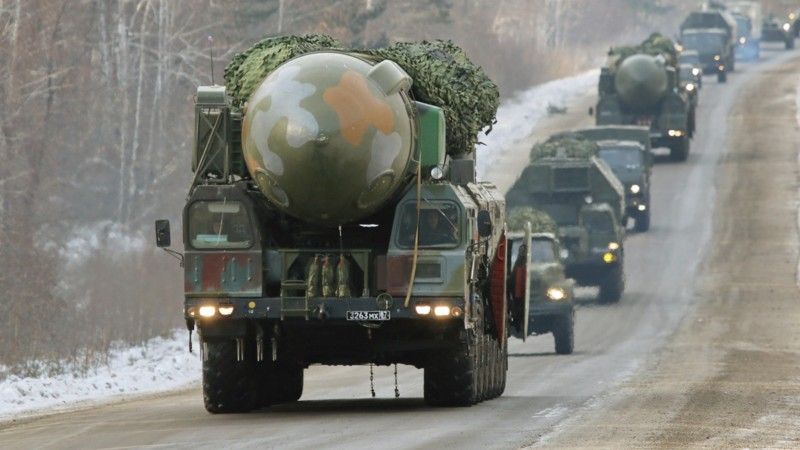
Photo. mil.ru
Since the Russian Federation’s inception, nuclear weapons have formed the foundation of the state’s international position and one of the pillars of strategic thinking among political and military elites. After the end of the Cold War and the collapse of the Soviet Union, a belief emerged that the risk of nuclear weapon use in Europe had been permanently marginalized, and that armed conflicts would be limited to asymmetric, local and hybrid actions.
NATO’s eastward expansion, the development of the European Union and increasing economic interdependence reinforced the conviction of the region’s relative stability. The Russian Federation’s aggression against Ukraine, initiated in 2014 and escalated into a full-scale invasion in February 2022, undermined those assumptions, bringing nuclear weapons back to the center of strategic debate in Europe and worldwide.
Russian nuclear potential
Russia possesses the world’s largest nuclear arsenal, encompassing both strategic and tactical weapons. Compared with other nuclear states, the structure of this arsenal is unique in that it includes a significant number of tactical warheads intended for regional and operational use.
This capability compensates for relatively weaker conventional forces compared with NATO. As a result, nuclear weapons become for the Kremlin not only a deterrent tool but also a means of maintaining strategic advantage — restricting adversaries« freedom of action and minimizing the consequences of potential defeats on the conventional battlefield.
Russian nuclear doctrine allows for the use of nuclear weapons not only in response to a nuclear attack or another attack involving weapons of mass destruction, but also in the case of conventional aggression that threatens the state’s existence. A key element here is the deliberate ambiguity of the concept of an „existential threat,” which permits flexible interpretation of the situation depending on political and strategic needs.
In practice, this means that an existential threat may be not only a direct attack on the territory of the Russian Federation, but also the loss of control over strategically important areas, a military defeat in a regional war, or the undermining of great-power status on the international stage.
See also 

Contextual layer: War in Ukraine
The war in Ukraine has provided numerous empirical examples of the Kremlin’s instrumental use of nuclear weapons. As early as 27th February 2022, just days after the full-scale invasion began, President Vladimir Putin announced an increase in the combat readiness of Russia’s strategic deterrent forces. That decision was a reaction to sanctions imposed by Western states and to the first deliveries of weapons to Ukraine.

Although the announcement did not indicate real preparation for the immediate use of nuclear weapons, it had a clear political and psychological dimension — a deterrent signal to NATO countries and an indication of Moscow’s readiness to employ its nuclear arsenal in the event of further escalation.
From that point on, nuclear rhetoric became a permanent element of Russia’s strategic communication. Government representatives, including Foreign Minister Sergey Lavrov and former President Dmitry Medvedev, repeatedly signaled publicly the possibility of using nuclear weapons should the country’s territorial integrity be threatened. Particular significance attached to the illegal annexation of four Ukrainian oblasts in the autumn of 2022, after which the Kremlin began to treat those territories as an integral part of the Russian Federation covered by nuclear protection. In practice, this meant extending the nuclear deterrent umbrella to areas actively contested by fighting.
Another concrete example of the strategic use of nuclear capability was the deployment of tactical nuclear weapons to the territory of Belarus in 2023. This was the first such case since the end of the Cold War in which Russian nuclear weapons were physically located outside the borders of the Russian Federation. Control of the arsenal remained in Moscow’s hands, but the deployment itself had symbolic and deterrent value, increasing pressure on NATO countries on the eastern flank, in particular Poland and the Baltic states.
A particularly clear example of indirect nuclear coercion was the occupation by Russian forces of the Zaporizhzhia Nuclear Power Plant in March 2022. That plant, the largest in Europe, was turned into part of military infrastructure, with equipment and military personnel stationed on the site. Shelling in the immediate vicinity of the reactors and power supply interruptions raised serious concerns at the International Atomic Energy Agency, which warned of the risk of a radiological catastrophe. In this case, the nuclear risk was used as a tool of political and military pressure without actual use of nuclear weapons.

8 Scenarios
Russian military doctrines identify eight main scenarios that could prompt the Russian Federation to use nuclear weapons. The first scenario assumes that Russian leadership concludes NATO intends to use nuclear weapons, which would justify a preventive strike.
Although in the realities of the war in Ukraine there was no direct nuclear threat from NATO, the Kremlin repeatedly used anticipatory rhetoric, signaling that further deliveries of long-range weapons to Ukraine or the introduction of no-fly zones could be regarded as aggression exceeding the threshold of Russia’s national security. In practice, this was a form of psychological deterrence meant to dissuade the West from full military involvement in the conflict.
The second scenario concerns a situation in which losses in the conventional war reach a critical level and continued operations offer no chance of success. An example is Russia’s situation in 2022 and 2023 during Ukrainian counteroffensives in the Kharkiv and Kherson oblasts, when Russian forces were pushed back from key lines and forced to reorganize. Despite serious equipment and personnel losses, Russia did not resort to nuclear weapons, which demonstrates a high threshold for actual escalation, but also attests to the importance of the nuclear threat itself as an element of strategic calculation.
The third scenario refers to the loss of key operational areas or strategic lines whose recovery by conventional means is unlikely. The autumn 2022 loss of Kherson — which had been a symbolic occupied regional capital — was a significant political blow, yet it did not lead to nuclear escalation. This example shows that nuclear capability also serves as a tool of indirect deterrence and of preserving bargaining advantage in local conflicts.
The fourth scenario relates to the disruption of command and logistics systems. In 2022 eastern Ukraine was the site of dynamic operational changes where Russian lines of communication and logistics were disrupted by Ukrainian actions. Theoretically, such situations could justify tactical nuclear use to restore balance on the front. In practice, however, the Kremlin limited itself to conventional means, reflecting awareness of the international consequences of actual nuclear use.
The fifth scenario assumes the necessity of quickly ending a conflict due to prolonged economic or social exhaustion. In Ukraine’s case, Russia did not achieve a quick resolution, and its economy was further weakened by international sanctions. Use of nuclear weapons in this context could theoretically force immediate peace negotiations; nonetheless, political decisions indicate that the Kremlin prefers hybrid pressure and conventional control over the region.
The sixth scenario assumes that limited use of nuclear weapons could bring about the end of hostilities and force peace talks. In practice, Russian Zapad exercises and the demonstrative deployment of the nuclear arsenal to Belarus can be seen as attempts to show that Russia has the capacity for such a maneuver without crossing the threshold into actual nuclear employment.
The seventh scenario concerns concentrated enemy forces as a cost-effective target for rapid neutralization using nuclear means. In the context of the war in Ukraine, Russian missile and artillery strikes have been conducted selectively, and large concentrations of troops have been attacked conventionally, indicating that nuclear use remained theoretical and deterrent rather than genuinely planned.
The eighth scenario is related to the collapse of morale among the opponent’s armed forces and society. Russian analyses indicate that in the event of a significant decline in the enemy’s combat capability, nuclear weapons might be considered a means to force an end to hostilities. In practice, Ukrainian morale remains high — confirmed by the successes of counteroffensives and continued public support for the country’s defense — which limits the effectiveness of this scenario.
Author: Agnieszka Rogozińska, PhD


