












- WIADOMOŚCI
- KOMENTARZ
- WAŻNE
On Trump’s split personality
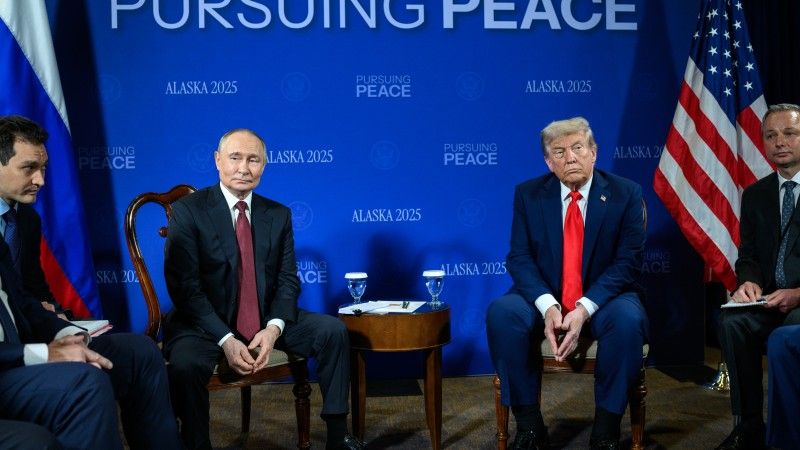
Photo. White House
Stop fooling yourselves. If you believe that Vladimir Putin uses doubles to sub in for him at official events, so does the 47th President of the United States.
There are two Trumps, however confined to a single physical body. One is the most powerful politician on Earth, shaping and changing the course of history, strictly goal-oriented and extremely self-confident. The other is an aspiring, although insecure businessman, whose predominant ambition is to make acquaintances with the most influential people in the world, hobnobbing with strongmen, cordially patting them on the shoulders, and being patted. Regardless of their provenance, moral rectitude, and adherence to democratic principles (or lack thereof).
Trump’s recent encounter with Putin perfectly encapsulated this second incarnation. The U.S. president rolled out a red carpet for the war criminal, literally applauded him upon arrival, and invited „the Kremlin butcher” to his limousine. All smiles and hugs. No matter Putin’s policies, let alone his ethical credentials.
Hours before the Anchorage summit Trump called another dictator, „the highly respected” ruler of Belarus. „I look forward to meeting President Lukashenko in the future” - he wrote on Truth Social.
Apparently, the U.S. leader has much more respect for such shady figures as his counterparts in Moscow, Minsk, Beijing, or Pyongyang than for Emmanuel Macron, Ursula von der Leyen, or Mark Carney. Because Putin and Lukashenka can be pivotal, indirectly, in „striking deals” and fulfilling his most intimate, personal dreams, like being awarded the Nobel Peace Prize. In this respect, Western leaders are a collective nuisance rather than an asset.
In Trump’s view, other nations can be divided solely into two camps: „with America” or „against America”. This simplistic differentiation is one of the reasons the U.S. president has difficulty defining Russia or Belarus. For him, both are in a sort of gray zone and, seemingly, amenable to his charms. At first sight, Putin and Lukashenka are by no means America’s allies. But the stronger, the more charismatic and, to put it bluntly, more brutal you are, the better the chances Trump will flatter and cozy up to you. Conversely, one false step, one unfavourable or biting comment about the U.S. president can get you banished into the „against America” camp.
It’s utterly irrelevant whether you are a democratically elected head of state or a bloodthirsty tyrant. Interestingly, in his political speeches, „democracy” is a term Trump uses frugally, much less eagerly than „deal”, „beautiful”, and „waterfront property”. Laws, rules, checks, and balances are not perceived as indispensable guardrails. They constitute obstacles that don’t allow him to govern more effectively and make America great again. In this case „democracy” is synonymous with „deep state”, at least to a certain degree.
Trump adroitly compares solidly established democracies with rogue actors. „They kill their political opponents? Oh, haven’t we?”. „They hack into our networks? Well, they are good at it but we are better”. „There is no free speech in Russia and China? In Europe there isn’t either”. Russian social platforms are flooded with antisemitic content, but it’s always Harvard, Harvard, Harvard…
Astonishingly, during the meeting in Anchorage, Trump also took lessons from Putin on the harmful nature of mail-in voting. By the way, the underlying suggestion that Russia’s electoral system is more transparent than America’s is particularly bizarre.
The United States is still the leader of the „Free World” and a beacon of democracy. Still, under Trump’s presidency, you don’t need to be a democrat to become his friend. This is not a criterion the current U.S president pays much attention to.
Author: Marek Magierowski – former spokesman for President Andrzej Duda, former Deputy Foreign Minister, and Ambassador of Poland to Israel (2018–21) and the United States (2021–24). Currently Director of the „Strategy for Poland” programme at the Freedom Institute.*


