


- WIADOMOŚCI
- KOMENTARZ
The Moscow CSTO summit: Between new challenges and old illusions

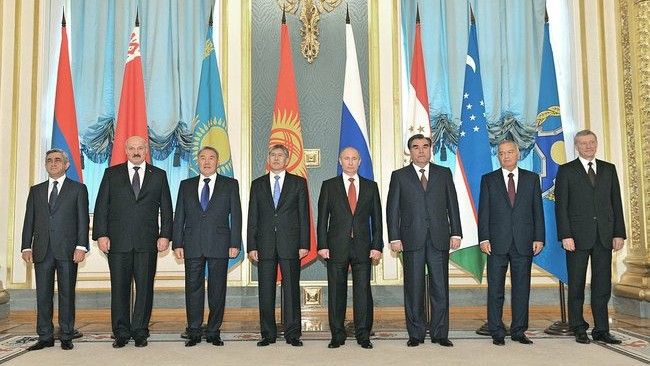
The two-day meetings within the framework of the Collective Security Treaty Organization (CSTO), which began in Moscow on November 10, 2026, are intended by the Kremlin to give the alliance new momentum. Wrapping up its presidency this year, the Russian Federation is emphasizing closer counter-terrorism cooperation, the development of defense technologies, and the construction of a new security architecture in Eurasia. Behind the facade of great-power rhetoric, however, lies an alliance plagued by a deep crisis of identity and trust.
This year’s events in the Russian capital have been divided into two closely linked segments. Taking place on November 10–11 at Moscow’s World Trade Centre is the International Collective Security Forum, which combines expert panels with an exhibition and business program. The culmination will be the actual CSTO Summit scheduled for November 11—a session of the Collective Security Council attended by the leaders of the member states, after which Moscow will formally hand over the organization’s chairmanship for 2027 to Tajikistan.

Technology and Business in the Service of Defense
Russia’s presidency is being held under the motto announced by Vladimir Putin:”Collective security in a multipolar world: common goal, shared responsibility.” As Anton Kobyakov, advisor to the Russian President and executive secretary of the organizing committee, explained in an interview with the TASS news agency, this format aims to bring together the efforts of the member states amid mounting global challenges and the transformation of the international security system.
Emphasis has been placed on the technological and industrial dimension, which in practice means striving to modernize the CSTO collective forces and equipping national contingents with modern Russian hardware and air defense systems.
”> Our common goal is not only to guarantee reliable collective defense against transnational threats, but also to achieve the organization’s technological leadership. I am convinced that, by combining expertise and business contacts, the forum will become a platform for developing coordinated measures to protect the interests of our states. @ Anton Kobyakov ,”
Anton Kobyakov emphasized, adding that the forum will serve as a foundation for new joint projects strengthening CSTO positions on the international stage.
The Counter-Terrorism Strategy until 2030 and security in Asia
The main axis of the discussions in Moscow is ensuring stability in the Asian region and developing security mechanisms on a Eurasian scale – including in cooperation with the Shanghai Cooperation Organization (SCO) and the Commonwealth of Independent States (CIS). Experts and diplomats are focusing on information threats, cybersecurity, and biological security.
A key political outcome of the summit scheduled for November 11 is expected to be the signing of the Moscow-initiated CSTO Counter-Terrorism Strategy until 2030. Although some media reports colloquially refer to this document as an “anti-terrorism law,” in reality, it is a comprehensive international doctrine of action. It provides for a coordinated fight against transnational terrorism and extremism, blocking their financing channels, countering radicalization in cyberspace, and neutralizing threats spilling over from Afghanistan and the Middle East.
A technological mirage and an alliance with feet of clay
Looking at the scale of the Moscow forum, it is hard to escape the impression that the Kremlin is trying to cloak the progressive erosion of its own military bloc under a mantle of propaganda. Anton Kobyakov’s declarations about the CSTO’s “technological leadership” sound almost grotesque at a time when the Russian defense industry has been operating on a wartime footing for years, struggling to meet the immediate needs of its own army at the front rather than the export ambitions of its allies. Promises to equip collective forces with ultra-modern hardware are today more of a wish list and an attempt to maintain the Central Asian states’ military dependence on Moscow than a realistic modernization offer.

The summit’s flagship project (the Counter-Terrorism Strategy until 2030) looks equally ambiguous. In the terminology of the Kremlin and the region’s authoritarian leaders, fighting “extremism” and “information threats” has long served as a convenient pretext for tightening censorship, surveilling citizens, and ruthlessly suppressing domestic opposition. Instead of a real shield against radicalism from Afghanistan, the citizens of CSTO member states are receiving yet another instrument of digital authoritarianism.
The best proof of what “shared responsibility” in the CSTO means today remains Armenia’s empty chair. Prime Minister Nikol Pashinyan’s consistent boycott of the summit exposes the organization’s fundamental weakness: when one of its members genuinely needed military support, the “Eastern NATO” proved to be a paper tiger. The Moscow summit, therefore, does not transform the CSTO into a modern defensive alliance; it merely confirms that the organization is increasingly becoming a hollow political forum through which Russia is desperately trying to prove to the world, and to itself, that it has not yet lost its status as the hegemon of the post-Soviet space.


