


- WIADOMOŚCI
- ANALIZA
- KOMENTARZ
Not by tanks: Russia’s real conquest of Europe


Within the European Union, fears of a Russian attack are growing, and estimates of when such a conflict could occur are shifting from 2030 to 2027 or even the autumn of 2026. How well-founded are these forecasts, and what assumptions underpin them?
Over four years of war in Ukraine, European perceptions of Russia have shifted markedly. Initial expectations of a swift Russian victory gave way to a widespread belief that the country was militarily and economically weak and on the verge of collapse. Those assessments have since been revised again. It is now more widely accepted that Moscow can sustain a protracted war and retain the capacity to confront NATO.
The failure of several earlier forecasts does not disprove the validity of the latest prediction, but it does raise questions about the reliability of current assessments and, more importantly, about the Kremlin’s possible strategic objectives and whether the potential gains would justify the risks for Moscow.
Why open war may not be the point
European discussions of possible Russian aggression usually identify several objectives. In the period preceding open hostilities, these include identifying vulnerabilities and testing societal resilience. In the event of an attack, Moscow’s objectives would be to expose the ineffectiveness of NATO’s collective defence and compel European states to withdraw their support for Ukraine.
These first two objectives tend to be seen as preparatory rather than ends in themselves, and are assumed to create the conditions for military aggression.
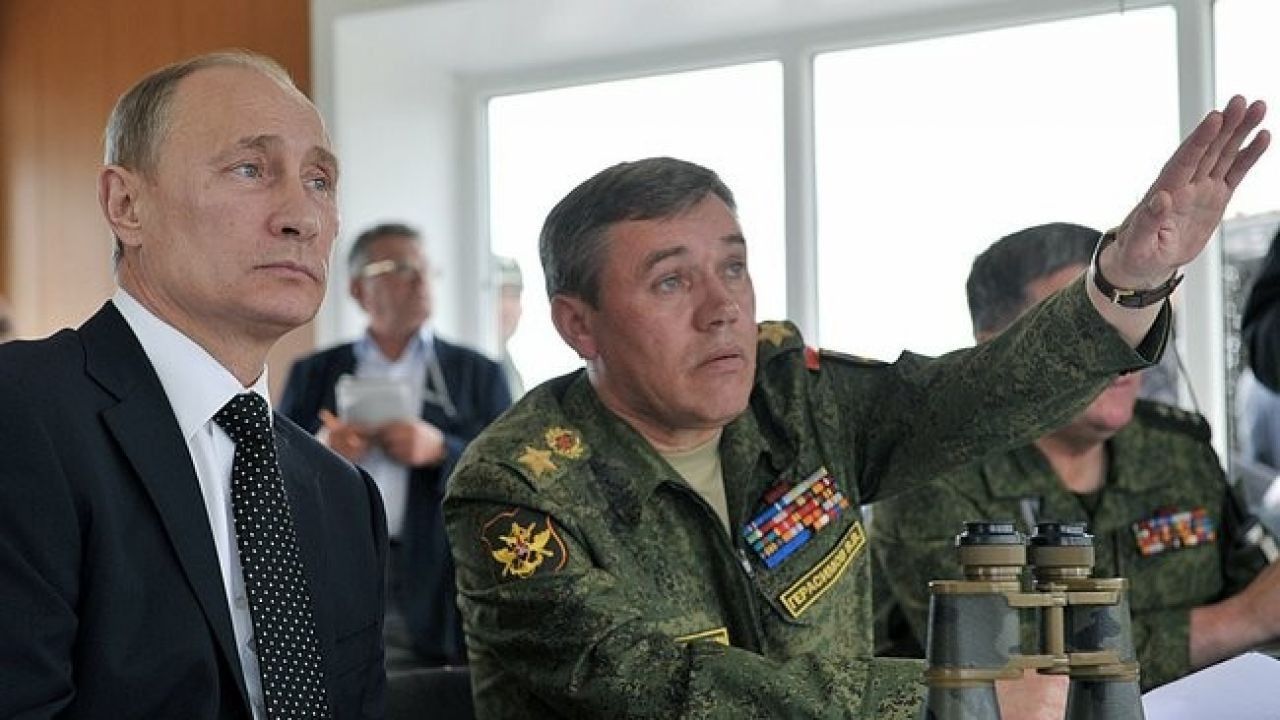
This points to a broader problem in the European approach: an excessive focus on military confrontation leads to an underestimation of the potential for influence below the threshold of Article 5. This focus can be explained by the widespread interpretation of the so-called „Gerasimov doctrine”. In fact, Valery Gerasimov, Chief of the General Staff of the Russian Armed Forces, did not set out a formal doctrine. Rather, he analysed contemporary conflicts and the changing nature of warfare. His analysis has nevertheless become an important reference point in Western assessments of Russian military strategy.
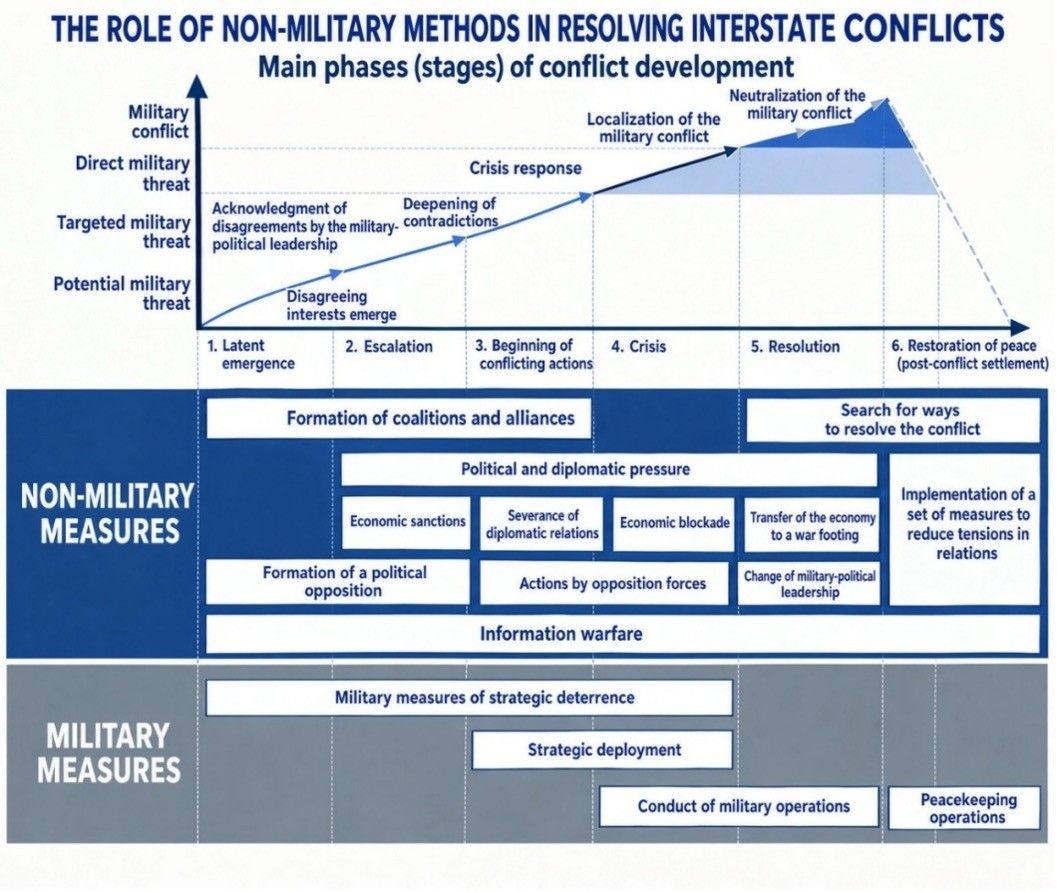
Photo. Translation from Russian. Source: “The Value of Science Is in the Foresight”
Gerasimov’s article places non-military measures ahead of military action, presenting them as instruments that can help prepare the ground for the use of force (see Fig. 1). This does not mean that preparing for war is their sole purpose. Reducing non-military instruments to mere preparations for aggression overlooks the role of indirect action and controlled chaos in Russian political and strategic thinking.
Non-military measures can also be used independently of military action to achieve the same strategic objectives — in this case, weakening NATO’s cohesion and undermining European support for Ukraine.
The choice of instruments — military, non-military, or a combination of both — ultimately depends on the means available and the expected balance between gains and risks.
Disadvantages of an open war for Moscow
In the event of an armed conflict with NATO, the potential risks are likely to outweigh the gains. Moreover, Russia’s available means may also prove insufficient to achieve its strategic objectives.
The scale and likelihood of a collective allied response cannot be known with certainty in advance. But uncertainty does not mean inaction. The probability of support from NATO allies is far from zero and is particularly high among European NATO members.
Economic and demographic factors reinforce this point. The EU’s combined economic resources substantially exceed Russia’s, and a war would make this disparity even more consequential. Once American resources are included, the imbalance becomes still more pronounced.

Moreover, open aggression against European NATO members could produce the opposite of Moscow’s intended result. Rather than dividing the alliance, an external threat could unite alliance members that currently differ over policy toward Russia. Greater European cohesion and stronger public support for security measures would be highly unfavourable outcomes for Russia.
None of this rules out miscalculation. States have started wars whose consequences proved far worse than expected. Yet Russia has already experienced the costs of a major strategic miscalculation in Ukraine and has therefore learned how costly such errors can be. It is more likely to act cautiously than recklessly when confronting a markedly stronger adversary.
Taken together, these factors suggest that direct aggression against NATO should be viewed not as inevitable but as one possible scenario among others — and one that carries extremely high risks for Russia.
Non-military measures as a preferable tool
Can the Kremlin’s strategic objectives be achieved without open war?
Isolated incidents, especially if they appear accidental or if their perpetrators cannot be reliably identified, are unlikely to force European politicians to abandon Ukraine or renege on their NATO commitments. For European governments, the perceived strategic benefits of supporting Ukraine clearly outweigh the risks associated with such incidents.
The greater threat lies in a more sophisticated form of non-military pressure: an effort to shift electoral preferences and political behaviour across EU societies. This could be achieved by exploiting incidents, shaping their coverage in traditional media and on social media, and capitalising on hasty or mistaken reactions by European leaders. If enough voters come to see their leaders as incompetent and as leading them toward an unnecessary war, they may support parties that promise a different course on security and foreign policy.
This approach suits Russia’s present situation for several reasons.
First, it avoids escalation to direct military confrontation with NATO.

Second, it relies on mechanisms integral to democratic systems: freedom of speech, political competition and regular elections. Attempts to restrict those mechanisms in response to alleged external interference can themselves become a source of political conflict.
Third, such influence operates in a grey zone in which the boundaries between domestic political struggle and external influence are difficult to draw. If authorities accuse opposition parties of links to the Kremlin without sufficient evidence, some voters may interpret the accusations as an attempt to discredit rivals. The Kremlin could also support or amplify the messages of opposition groups without their knowledge or consent, thereby deepening political chaos and polarisation.
Finally, the strategy can employ widely used tools of information influence: coordinated online campaigns, bots, viral memes and the targeted dissemination of conflicting interpretations. Attributing such activity to a particular actor can be difficult, in part because these tools are widely used and information can spread rapidly across platforms.
Strategic uncertainty and strategic deception
Two central elements of such non-military pressure are strategic uncertainty and strategic deception.
Strategic uncertainty involves the deliberate creation of contradictory signals — threatening statements, orchestrated leaks and ambiguous incidents — that prevent Europe from determining Russia’s true intentions. This can polarise public debate, pitting those accused of naivety against those accused of excessive confrontationalism. European societies are then caught between calls for mobilisation and hopes that escalation can be avoided.
Strategic deception goes further. Its purpose is not simply to complicate an opponent’s assessment but to create a false understanding of the situation and induce decisions that run counter to the opponent’s interests. It is usually based not on outright lies but on more complex forms of manipulation — in particular, the use of information that the opponent believes it has obtained independently or from sources it considers trustworthy.

One possible mechanism is that Putin publicly denies any plans to attack the EU while, through closed channels and a growing number of ambiguous incidents, the opposite impression is created. Because Europeans have grown accustomed to distrusting official statements by the Russian authorities, they tend to accept these unofficial signals without serious reflection — precisely because they appear to contradict what Moscow says openly.
As a result, European political elites may be drawn into overreacting to the prospect of war, thereby overheating the information space and amplifying public anxiety. The greater the public anxiety, the stronger the dissatisfaction with the authorities’ response and the demand for further news and explanations. The result is a vicious circle that fuels domestic political friction.
Under the influence of this and other factors — including migration and fatigue with the green agenda — political preferences and electoral behaviour are already shifting gradually.
European elections as a turning point
National elections in a number of EU countries over the coming years will serve as an important indicator of changes in political sentiment.
In France, opinion polls currently indicate strong support for Marine Le Pen in the 2027 presidential election. In Spain, support for the right-populist Vox party stands at around 18–19 per cent, potentially making it an important force in any future right-wing governing arrangement. In Germany, support for the right-populist AfD is growing, adding to pressure on Chancellor Friedrich Merz’s government and raising questions about its political stability.

These elections could significantly alter the EU’s political landscape. This, in turn, could complicate agreement among European governments on security policy and weaken support for Ukraine, while increasing pressure for a more pragmatic approach to Russia In this way, Moscow could advance its strategic objectives without resorting to a military conflict that carries extremely high risks for Russia.


